140 posters, 10 videos, 15 audios, 20 sessions, 508 authors, 204 institutions
ePostersLive by SciGen Technologies S.A. All rights reserved.
8th World Congress on Vascular Access 2024
April 17 - 19, 2024 | Prague, Czech Republic

111
Comparison of complications of PICC and long peripheral catheters in patients during hospital admission.
Poster Presenter
Authors
Petra Simkova, Katerina Lisova, Tereza Matějčková, Katerina Pavelkova, Jiri Charvat
Affiliations
Part of Topic
Comparison of complications of PICC and long peripheral catheters(LPC) in patients during hospital admission.
Introduction
PICCs and LPC are inserted in many patients admitted to the hospital. LPC is indicated in DIVA patients or if dwell time exceeds 7 days, provided that the osmolality of the administered solution is not higher than 600 mosm/l and the pH is between 5 and 9, while PICC is the first choice of central venous catheter. The purpose of the presentation is evaluation of complications of these two types of vascular devices in one center in patients during hospital admission.
Methods
In 2022 the number of PICC and LPC insertions was recorded in Faculty Hospital. The indication for peripheral and central venous catheters was carefully assessed before insertion.
Before the insertion of the vascular device, an ultrasonographic examination was performed and a suitable vein was determined. For PICC, the vein with the largest diameter in the middle part of the arm was chosen, with a preference for the right side. Before LPC insertion, the forearm and arm were examined by ultrasound, and the catheter was selected so that its diameter was not greater than 33% of the vein diameter and that at least two-thirds was located into the vein. The most peripherally located suitable vein was preferred for LPC.
After maximum barrier prevention of infection , the selected vascular device was introduced into the vein under ultrasonographic navigation. PICC tip placement was performed based on ECG or ultrasonographic navigation. All devices were fixed with sutureless fixation and tissue adhesive was applied to the exit site.
The patients were monitored by nurses in the ward. The insertion site was checked daily. When the catheter was used, the nurses washed their hands before touching the catheter and the surrounding area. The hub of the needleless connector was cleaned with 2% chlorhexidine gluconate for 15s before use. The catheter was flushed with prefilled 0.9% NaCl syringes using the push-pause method. A new semipermeable transparent dressing was applied every 7 days or sooner in case of contamination or dressing loosening. Catheter indwelling time and complication rates were recorded and evaluated
Discussion
PICC and LPC can be associated with significant complications such as infection, thrombosis, catheter occlusion, dislocation.
Some previous studies have compared complication rates retrospectively with inconclusive results. In our study, the selected vascular device was introduced on the basis of ultrasonographic examination and the frequency of complications was prospectively monitored.
Patients indicated for LPC insertion were significantly older, which was probably related to the more frequent insertion of this device in patients with palliative care. The dwell time was longer with PICC, which can be explained by its indication in more severe patients.
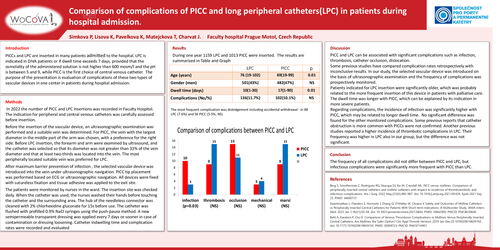
Regarding complications, the incidence of infection was significantly higher with PICC, which may be related to longer dwell time. No significant difference was found for the other monitored complications. Some previous reports that catheter obstruction is more common with PICCs were not confirmed. Another previous studies reported a higher incidence of thrombotic complications in LPC. Their frequency was higher in LPC also in our group, but the difference was not significant.
Conclusion
The frequency of all complications did not differ between PICC and LPC, but infectious complications were significantly more frequent with PICC than LPC