140 posters, 10 videos, 15 audios, 20 sessions, 508 authors, 204 institutions
ePostersLive by SciGen Technologies S.A. All rights reserved.
8th World Congress on Vascular Access 2024
April 17 - 19, 2024 | Prague, Czech Republic

110
Ultrasound placed long peripheral cannulas, as pain control tool, in pediatric patients with difficult intravenous access (DIVA)
Poster Presenter
Part of Topic
Ultrasound placed long peripheral cannulas, as pain control tool, in pediatric patients with difficult intravenous access (DIVA)
L. Menotti, MResident1; A. Divisic, MD2; A. Mazza, MD3; C. Agosto, MD2; P. Amoruso, RN2; G. Ghiraldo, RN2; F. Benini, MD2
1 Department of Woman’s and Child’s Health, University of Padova, Padova, Italy.
2 Pediatric Palliative Care, Pain Service, Department of Woman’s and Child’s Health, University of Padova, Padova, Italy.
3 Pediatric Intensive Care Unit, Department of Woman’s and Child’s Health, University-Hospital, Padova, Italy.
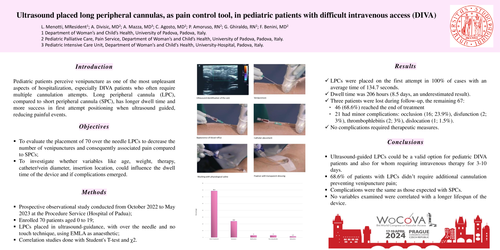
Introduction: Pediatric patients perceive venipuncture as one of the most unpleasant aspects of hospitalization, especially DIVA patients who often require multiple cannulation attempts. Long peripheral cannula (LPC), compared to short peripheral cannula (SPC), has longer dwell time and more success in first attempt positioning when ultrasound guided, reducing painful events.
Objectives: To evaluate the placement of 70 over the needle LPCs to decrease the number of venipunctures and consequently associated pain compared to SPCs. To investigate whether variables like age, weight, therapy, catheter/vein diameter, insertion location, could influence the dwell time of the device and if complications emerged.
Methods: Prospective observational study conducted from October 2022 to May 2023 at the Procedure Service (Hospital of Padua); Enrolled 70 patients aged 0 to 19; LPCs placed in ultrasound-guidance, with over the needle and no touch technique, using EMLA as anaesthetic; Correlation studies done with Student's T-test and χ2.
Results: LPCs were placed on the first attempt in 100% of cases with an average time of 134.7 seconds. Dwell time was 206 hours (8.5 days, an underestimated result). Three patients were lost during follow-up, the remaining 67: 46 (68.6%) reached the end of treatment; 21 had minor complications: occlusion (16; 23.9%), disfunction (2; 3%), thrombophlebitis (2; 3%), dislocation (1; 1.5%). No complications required therapeutic measures.
Conclusions: Ultrasound-guided LPCs could be a valid option for pediatric DIVA patients and also for whom requiring intravenous therapy for 3-10 days. 68.6% of patients with LPCs didn’t require additional cannulation preventing venipuncture pain. Complications were the same as those expected with SPCs. No variables examined were correlated with a longer lifespan of the device.