140 posters, 10 videos, 15 audios, 20 sessions, 508 authors, 204 institutions
ePostersLive by SciGen Technologies S.A. All rights reserved.
8th World Congress on Vascular Access 2024
April 17 - 19, 2024 | Prague, Czech Republic

109
<p>Is there an increased risk of PICC-related deep vein thrombosis in patients with testicular cancer undergoing platinum-based chemotherapy? </p> <p>An International Retrospective Evaluation</p>
Poster Presenter
Authors
Bibiana Vertaková Krakovská, Viktor Manasek, Maroš Kunderlík, David Vrána
Affiliations
Oncology Center, Agel Hospital, Nový Jičín, St. Elizabeth Cancer Institute and 1st. Department of Oncology Commenius University Bratislava, St.Elizabeth Cancer Centre, Bratislava, Slovakia, Oncology Center of Agel Hospital, Nový Jičín, Czech Republic
Part of Topic
Background: The risk of catheter-related thrombosis (CRT) is increased in cancer patients in comparison to the average population. It has been suspected, that patients with testicular tumours, undergoing systemic chemotherapy, who have peripherally inserted central venous access - PICC, have a higher risk of CRT. This hypothesis is supported by the clinical experience of oncologists and the expert opinion of international experts.
Objectives and methods: We retrospectively evaluated the incidence of CRT and time to CRT onset, in patients with testicular cancer, who underwent chemotherapy (bleomycin/ etoposide/ cispatinum -based regimen) and had a short/medium/long-term venous access. In all patients, in two centres in the Czech and Slovak Republic, central venous access was placed concerning the recommendations and protocols (RaPeVa, RAVESTO) and following all the rules and standards, by trained personnel in large centres.
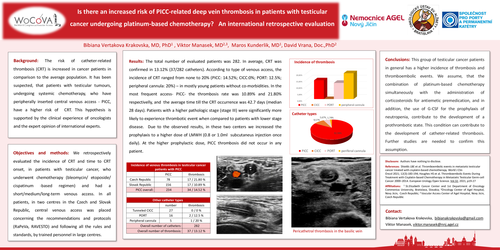
Results: The total number of evaluated patients was 282. In average, CRT was confirmed in 13.12% (37/282 catheters). According to type of venous access, the incidence of CRT ranged from none to 20% (PICC: 14.52%; CICC:0%; PORT: 12.5%; peripheral cannula: 20%) – in mostly young patients without co-morbidities. In the most frequent access- PICC- the thrombosis rate was 10.89% and 21.80% respectively, and the average time till the CRT occurrence was 42.7 days (median 28 days). Patients with a higher pathologic stage (stage III) were significantly more likely to experience thrombotic events when compared to patients with lower-stage disease. Due to the observed results, in these two centres, we increased the prophylaxis to a higher dose of LMWH (0.8 or 1.0ml subcutaneous injection once daily). At the higher prophylactic dose, PICC thrombosis did not occur in any patient.
Conclusions: This group of testicular cancer patients in general has a higher incidence of thrombosis and thromboembolic events. We assume, that the combination of platinum-based chemotherapy simultaneously with the administration of corticosteroids for antiemetic premedication, and in addition, the use of G-CSF for the prophylaxis of neutropenia, contribute to the development of a prothrombotic state. This condition can contribute to the development of catheter-related thrombosis. Further studies are needed to confirm this assumption.