141 posters, 8 videos, 8 audios, 5 topics, 442 authors, 228 institutions
ePostersLive by SciGen Technologies S.A. All rights reserved.
6th World Congress on Vascular Access 2021
April 29 - 30, 2021 | Virtual

P076
Safety of vascular access procedures and incidence of immediate vascular complications – a single center study
Poster Presenter
Part of Topic
Worldwide Network
Safety of Vascular Access Procedures and incidence of immediate vascular complications – a single center study
Introduction Vascular access is the most common inpatient procedure which however can lead to a number of serious immediate and late procedure related complications that every clinician should be able to recognize on time and manage successfully. Immediate or mechanical complications occur at the time of catheter insertion and include vascular, cardiac and pulmonary complications. They are highly related to the skills and the experience of the vascular access specialist.
Method This is a single center retrospective observational study from a nurse led VA unit of a 250 bed general oncology hospital. The unit is operated by two nurses (vascular access specialists) who perform all the procedures under real time ultrasound guidance and use the ECG method for the verification of the catheters’ tip position at the cavo atrial junction.
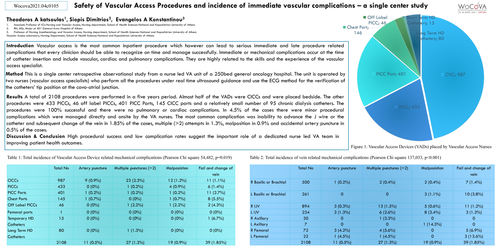
Results A total of 2108 procedures were performed in a five years period. Almost half of the VADs were CICCs and were placed bedside. The other procedures were 433 PICCs, 46 off label PICCs, 401 PICC Ports, 145 CICC ports and a relatively small number of 95 chronic dialysis catheters. The procedures were 100% successful and there were no pulmonary or cardiac complications. In 4.5% of the cases there were minor procedural complications which were managed directly and onsite by the VA nurses. The most common complication was inability to advance the J wire or the catheter and subsequent change of the vein in 1.85% of the cases, multiple (>2) attempts in 1.3%, malposition in 0.9% and accidental artery puncture in 0.5% of the cases.
Discussion & Conclusion High procedural success and low complication rates suggest the important role of a dedicated nurse led VA team in improving patient health outcomes.