141 posters, 8 videos, 8 audios, 5 topics, 442 authors, 228 institutions
ePostersLive by SciGen Technologies S.A. All rights reserved.
6th World Congress on Vascular Access 2021
April 29 - 30, 2021 | Virtual

P074
Experiences in developing and running a successful PICC Team in the Czech Republic during a Lean Economic period
Poster Presenter
Authors
Affiliations
Part of Topic
Worldwide Network
Experiences in developing and running a successful PICC Team in the Czech Republic during a Lean Economic period.
M.Douglas1, A.Drobilicova2,
PICC Team Leader University Hospital Olomouc, Czech Republic1,
Director of Nursing, University Hospital Olomouc, Czech Republic, Deputy Dean of the Faculty of Nursing Sciences, Palacky University Olomouc, Czech Republic2
Introduction:
The successful development of a Peripherally Inserted Central Catheter (PICC) Team project at the University Hospital Olomouc in October 2017 was a Nursing Department initiative, with full hospital management support.
To obtain a suitable budget it was imperative to convince the Financial Department that an investment in the PICC team would not only benefit the patient but also prove financially viable in the long term and reduce overall cost to the hospital.
Methods:
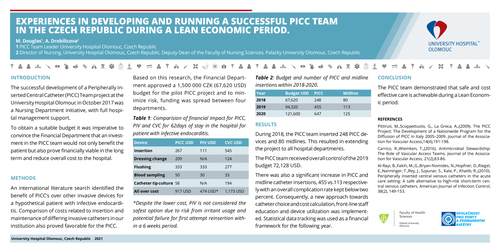
An international literature search identified the benefit of PICC’s over other invasive devices for a hypothetical patient with infective endocarditis. Comparison of costs related to insertion and maintenance of differing invasive catheters in our hospital also proved favorable for the PICC.
Based on this research, the Financial Department approved a 1,500 000 CZK (67,620 USD) budget for the pilot PICC project and to minimize risk, funding was spread between four departments.
Results:
During 2018, the PICC team inserted 248 PICC devices and 80 midlines. This resulted in extending the project to all hospital departments.
The PICC team received overall control of the 2019 budget 72,128USD.
There was also a significant increase in PICC and midline catheter insertions, 455 vs.113 respectively with an overall complication rate kept below two percent. Consequently, a new approach towards catheter choice and cost calculation, front-line staff education and device utilization was implemented. Statistical data tracking was used as a financial framework for the following year.
Conclusion:
The PICC team demonstrated that safe and cost effective care is achievable during a Lean Economic period.
References:
Pittiruti, M.,Scoppettuolo, G., La Greca, A.,(2009). The PICC Project: The Development of a Nationwide Program for the Diffusion of PICC in Italy 2005–2009. Journal of the Association for Vascular Access,14(4),191-198.
Carrico, R.,Wiemken, T.,(2016). Antimicrobial Stewardship: The Role of Vascular Access Teams. Journal of the Association for Vascular Access, 21(2),83-86.
Al-Rayi, B.,Fakih, M.,G.,Bryan-Nomides, N.,Hopfner, D.,Riegel, E.,Nanninger, T.,Rey, J., Szpunar, S., Kale, P., Khatib, R.,(2010). Peripherally inserted central venous catheters in the acute care setting: A safe alternative to high-risk short-term central venous catheters. American Journal of Infection Control, 38(2), 149-153.