141 posters, 8 videos, 8 audios, 5 topics, 442 authors, 228 institutions
ePostersLive by SciGen Technologies S.A. All rights reserved.
6th World Congress on Vascular Access 2021
April 29 - 30, 2021 | Virtual

P070
A prevalence audit evaluating standards of care for vascular access devices
Part of Topic
Worldwide Network
A prevalence audit evaluating standards of care for vascular access devices
McGuire, R; Norman, E; Hayden, I. King’s College Hospital NHS Foundation Trust, London, UK.
Abstract
Introduction
Vascular access devices (VAD) are vital for the administration of intravenous therapy. Although essential, VADs put patients at risk of complications including catheter-related bloodstream infections (CR-BSI), which are amongst the most dangerous for patients, but are largely preventable (Loveday et al, 2014). Consequently, reducing them has become the focus of infection prevention strategies. An audit of VADs conducted in our 500-beds hospital in October 2013 demonstrated poor standards of care and low compliance with evidence-based guidelines (McGuire, 2015). A bundle strategy of training, education and standardisation was implemented to raise standards and improve compliance, and the audit repeated in 2018 to evaluate the impact.
Method
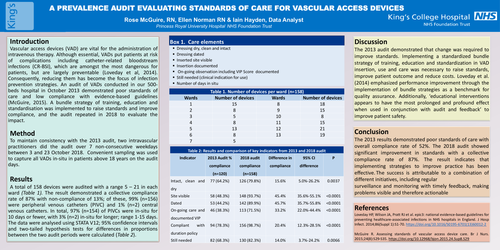
Two intravascular practitioners did the audit over 7 non-consecutive weekdays between 3 and 23 October 2018. Convenient sampling was used to capture all VADs in-situ in patients above 18 years on the audit days.
Results
A total of 158 devices were audited, and the result demonstrated a collective compliance rate of 87% with non-compliance of 13%; of these, 99% (n=156) were peripheral venous catheters (PVC) and 1% (n=2) central venous catheters. In total, 97% (n=154) of PVCs were in-situ for 10 days or fewer, with 3% (n=2) in-situ for longer; range 1-15 days.
Discussion
The 2013 audit demonstrated that change was required to improve standards. Implementing a standardised bundle strategy of training, education and standardisation in VAD insertion, use and care was necessary to improve patient experience, outcome and reduce costs. Loveday et al (2014) emphasised performance improvement through the implementation of bundle strategies as a benchmark for quality assurance. Additionally, ‘educational interventions appears to have the most prolonged and profound effect when used in conjunction with audit and feedback’ to improve patient safety.
Conclusion
The 2013 audit results demonstrated poor standards of care with overall compliance rate of 52%. The 2018 audit results showed significant improvement in standards with a collective compliance rate of 87%.The result indicates that implementing strategies to improve practice and raise standards has been effective.