141 posters, 8 videos, 8 audios, 5 topics, 442 authors, 228 institutions
ePostersLive by SciGen Technologies S.A. All rights reserved.
6th World Congress on Vascular Access 2021
April 29 - 30, 2021 | Virtual

P065
User evaluation of a prototype of the Vascoscope, an aid for easy Ultrasound Guided Vascular Access
Poster Presenter
Authors
Affiliations
Part of Topic
Research & Innovations
Video
Practical user evaluation with prototype Vascoscope, an innovative system for easy Ultrasound Guided Vascular Access
The Vascoscope system is a recently developed solution to reduce barriers for ultrasound guided cannulation of hemodialysis shunts and peripheral intravenous catheters. The Vascoscope consists of a portable ultrasound system with innovative features including a stabilizer that keeps the probe in place on the arm, and special video glasses that enable simultaneously viewing of the ultrasound image and cannulation area. This practical evaluation focused the usability and perceived feasibility of the current prototype of the Vascoscope for hemodialysis through sessions with potential users: 10 dialysis nurses and 2 nephrologists. The sessions started with an instruction and following that the participant tried the Vascoscope first on a phantom where he/she practiced cannulation. When the participant felt secure to test the Vascoscope on a patient, the complete procedure of cannulation, except for the actual puncturing, was performed. Before and afterwards, each participant was interviewed using a questionnaire,.
The overall outcome was very positive. Especially the unique features of the Vascoscope:
The main features of the Vascoscope, stabilization of the probe to the patient’s arm, and simultaneous viewing of ultrasound image and cannulation procedure, were highly appreciated and found to be of practical use.
For the individual system parts suggestions for improvements were made. These will be used for the production version of the Vascoscope to be introduced on the market by the end of 2021
Peripheral intravenous cannulation is the most common invasive medical procedure and still the primary failure rate is high. According to the Australian Commission on Safety and Quality in Health Care nearly half of all first attempts fail [1]. Failure results in unnecessary stress and pain for the patient, but also in extra complication, treatment failures, and use of costly and scarce resources like vascular access specialists. Ultrasound guidance is the golden standard for more complex vascular access procedures and is strongly recommended for peripheral vein cannulation in patients with moderate to difficult vein access [2].
A special situation concerns the shunt access in hemodialysis. Most patient with renal failure are treated with hemodialysis, three times a week. To enable hemodialysis a specially prepared piece of vein, the shunt, is cannulated twice to deliver the blood to and from the hemodialysis machine. The shunt is the lifeline of the patient and needs to be preserved as good as possible. Ultrasound guidance reduces the risk of miscannulation and/or damage of the shunt wall. Also, the placement of the catheter is more precise improving the flowrate and preserving the shunt wall.
Earlier work performed at UMC Utrecht, showed that several barriers exist for using ultrasound guided shunt cannulation. Most importantly:
The Vascoscope system is developed to reduce barriers for ultrasound guided shunt cannulation for hemodialysis.
The Vascoscope is easy to use and simple to learn innovation for ultrasound guided vascular access. It consists of a
portable ultrasound system with added features including a patented probe stabilizer and special video glasses.
The objective of this evaluation is to get insight into the usability and perceived feasibility of the Vascoscope. And get input for possible changes in design or working of the Vascoscope, ensuring the realization of a device that is valued by our targeted users.
More specifically the following elements were evaluated for the system as a whole and for the probe stabilizer and the video glasses in particular : Usefulness, Ease of use, Learnability and Training, Acceptability, Demand, Implementation. Another important objective is to identify necessary and/or desired improvements the system, the components and the functionality.
The Vascosope system consisted of the following components:
Participants were selected from the nurses and nephrologists present during the visits of the investigator at the four participating Elyse Clinics. They were asked to participate. No personal information was asked for, other than the role of the participant and the number of years of experience.
Patients were selected form the patients present during the visit. They were asked orally for permission. No personal data were documented.
The evaluation included the following steps:
After completion, each participant is interviewed asking for feedback on the (use of the) Vascoscope. Each phase is discussed. The interview covers various aspects: Usefulness, Ease of use, Learnability and Training, Acceptability, Demand, Implementation. Also, participants were asked to make suggestions for improvements.
In total ten Hemodialysis nurses and two nephrologists working at the Elyse clinics were included. All participants completed the evaluation.
Their experience as health professional varied from: less than a year to 40 years. The average was 14.5 and the median 10.5 years.
The current device in use in al the Elyse centers is the B&D SiteRight prevue.
Eight of the ten nurses use the ultrasound for cannulation sometimes and 2 use it often. The nephrologists do not normally perform cannulations. When using ultrasound 7 of the 10 nurses perform ultrasound guided cannulation, and three use the ultrasound only before and right after cannulation (ultrasound assisted cannulation)
All 10 nurses have problems with the current ultrasound systems. Six find it difficult to keep the probe in the right place when cannulating, two find that they give too much pressure on the shunt with the probe, and another two have problems with viewing the image on the screen (far away, not looking simultaneously to screen and cannulation area).
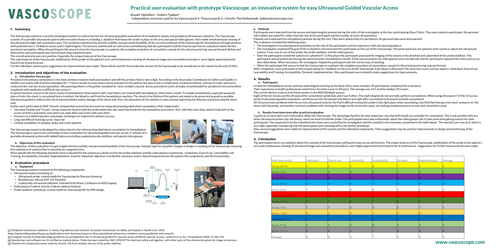
In general, al users were very enthusiastic about the Vascoscope. The advantage found to be most important, was that both hands are available for cannulation. This is not possible with any other ultrasound system: you will always need one hand to hold the probe. The participants were also enthusiastic about the video glasses, but it took some time getting used to for most participants. The responses from the individual interviews were scored by the investigator and this resulted in the outcomes presented in the table below. The overall score was an 8, which is very high, especially considering that the participants were working with a not perfect prototype.
Also, several suggestions were made for improvements of the system and the individual components. These suggestions may be used for improvements in design and functioning of the Vascoscope.
The participants were very positive about the concept of the Vascoscope and found it easy to use and to learn. The unique features of the Vascoscope, stabilization of the probe to the patient’s arm, and simultaneous viewing of ultrasound image and cannulation procedure, were highly appreciated and found to be of practical use. Suggestions for further improvements were made.