141 posters, 8 videos, 8 audios, 5 topics, 442 authors, 228 institutions
ePostersLive by SciGen Technologies S.A. All rights reserved.
6th World Congress on Vascular Access 2021
April 29 - 30, 2021 | Virtual

P026
Real-world data of three different venous access devices application in China: A 200-hospital database analysis
Part of Topic
Research & Innovations
Real-world data of three different venous access devices application in China: A 200-hospital database analysis
Introduction
Aim of this study is to understand demography, application, and costs of different venous access devices (VADs) in clinical practice, including central venous catheter (CVC), peripherally inserted central catheter (PICC) and totally implanted port (PORT), and to identify factors which influence treatment choice in real-world setting in China.
Methods
We investigated a database, which contains electronic medical records from nearly 200 hospitals across the nation. Ambulatory, inpatient and medication records from Jan 01st, 2015 to Jun 30th, 2018 were examined for retrospective analysis.
Demographic data have been collected for analysis, including age, gender, and geographic information. Complication rate, such as infection and thrombus formation have been explored for each VAD (CVC, PICC and PORT groups). Logistic regression analysis was performed to identify influential factors.
Results
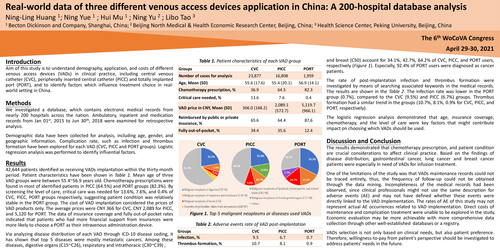
42,644 patients identified as receiving VADs implantation within the thirty-month period. Patient characteristics have been shown in Table 1. Mean age of three VAD groups were between 55.4~56.9 years old. Chemotherapy prescriptions were found in most of identified patients in PICC (64.5%) and PORT groups (82.3%). By screening the level of care, critical care was needed for 13.6%, 7.6%, and 0.4% of CVC, PICC, PORT groups respectively, suggesting patient condition was relatively stable in the PORT group. The cost of VAD implantation considered the prices of VAD products only. The average prices were CNY 366 for CVC, CNY 2,089 for PICC, and 5,120 for PORT. The data of insurance coverage and fully out-of-pocket rates indicated that patients who had more financial support from insurances were more likely to choose a PORT as their intravenous administration device.
Via analyzing disease distribution of each VAD through ICD-10 disease coding, it has shown that top 5 diseases were mostly metastatic cancers. Among these diseases, digestive organs (C15~C26), respiratory and intrathoracic (C30~C39), and breast (C50) account for 34.1%, 42.7%, 64.2% of CVC, PICC, and PORT users, respectively (Figure 1). Especially, 92.4% of PORT users were diagnosed as cancer patients.
The rate of post-implantation infection and thrombus formation were investigated by means of searching associated keywords in the medical records. The results are shown in the Table 2. The Infection rate was lower in the PORT group (0.7%), compared to the CVC (9.5%) and PICC (6.7%) groups. Thrombus formation had a similar trend in the groups (10.7%, 8.1%, 0.9% for CVC, PICC, and PORT, respectively).
The logistic regression analysis demonstrated that age, insurance coverage, chemotherapy, and the level of care were key factors that might contribute impact on choosing which VADs should be used.
Discussion and Conclusion
The results demonstrated that chemotherapy prescription, and patient condition are crucial considerations to affect clinical practice. Based on the findings of disease distribution, gastrointestinal cancer, lung cancer and breast cancer patients were especially in need of VADs for infusion treatment.
One of the limitations of the study was that VADs maintenance records could not be traced entirely, thus, the frequency of follow-up could not be obtained through the data mining. Incompleteness of the medical records had been observed, since clinical professionals might not use the same description for adverse events (AE) and may not have defined whether these events were directly linked to the VAD implementation. The rates of AE of this study may not represent actual AE occurrences related to VAD implementation. Direct costs of maintenance and complication treatment were unable to be explored in the study. Economic evaluation may be more achievable with more comprehensive data collection through other well-established databases or a registry.
VADs selection is not only based on clinical needs, but also patient preference. Therefore, willingness-to-pay from patient’s perspective should be investigated to address patients’ needs in the future.