141 posters, 8 videos, 8 audios, 5 topics, 442 authors, 228 institutions
ePostersLive by SciGen Technologies S.A. All rights reserved.
6th World Congress on Vascular Access 2021
April 29 - 30, 2021 | Virtual

P027
Complete occlusion of venous port by a blood clot – the effect of low-dose trombolysis using the “2 needles method“
Poster Presenter
Authors
Viktor Manasek, Iveta Kocianova, Bibiana Vertakova Krakovska
Affiliations
Part of Topic
Research & Innovations
Complete occlusion of venous port by a blood clot – the effect of low-dose trombolysis using the „2 needles method“
Introduction: Port occlusion caused by a blood clot may occur if the port is handled incorrectly, particularly when the positive pressure rule failed while pulling out the port needle, eventually if the proper port flushing is omitted. If the occlusion is partial, blood aspiration usually fails, but it is possible to deliver solutions to the port (including thrombolytic agents). Fibroblastic sleeve represents the main cause of this phenomenon. The disruption by overpressure flushing successfully proceeds in most cases. The problem arises when the occlusion is complete. Thus, the clot may be present in the port chamber and both, aspiration and application fail and it is impossible to infuse thrombolytics.
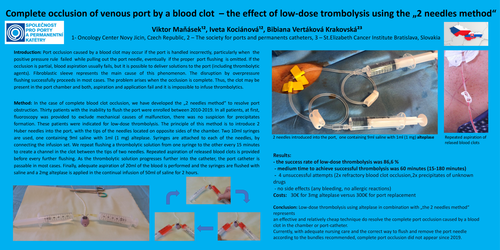
Method: In the case of complete blood clot occlusion, we have developed the „2 needles method“ to resolve port obstruction. Thirty patients with the inability to flush the port were enrolled between 2010-2019. In all patients, at first, fluoroscopy was provided to exclude mechanical causes of malfunction, there was no suspicion for precipitates formation. These patients were indicated for low-dose thrombolysis. The principle of this method is to introduce 2 Huber needles into the port, with the tips of the needles located on opposite sides of the chamber. Two 10ml syringes are used, one containing 9ml saline with 1ml (1 mg) alteplase. Syringes are attached to each of the needles, by connecting the infusion set. We repeat flushing a thrombolytic solution from one syringe to the other every 15 minutes to create a channel in the clot between the tips of two needles. Repeated aspiration of released blood clots is provided before every further flushing. As the thrombolytic solution progresses further into the catheter, the port catheter is passable in most cases. Finally, adequate aspiration of 20ml of the blood is performed and the syringes are flushed with saline and a 2mg alteplase is applied in the continual infusion of 50ml of saline for 2 hours.
Results:
- the success rate of low-dose thrombolysis was 86,6 %
- medium time to achieve successful thrombolysis was 60 minutes (15-180 minutes)
- 4 unsuccessful attempts (2x refractory blood clot occlusion,2x precipitates of unknown drugs
- no side effects (any bleeding, no allergic reactions)
Costs: 30€ for 3mg alteplase versus 300€ for port replacement
Conclusion: Low-dose thrombolysis using alteplase in combination with „the 2 needles method“
represents
an effective and relatively cheap technique do resolve the complete port occlusion caused by a blood clot in the chamber or port-catheter.
Currently, with adequate nursing care and the correct way to flush and remove the port needle according to the bundles recommended, complete port occlusion did not appear since 2019.