141 posters, 8 videos, 8 audios, 5 topics, 442 authors, 228 institutions
ePostersLive by SciGen Technologies S.A. All rights reserved.
6th World Congress on Vascular Access 2021
April 29 - 30, 2021 | Virtual

P056
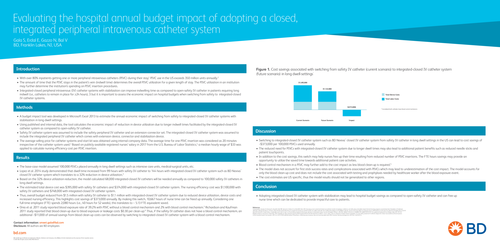
Evaluating the hospital annual budget impact of adopting a closed, integrated peripheral intravenous catheter system
Poster Presenter
Authors
Affiliations
Part of Topic
Research & Innovations
Title: EVALUATING THE HOSPITAL ANNUAL Budget Impact of ADOPTING A closeD, INTEGRATED peripheral intravenous catheter system
Introduction:
With over 80% inpatients getting one or more peripheral intravenous catheters (PIVC) during their stay,1 PIVC use in the US exceeds 350 million units annually.2
The amount of time that the PIVC stays in the patient’s vein (indwell time) determines the overall PIVC utilization for a given length of stay. The PIVC utilization in an institution may further determine the institution’s spending on PIVC insertion procedures.
Integrated-closed peripheral intravenous (IV) catheter systems with stabilization can improve indwelling time as compared to open-safety IV catheter in patients requiring long indwell (i.e. catheters to remain in place for ≥24 hours),3 but it is important to assess the economic impact on hospital budgets when switching from safety to integrated-closed IV catheter systems.
Methods:
A budget impact tool was developed in Microsoft Excel 2013 to estimate the annual economic impact of switching from safety to integrated-closed IV catheter systems with stabilization in long dwell settings.
Using published and internal data, the tool calculates the economic impact of reduction in device utilization due to longer indwell times facilitated by the integrated-closed IV catheter system.
Safety IV catheter system was assumed to include the safety peripheral IV catheter and an extension-connector set. The integrated-closed IV catheter system was assumed to include the integrated peripheral IV catheter which comes with extension device, connector and stabilization device.
The average selling price for catheter systems and start kit was obtained using internal company data. The average time for one PIVC insertion was considered as 20 minutes irrespective of the catheter system used.2 Based on publicly available registered nurses’ salary in 2017 from the U.S. Bureau of Labor Statistics,4 a median hourly wage of $33 was applied to calculate nursing efficiency cost per PIVC insertion.
Results:
The base-case model assumed 100,000 PIVCs placed annually in long dwell settings such as intensive care units, medical-surgical units, etc.
Lopez et al. 2014 study demonstrated that dwell time increased from 99 hours with safety IV catheter to 144 hours with integrated-closed IV catheter system such as BD NexivaTM closed IV catheter system which translates to a 32% reduction in device utilization.3
Based on the 32% device utilization reduction, the model calculated 68,000 integrated-closed IV catheters will be needed annually as compared to 100,000 safety IV catheters in long dwell settings.
The estimated total device cost was $395,000 with safety IV catheters and $374,000 with integrated-closed IV catheter system. The nursing efficiency cost was $1,100,000 with safety IV catheters and $748,000 with integrated-closed IV catheter system.
Thus, overall budget reduced from $1.5 million with safety IV catheter to $1.1 million with integrated-closed IV catheter system due to reduced device utilization, device costs and increased nursing efficiency. This highlights cost savings of $373,000 annually. By making this switch, 10,667 hours of nurse time can be freed up annually. Considering one fulltime employee (FTE) spends 2,080 hours (i.e. 40 hours for 52 weeks), this translates to ~ 5.13 FTE equivalent saved.
Onia et al. 2011 study reported blood exposure rate of 39.2% with PIVC without a blood control mechanism and 2% with blood control mechanism.5 Richardson and Kaufman 2011 study reported that blood clean-up due to blood exposure or leakage costs $0.30 per clean-up.6 Thus, if the safety IV catheter does not have a blood control mechanism, an additional ~$11,000 of annual savings from blood clean-up costs can be observed by switching to integrated-closed IV catheter system with a blood control mechanism.
Discussion:
Switching to integrated-closed IV catheter system such as BD NexivaTM closed IV catheter system from safety IV catheter in long dwell settings in the US can lead to cost savings of ~$373,000 per 100,000 PIVCs used annually.
The reduced need for PIVCs with integrated-closed IV catheter system may also lead to additional patient benefits such as reduced sticks and patient touchpoints.
In addition to the cost savings, this switch may help nurses free up their time resulting from lesser need of PIVC insertions. The FTE hours savings may provide an opportunity to utilize the saved time towards additional patient care activities.
Blood control mechanism in a PIVC may further add to the cost impact as less blood clean-up is required.
The model does not account for first stick success rates and complications associated with PIVCs which may lead to underestimation of the cost impact. The model accounts for only the blood clean-up cost and does not include the cost associated with testing and prophylaxis needed by healthcare worker after the blood exposure event.
The cost estimates are US specific, thus the model results should not be generalized to other regions.
Conclusion:
Adopting integrated-closed IV catheter system with stabilization may lead to hospital budget savings and can free up nurse time which can be dedicated to provide impactful care to patients. It may also improve patient safety by reducing complications and need for catheter removal due to complications,3 and healthcare worker safety by reducing needle-stick injury.3