141 posters, 8 videos, 8 audios, 5 topics, 442 authors, 228 institutions
ePostersLive by SciGen Technologies S.A. All rights reserved.
6th World Congress on Vascular Access 2021
April 29 - 30, 2021 | Virtual

P054
PICC “USE OF LABEL” IN YOUNG CANCER PATIENT WITH SUPERIOR VENA CAVA SYNDROME (SVCS)
Poster Presenter
Authors
Affiliations
Part of Topic
Research & Innovations
Audio
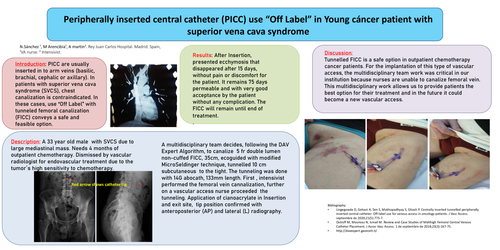
PICC are usually inserted in to arm veins (basilic, brachial, cephalic or axillary). In patients with superior vena cava syndrome (SVCS), chest canalization is contraindicated. In these cases, use “Off Label” with tunneled femoral canalization (FICC) conveys a safe and feasible option.
A 33 year old male with SVCS due to large mediastinal mass. Needs 4 months of outpatient chemotherapy. Dismissed by vascular radiologist for endovascular treatment due to the tumor´s high sensitivity to chemotherapy.
A multidisciplinary team decides, following the DAV Expert Algorithm, to canalize 5 fr double lumen non-cuffed FICC, 35cm, ecoguided with modified MicroSeldinger technique, tunnelled 10 cm subcutaneous to the tight. The tunneling was done with 14G abocath, 133mm length. First , intensivist performed the femoral vein cannalization, further on a vascular access nurse proceeded the tunneling. Application of cianoacrylate in Insertion and exit site, tip position confirmed with anteroposterior (AP) and lateral (L) radiography.
After Insertion, presented ecchymosis that disappeared after 15 days, without pain or discomfort for the patient. It remains 75 days permeable and with very good acceptance by the patient without any complication. The FICC will remain until end of treatment.
Tunnelled FICC is a safe option in outpatient chemotherapy cancer patients. For the implantation of this type of vascular access, the multidisciplinary team work was critical in our institution because nurses are unable to canalize femoral vein. This multidisciplinary work allows us to provide patients the best option for their treatment and in the future it could become a new vascular access.