141 posters, 8 videos, 8 audios, 5 topics, 442 authors, 228 institutions
ePostersLive by SciGen Technologies S.A. All rights reserved.
6th World Congress on Vascular Access 2021
April 29 - 30, 2021 | Virtual

P046
Catheter tip misplacement during ultrasound-guided axillary vein central venous catheter: single-centre retrospective study
Poster Presenter
Authors
Affiliations
Part of Topic
Research & Innovations
Audio
CATHETER TIP MISPLACEMENT DURING ULTRASOUND-GUIDED AXILLARY VEIN CENTRAL VENOUS CATHETER: SINGLE-CENTRE RETROSPECTIVE STUDY
Setiawan I, Harijanto E, Melati AC
Critical Care Unit, Premier Bintaro Hospital, Tangerang Selatan, Indonesia
Introduction :
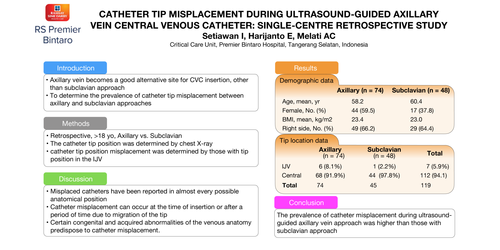
Axillary vein becomes a good alternative site for central venous catheter (CVC) insertion, other than subclavian approach. This study aims to determine the prevalence of catheter tip misplacement in between two common approaches, axillary and subclavian approaches.
Methods :
Retrospective procedural data were collected based on sequential adult patients, age 18 years old and older, had CVC inserted at axillary vein and subclavian vein, in Critical Care Unit Premier Bintaro Hospital, Indonesia, from January 2018 to December 2019. The catheter tip position was determined by chest X-ray after the procedure. Insertion of CVC was conducted by intensivists and using ultrasound guided. Demographic data included age, sex, Body Mass Index (BMI). Data collected in this study included site of insertion (subclavian and axillary approaches), and catheter tip position misplacement was determined by those with tip position in the IJV.
Results :
A total 119 of patients had CVC insertion (74 and 45 subjects in the axillary and subclavian groups, respectively) with mean age of 55.6 years, 52% female and mean BMI of 23.2 kg/m2. This study found that there were 6 cases (8.1 %) with axillary approach had tip located at IJV, while there was only 1 case (2.2%) with subclavian approach.
Discussion & Conclusion :
Misplaced catheters have been reported in almost every possible anatomical position, including the arterial system, mediastinum, pleura, pericardium, trachea, esophagus, subarachnoid space, and other aberrant sites. Catheter misplacement can occur at the time of insertion or after a period of time due to migration of the tip. Certain congenital and acquired abnormalities of the venous anatomy predispose to catheter misplacement. The prevalence of catheter misplacement during ultrasound-guided axillary vein approach was higher than those with subclavian approach