141 posters, 8 videos, 8 audios, 5 topics, 442 authors, 228 institutions
ePostersLive by SciGen Technologies S.A. All rights reserved.
6th World Congress on Vascular Access 2021
April 29 - 30, 2021 | Virtual

P045
Demystifying moisture vapour transmission rate (MVTR) for vascular access fixation dressings
Poster Presenter
Authors
Affiliations
Part of Topic
Research & Innovations
Introduction
Catheter insertion sites are commonly covered by transparent film dressings, offering protection of the insertion site from infection and securement of the catheter while allowing site observation through a clear window.1 Currently, there is considerable focus on creating IV film dressings with ever-increasing moisture vapour transmission rates (MVTR) to prevent the accumulation of moisture under the film and reduce the risk of infection. These increasingly high MVTR IV dressings are often promoted as superior to IV dressings with lesser MVTR values. Assumptions have been made that continuing to further increase the MVTR of IV dressings would lead to additional clinical benefit, but there is no evidence to support this.
MVTR is a recognized standard for the assessment of semi-permeable films and is often a specification quoted for comparison of vascular access fixation dressings. This poster explores the methodology of MVTR determination, explaining that some MVTR data is not clinically relevant to dressings for vascular access.
Purpose
The purpose of this study is to explain how MVTR is determined and to demonstrate how the two standard methods can lead to very different values, suggesting that taken in isolation, the MVTR value may not provide sufficient information to be clinically relevant.
Methods
European Standard EN 137262 was used to determine the MVTR of seven different IV dressings (Table 1) with two different methods (upright and inverted).
MVTR was determined under controlled conditions in an independent contract laboratory (Surgical Materials Testing Laboratory, Wales), by exposing the dressings to either moisture vapour or direct contact with water and was calculated by the mass differential detailed within EN 13726 Part.2 Testing was performed on 5 replicates of each dressing.
EN 13726-2:20022 section 3.2 covers the MVTR of a wound dressing when in contact with water vapour, and section 3.3 covers the MVTR of a wound dressing when in contact with liquid. Test apparatus is pictured in Figures 1 and 2.
The sealed cups were placed in an incubator at 37°C. The tests only measured a section and not the whole dressing, and - in the first step - did not include any soft cloth reinforcement (often called ‘bordered’). The following deviations were reported by the independent test laboratory: 1) Testing was performed at 37°±2°C rather than ±1°C as stated in the standard. 2) The dressings were tested using a smaller aperture (Figure 2: 2 cm diameter rather than 3.57 cm) test cylinders (Paddington cups) with 10 ml of fluid (rather than 20 ml), ensuring an air gap of 5 mm ± 1 mm at the top of the cup. Note: The change in area was made to accommodate Dressing E, which was too small to fill the standard area.
A statistical analysis using SAS 9.4 (SAS Institute, Cary NC) was performed to evaluate the significance of the differences in the results obtained with the two MVTR test methods for each dressing tested (post-hoc comparisons of differences in MVTR by method within samples using Tukey’s test).
In an additional test, which was conducted with the dressings (A,F,G) exposing the highest upright MVTR, the MVTR of the dressing sections, which are covered with reinforcement cloths, were evaluated.
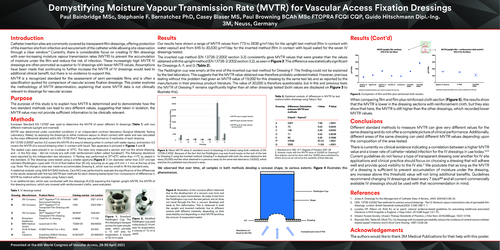
Figure 3. Mean MVTR value (± standard error) of dressings A-G tested using both methods of EN 13726-2:2002. Because of the fact that the Paddington cup was found empty at the end of the test for Dressing F using the inverted method, Dressing F is displayed with both the value obtained in this assay (30,000) and the value obtained in a previous assay by the same test laboratory (19,000), which matches the published manufacturer’s value.
Conclusions
Different standard methods to measure MVTR can give very different values for the same dressing and do not offer a complete picture of clinical performance. Additionally, different areas of the same dressing can yield different MVTR values depending upon the composition of the area tested.
There is currently no clinical evidence indicating a correlation between a higher MVTR value and a lower rate of catheter-related infection for the IV dressings in use today.3,4,5 Current guidelines do not favour a type of transparent dressing over another for IV site applications and clinical practice should focus on choosing a dressing that will adhere well and provide good visibility to the IV site.3 We postulate that as long as the MVTR of a dressing is sufficient to prevent accumulation of moisture under the dressing, any increase above this threshold value will not bring additional benefits. Guidelines recommend changing IV dressings at least every 7 days3,4 and all current commercially available IV dressings should be used with that recommendation in mind.
References
1. Jones A. Dressings for the Management of Catheter Sites: A Review. JAVA. 2004;9(1):26-33.
2. CEN. 13726-2:2002 Test methods for primary wound dressings - Part 2: Moisture vapour transmisison rate of permeable film dressings. London: British Standards Institute;2002. 0 580 39511 1.
3. Loveday HP, Wilson JA, Pratt RJ, et al. epic3: national evidence-based guidelines for preventing healthcare-associated infections in NHS hospitals in England. J Hosp Infect. 2014;86 Suppl 1:S1-70.
4. Infusion Nurses Society. Infusion Therapy Standards of Practice. J Infus Nurs. 2016;39(Suppl. 1S):S1-S159.
5. Reynolds MG, Tebbs SE, Elliott TSJ. Do dressings with increased permeability reduce the incidence of central venous catheter related sepsis? Intensive and Critical Care Nursing. 1997;13:26-29.
1. Standard error (SE): 317; Degrees of Freedom (DF): 56
2. Analysis made with the MVTR value of 30,000 for Dressing F (the analysis cannot be done with the 19,000 value published by others since we do not know the variability of that data set).
When comparing film and film plus reinforced cloth section (Figure 5), the results show that the MVTR is lower in the dressing sections with reinforcement cloth, but they also show that here, the MVTR is still higher than the other dressings, which recorded lower MVTR values.
Results
Our results have shown a range of MVTR values from 773 to 2838 g/m2/day for the upright test method (film in contact with water vapour) and from 845 to 30,530 g/m2/day for the inverted method (film in contact with liquid water) for the seven IV dressings tested.
The inverted cup method (EN 13726-2:2002 section 3.3) consistently gave MVTR values that were greater than the values obtained with the upright method (EN 13726-2:2002 section 3.2), as seen in Figure 3. This difference was statistically significant for Dressings A, F, and G (Table 2).
The Paddington cup was empty at the end of the inverted cup test method for Dressing F. This finding could not be explained by the test laboratory. This suggests that the MVTR value obtained was therefore probably underestimated. However, previous testing without this problem had given an MVTR value of 19,000 for this dressing by the same test lab and as reported by the manufacturer in their previous product literature. The value of 30,000 is therefore questionable, but in this and previous tests the MVTR of Dressing F remains significantly higher than all other dressings tested (both values are displayed on Figure 3 to illustrate this).
Dressing
Manufacturer
Product Name
Catalog number
Lot number
A
3M Company
3M™ Tegaderm™ I.V. Advanced Securement Dressing
1685
2021-01A 6
B
3M Company
3M™ Tegaderm™ I.V. Transparent Film Dressing with Border
1633
2022-09K 1
C
3M Company
3M™ Tegaderm™ HP Transparent Film Dressing
9534HP
334LKM
D
Richardson Healthcare
ClearFilm I.V. dressing
816060
171104
E
BSN Medical GmbH
Leukomed I.V. film
72390-00
93240832
F
Smith & Nephew
IV3000 Ported 7cm x 9cm
4006
201852
G
Centurion
SorbaView SHIELD Window Dressing Medium
SV353UDT
2016080201
Acknowledgements
The authors would like to thank 3M Medical Publications for their help with this poster.