141 posters, 8 videos, 8 audios, 5 topics, 442 authors, 228 institutions
ePostersLive by SciGen Technologies S.A. All rights reserved.
6th World Congress on Vascular Access 2021
April 29 - 30, 2021 | Virtual

P043
Prevention of venous catheter dislodgement as a way of increasing patient safety and reduce healthcare professional’s risk for exposure to hazardous drugs and contaminated blood
Poster Presenter
Authors
Affiliations
Part of Topic
Research & Innovations
Video
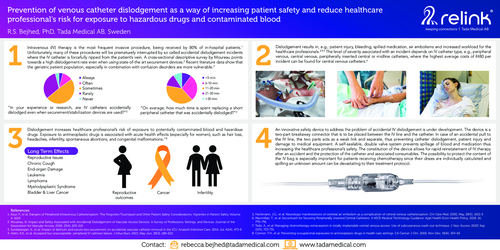
Prevention of venous catheter dislodgement as a way of increasing patient safety and reduce healthcare professional’s risk for exposure to hazardous drugs and contaminated blood.
R.S. Bejhed, PhD, Tada Medical AB, Sweden
SECTION 1
Intravenous (IV) therapy is the most frequent invasive procedure, being received by 80% of in-hospital patients.1 Unfortunately, many of these procedures will be prematurely interrupted by so called accidental dislodgement incidents where the IV catheter is forcefully ripped from the patient’s vein. A cross-sectional descriptive survey by Moureau points towards a high dislodgement rate even when using state-of-the art securement devices.2 Recent literature data show that the geriatric patient population, especially in combination with confusion disorders are more vulnerable.3
SECTION 2
Dislodgement results in, e.g., patient injury, bleeding, spilled medication, air embolisms and increased workload for the healthcare professionals.2,4-5 The level of severity associated with an incident depends on IV catheter type, e.g., peripheral venous, central venous, peripherally inserted central or midline catheters, where the highest average costs of €480 per incident can be found for central venous catheters.6
SECTION 3
Dislodgement increases healthcare professional’s risk of exposure to potentially contaminated blood and hazardous drugs. Exposure to antineoplastic drugs is associated with acute health effects (especially for women), such as hair loss, headaches, infertility, spontaneous abortions, and congenital malformations.7-8
SECTION 4
An innovative safety device to address the problem of accidental IV dislodgement is under development. The device is a two-part breakaway connector that is to be placed between the IV line and the catheter. In case of an accidental pull to the IV line, the two parts acts as a weak link and separate, thus preventing catheter dislodgement, patient injury and damage to medical equipment. A self-sealable, double vale system prevents spillage of blood and medication thus increasing the healthcare professional’s safety. The constitution of the device allows for rapid reinstatement of IV therapy after an accident and the protection of the catheter and associated consumables. The possibility to protect the content of the IV bag is especially important for patients receiving chemotherapy since their doses are individually calculated and spilling an unknown amount can be devastating to their treatment protocol.
References
1. Kaur, P., et al. Dangers of Peripheral Intravenous Catheterization: The Forgotten Tourniquet and Other Patient Safety Considerations. Vignettes in Patient Safety Volume 4. 2019
2. Moureau, N. Impact and Safety Associated with Accidental Dislodgement of Vascular Access Devices: A Survey of Professions, Settings, and Devices. Journal of the Association for Vascular Access. 2018, 23(4), 203-215
3. Sundararajan, K., et al. Impact of delirium and suture-less securement on accidental vascular catheter removal in the ICU. Anaesth Intensive Care. 2014, Jul, 42(4), 473-9
4. Helm, R.E., et al. Accepted but unacceptable: peripheral IV catheter failure. J Infus Nurs. 2015, May-Jun, 38(3), 189-203
5. Heckmann, J.G., et al. Neurologic manifestations of cerebral air embolism as a complication of central venous catheterization. Crit Care Med. 2000, May, 28(5), 1621-5
6. Macmillan, T., et al. SecurAcath for Securing Peripherally Inserted Central Catheters: A NICE Medical Technology Guidance. Appl Health Econ Health Policy, 2018, 16, 779–791
7. Taibi, A., et al. Managing chemotherapy extravasation in totally implantable central venous access: Use of subcutaneous wash-out technique. J Vasc Access. 2020, Sep, 21(5), 723-731
8. Connor, T.H., et al. Preventing occupational exposures to antineoplastic drugs in health care settings. CA Cancer J Clin. 2006, Nov-Dec, 56(6), 354-65