141 posters, 8 videos, 8 audios, 5 topics, 442 authors, 228 institutions
ePostersLive by SciGen Technologies S.A. All rights reserved.
6th World Congress on Vascular Access 2021
April 29 - 30, 2021 | Virtual

P042
The effect of continuous low flow administration on central venous catheter's function and complications
Poster Presenter
Part of Topic
Research & Innovations
The effect of continuous low flow administration on central venous catheter's function and complications
Yintian Liu, Qiuying Liao, Jinai He
The First Affiliated Hospital of Jinan University, Guangzhou, China
INTROUDCTION
Background: After cardiovascular surgery, some patients need to pump vasoactive drugs through a central venous catheter to maintain a certain heart rate and blood pressure. During the continuous pumping of vasoactive drugs, if the catheter is forced to flush, the patient's blood pressure and heart rate will suddenly change and affect the prognosis of patients.
Objective: Performing the influence of non-flush on CVC in continuous low flow rate infusion.
METHOD
Study Design: A retrospective study between July 2016-October 2019 in an university-affiliation hospital. Patients: The patients inserted three-cavity CVC during the cardiac vascular surgery were included.
Data collection: By queried the patient's electronic medical record.
Observation indicators:
Catheterization information, drug maintenance rate and duration, catheter outcome, and complications.
Only the cavity of the constant pump with continuous low flow rate was analysed—medial (M) cavity and proximal (P) cavity.
Ethics: This study has been approved by the ethics committee of The First Affiliated Hospital of Jinan University.
RESULTS
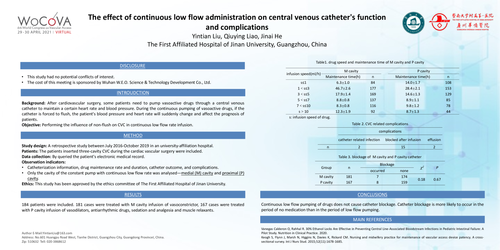
184 patients were included. 181 cases were treated with M cavity infusion of vasoconstrictor, 167 cases were treated with P cavity infusion of vasodilators, antiarrhythmic drugs, sedation and analgesia and muscle relaxants.
CONCLUSIONS
Continuous low flow pumping of drugs does not cause catheter blockage. Catheter blockage is more likely to occur in the period of no medication than in the period of low flow pumping.