141 posters, 8 videos, 8 audios, 5 topics, 442 authors, 228 institutions
ePostersLive by SciGen Technologies S.A. All rights reserved.
6th World Congress on Vascular Access 2021
April 29 - 30, 2021 | Virtual

P037
Risk Factors associated to development of venous catheter- related thrombosis
Poster Presenter
Authors
Affiliations
Part of Topic
Research & Innovations
RISK FACTORS ASSOCIATED WITH THE DEVELOPMENT OF CATHETER-RELATED SYMPTOMATIC THROMBOSIS
E. Lafuente1, A. Civit1, L. Gonzalez1, M. Gale1, C. Hidalgo1, V. Lee1
1 Barcelona Nursing Council, Barcelona, Spain.
Introduction: Catheter related thrombosis (CRT) is multifactorial and associated with factors such as demography, time, patient’s pathology, drug therapy and anatomy (1,2). Fluctuating taxes, are being reported, this variability in results is due to the heterogeneity of the variables involved. For this reason, a study to associate certain risk factors with the development of catheter-related thrombosis (CRT) has been conducted (3,4).
Method: Retrospective case-control study. January 2017 to December 2019.
Population: Adult patients with an indwelling venous access device admitted in a tertiary care hospital that experienced catheter-associated thrombosis diagnosed by a vascular surgeon or CT-angiography. Control group patients were chosen in a random manner. The study sample was 123 patients, 62 in the control group and 61 in the case group.
Results:
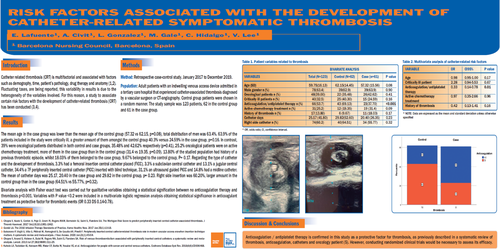
The mean age in the case group was lower than the mean age of the control group (57.32 vs 62.15, p=0.08), total distribution of men was 63.4%. 63.9% of the patients included in the study were critically ill, a greater amount of them amongst the control group 40.3% versus 24.59% in the case group, p=0.16. In contrast, 39% were oncological patients distributed in both control and case groups, 35.48% and 42.62% respectively (p=0.41), 25.2% oncological patients were on active chemotherapy treatment, more of them in the case group than in the control group (31.4 vs 19.35, p=0.09). 13.80% of the studied population had history of a previous thrombotic episode, whilst 18.03% of them belonged to the case group, 9.67% belonged to the control group, P= 0.17. Regarding the type of catheter and the development of thrombosis, 3.3% had a femoral insertion central catheter placed (FICC), 3.3% a subclavian central catheter and 13.1% a jugular central catheter, 34.4% a 7F peripherally inserted central catheter (PICC) inserted with blind technique, 31.1% an ultrasound guided PICC and 14.8% had a midline catheter. The mean of catheter days was 25.17, 20.40 in the case group and 29.82 in the control group, p= 0.23. Right side insertion was 60.20%, larger amount in the control group than in the case group (64.51% vs 55.77%, p=0.32).
Bivariate analysis with Fisher exact test was carried out for qualitative variables obtaining a statistical signification between no anticoagulation therapy and thrombosis p<0.001. Variables with P value <0.2 were included in a multivariate logistic regression analysis obtaining statistical significance in anticoagulant treatment as protective factor for thrombotic events (OR 0.33 DS 0.14-0.78)
Discussion & Conclusions: Anticoagulation / antiplatelet therapy is confirmed in this study as a protective factor for thrombosis, as previously described in a systematic review of thrombosis, anticoagulation, catheters and oncology patient (5). However, conducting randomized clinical trials would be necessary to assess its efficacy.
Bibliography:
1-Chopra V, Kaatz S, Conlon A, Paje D, Grant PJ, Rogers MAM, Bernstein SJ, Saint S, Flanders SA. The Michigan Risk Score to predict peripherally inserted central catheter-associated thrombosis. J Thromb Haemost. 2017 Oct;15(10):1951-1962
2-Gorski LA. The 2016 Infusion Therapy Standards of Practice. Home Healthc Now. 2017 Jan;35(1):10-18.
3-Balsorano P, Virgili G, Villa G, Pittiruti M, Romagnoli S, De Gaudio AR, Pinelli F. Peripherally inserted central catheter-related thrombosis rate in modern vascular access era-when insertion technique matters: A systematic review and meta-analysis. J Vasc Access. 2020 Jan;21(1):45-54
4 Chopra V, Anand S, Hickner A, Buist M, Rogers MA, Saint S, Flanders SA. Risk of venous thromboembolism associated with peripherally inserted central catheters: a systematic review and meta-analysis. Lancet. 2013 Jul 27;382(9889):311-25
5 Kahale LA, Tsolakian IG, Hakoum MB, Matar CF, Barba M, Yosuico VE, et al. Anticoagulation for people with cancer and central venous catheters. Cochrane Database Syst Rev. 2018;6(6):CD006468