141 posters, 8 videos, 8 audios, 5 topics, 442 authors, 228 institutions
ePostersLive by SciGen Technologies S.A. All rights reserved.
6th World Congress on Vascular Access 2021
April 29 - 30, 2021 | Virtual

P035
Minimidline catheter, a vascular access alternative for plasma replacement through centrifugation
Poster Presenter
Authors
A Civit, E Lafuente, MR Terrradas, A Calleja, A Vasco, Y Advincula
Affiliations
Part of Topic
Research & Innovations
MINIMIDLINE CATHETER, A VASCULAR ACCESS ALTERNATIVE FOR PLASMA REPLACEMENT THROUGH CENTRIFUGATION
- Civit1, E. Lafuente1, M. Terrradas1, A. Calleja2, A. Vasco1, Y. Advincula1
1 Barcelona Nursing Council, Barcelona, Spain. 2 Barcelona Nursing Council, Santa Eulalia de Ronçana, Spain.
Introduction: Minimidline catheter, a vascular access alternative for plasma replacement through centrifugation Introduction Plasma replacements through centrifugation is a procedure progressively more used as treatment for some autoimmune diseases. This procedure requires 2 peripheral venous access, one for entrance and one for exit of blood uses flows between 5 and 140 ml/min (1,2). As first option 16–18G peripheral intravenous catheters (PIVC) must be considered, however, on occasion blind insertion of the catheter it is not possible. In these circumstances the next choice would be a central vascular access device (CVAD), given the possible complications related to this type of device a study has been conducted to establish whether the 18G minimidline placed with an ultrasound-guided technique is a valid device (3,4).
The aim: To determine if the minimidline
is a valid and safe device to conduct a plasma replacement technique in difficult intravenous access (DIVA) patients.
Method: Prospective descriptive study. January 2017–December 2019.
Population: Sessions of plasmatic replacement.
Results:
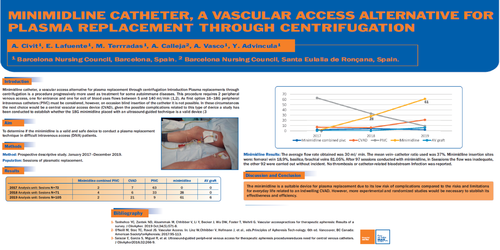
Minimidline Results: The average flow rate obtained was 30 ml/ min. The mean vein- catheter ratio used was 37%. Minimidline insertion sites were: femoral vein 18.9%, basilica/brachial veins 81.05%. After 97 sessions conducted with minimidline, in 5sessions the flow was inadequate, the other 92 were carried out without incident. No thrombosis or catheter-related bloodstream Infection was reported.
Discussion and Conclusión: The minimidline is a suitable device for plasma replacement due to its low risk of complications compared to the risks and limitations for everyday life related to an indwelling CVAD. However, more experimental and randomized studies would be necessary to stablish its effectiveness and efficiency
BIBLIOGRAFIA
1- Tanhehco YC, Zantek ND, Alsammak M, Chhibber V, Li Y, Becker J, Wu DW, Foster T, Wehrli G. Vascular accesspractices for therapeutic apheresis: Results of a survey. J ClinApher. 2019 Oct;34(5):571-8
2- O'Neill M, Stec TC, Raval JS. Vascular Access. In: Linz W,Chhibber V, Hofmann J, et al., eds.Principles of Apheresis Tech-nology. 6th ed. Vancouver, BC Canada: American SocietyforApheresis; 2017:95-113.
3- Salazar E, Garcia S, Miguel R, et al. Ultrasound-guided periph-eral venous access for therapeutic apheresis proceduresreduces need for central venous catheters. J ClinApher2016;32:266-9.