141 posters, 8 videos, 8 audios, 5 topics, 442 authors, 228 institutions
ePostersLive by SciGen Technologies S.A. All rights reserved.
6th World Congress on Vascular Access 2021
April 29 - 30, 2021 | Virtual

P032
Incorporation of second generation chlorhexidine-silver-sulfadiazine-impregnated catheters in an adult intensive care unit
Poster Presenter
Authors
M P Paniagua, V P Paz, A S Santillán, R O Orellana, L D D'agostino, C R Rodriguez
Affiliations
Part of Topic
Research & Innovations
Audio
Incorporation of second generation chlorhexidine-silver-sulfadiazine-impregnated catheters in an adult intensive care unit
Paniagua M, Paz V, Santillán A, Orellana R, D'Agostino L, Rodríguez C.
Sanatorio de Los Arcos, CABA, Argentina.
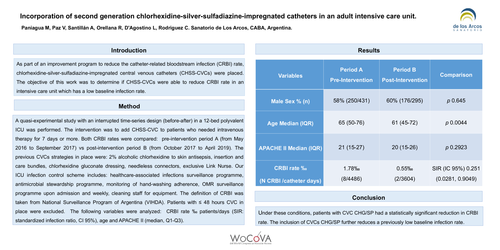
Introduction: As part of an improvement program to reduce the catheter-related bloodstream infection (CRBI) rate, chlorhexidine-silver-sulfadiazine-impregnated central venous catheters (CHSS-CVCs) were placed. The objective of this work was to determine if CHSS-CVCs were able to reduce CRBI rate in an intensive care unit which has a low baseline infection rate.
Method: A quasi-experimental study with an interrupted time-series design (before-after) in a 12-bed polyvalent ICU was performed. The intervention was to add CHSS-CVC to patients who needed intravenous therapy for 7 days or more. Both CRBI rates were compared: pre-intervention period A (from May 2016 to September 2017) vs post-intervention period B (from October 2017 to April 2019). The previous CVCs strategies in place were: 2% alcoholic chlorhexidine to skin antisepsis, insertion and care bundles, chlorhexidine gluconate dressing, needleless connectors, exclusive Link Nurse. Our ICU infection control scheme includes: healthcare-associated infections surveillance programme, antimicrobial stewardship programme, monitoring of hand-washing adherence, OMR surveillance programme upon admission and weekly, cleaning staff for equipment. The definition of CRBI was taken from National Surveillance Program of Argentina (VIHDA). Patients with ≤ 48 hours CVC in place were excluded. The following variables were analyzed: CRBI rate ‰ patients/days (SIR: standardized infection ratio, CI 95%), age and APACHE II (median, Q1-Q3).
Results: Male sex: 58% (250/431) vs. 60% (176/295) (p = 0.645), age 65 (50-76) vs. 61 (45-72) (p = 0.0044), APACHE II: 21(15-27) vs. 20 (15-26) (p = 0.2923). CRBI rate: 1.78‰ (8/4486) vs. 0.55‰ (2/3604) (SIR (IC 95%) 0.251 (0.0281, 0.9049)).
Conclusion: under these conditions, patients with CVC CHG/SP had a statistically significant reduction in CRBI rate. The inclusion of CVCs CHG/SP further reduces a previously low baseline infection rate.