141 posters, 8 videos, 8 audios, 5 topics, 442 authors, 228 institutions
ePostersLive by SciGen Technologies S.A. All rights reserved.
6th World Congress on Vascular Access 2021
April 29 - 30, 2021 | Virtual

PP11
A long-term tunneled femoral central venous catheter in children with cancer and mediastinal mass
Poster Presenter
Authors
Affiliations
Part of Topic
Worldwide Network
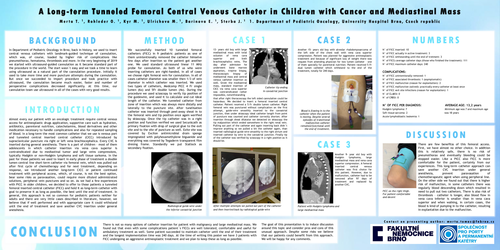
A long-term tunneled femoral central venous catheter in children with cancer and mediastinal mass.
Merta T.1, Rohleder O.1, Kyr M.1, Barinova E.1, Ulrichova M. 1, Sterba J.1
1) Department ofPediatric Oncology, Brno, Czech republic
Background
In Department of Pediatric Oncology in Brno, back in history, we used to insert central venous catheters with landmark-guided technique of cannulation, which was, of course, loaded by higher risk of complications like pneumothorax, hematoma, thrombosis and more. In the very beginning of 2019 we started with ultrasound-guided cannulation as it became standard part of the procedure in the world. The start wasn´t easy and we took a time to learn using ultrasound as a natural part of the cannulation procedure. Initially it used to take more time and more puncture attempts during the cannulation. But once we succeeded to import procedure and took practice with ultrasound, the cannulation became much easier, faster and number of peroperative complications decreased significantly. At this time, our cannulation team use ultrasound in all of the cases with very good results.
Introduction
Almost every our patient with an oncologic treatment require central venous access for antineoplastic drugs application, supportive care such as hydration, antibiotics, parenteral nutrition, catecholamins, blood derivatives and other medication necessary to handle complications and also for repeated sampling of blood. In a long-term the most common catheter that we use is venous port or tunneled central inserted central catheter (CICC) introduced by supraclavicular puncture via right or left vena brachiocephalica. Every CVC is inserted during general anesthesia. There is a part of children – most of them adolescents in which catheter insertion via vena cava superior is contraindicated due to mediastinal tumor and large veins compressions, typically Hodgkin or non-Hodgkin lymphoma and soft tissue sarkoma. In the past for those patients we used to insert in early phase of treatment a double lumen central line short-term catheter via femoral vein, which was pulled out after first cycle of chemotherapy and for next treatment, depending on response, we introduced another long-term CICC or patient continued treatment with peripheral access, which, of course, is not the best option, bear some risks as paravasation, could require more diluted administrated solutions, peripheral vein punctures and so on. As we had a few experiences with PICC in older children, we decided to offer to those patients a tunneled femoral inserted central catheters (FICC) and hold it as long-term catheters with goal to preserve them as long as possible, the best until the end of treatment. In general this approach is not so common for pediatric patients neither for adults and there are very little cases described in literature, however, we believe that if well performed and with appropriate care it could withstand until the end of treatment and save another CVC insertion under general anesshesia.
Method
We succesfully inserted 10 tunneled femoral catheters (FICC) in 9 pediatric patients as one of them unintentionally removed the catheter himselve few days after insertion so the patient got another one. We used standard ultrasound linear 11 MHz probe for cannulation. As both of us who were inserting catethers are right-handed, in all of cases we choosed right femoral vein for cannulation. In all of cases catheter diameter was smaller then 1/3 of vein diameter in wich catheter was inserted. We used two types of catheters, Medcomp PICC 4 Fr single lumen (6x) and 5Fr double lumen (4x). During the procedure we used skiascopy to verify tip position of the guidewire, and used it to calculate and cut ideal length of the catheter. We tunneled catheter from zone of insertion which was always more distally and laterally to the puncture site. After tunelisation catheter was inserted through peel-away sheat in to the femoral vein and tip position once again werified by skiascopy. Once the tip catheter was in a right position and function verified we used SecurAcath as primary fixation with drop of surgical glue to the exit site and to the site of puncture as well. Exite site was covered by Excilon antimicrobial Drain Sponge impregnated with polyhexamethylene biguanide and everything was covered by Tegaderm transparent film dresing frame. Standardly we put Statlock as secondary fixation.
Case 1
13- years old boy with large mediastinal mass with total oclusion of vena cava superior and both brachiocephalics vein. The day after admission he underwent bone marrow aspiration, trepine biopsy, thoracoscopic biopsy of mediastinal mass and central venous catheter insertion as well. Given the mediastinal mass, standard insertion of CICC via vena cava superior was contraindicated rather impossible, notwithstanding that after right thoracoscopy the left sided cannulation could be hazardous. We decided to insert a femoral inserted central catheter. Patient received a 5 Fr double lumen catheter. Right femoral vein was punctured without complication on the first attempt, guide-wire smoothly inserted to the cavoatrial junction, then under skiascopy the catheter length from point of puncture was counted and catheter correctly shorten. After insertion through sheat dilatator we detected on skiascopy the tip malposition which ended somewhere in the right renal vein. (image….). Pulling out part of the catheter and again inserting back didn´t improve anything so we pulled a bit the catheter again, than inserted radiologic guide wire smoothly to the right atrium and inserted catheter by wire to the cavoatrial junction. Finally tip of the catheter was verified by skiascopy in a right position as it should be.
Case 2
Another 15- years old boy with alveolar rhabdomyosarcoma of the left side of the chest wall with vena cava superior compression. Patient was planned for agressive antineoplastic treatment and because of significant loss of weight there was request from attending physician for two lumen catheter – one of them specially for parenteral nutrition. Patient received 5 Fr dual lumen catheter which withstand to the end of the tratment, totaly for 240 days….FOTO i z mobilu
Case 3
Another 9- year old boy with Hodgkin lymphoma, large mediastinal mass and vena cava superior compression. A femoral inserted central venosc catheter was first choice for this patient. However, due to malfunction catheter had to be removed.after 97 days of treatment and replaced by another CVC.
Results
N° of FICC inserted: 10
N°of FICC actually in active treatment: 3
N°of FICC withstanding until the end of tretment: 3
N°of FICCs average catheter days (those who finished the treatment: 111
N°of FICC maximum catheter days: 240
Complications:
N°of FICC unintentionally removed: 1
N°of FICC associated thrombosis: 1 (asymptomatic)
N°of FICC malfunction (reason for explantation): 2
N°of FICC malfunction (solved): practically every catheter at least once
N°of FICC exit site infections (reason for explantation): 1
N°of CLABSI: 1
N°of CRBSI: 0
N° of FICC per diagnosis:
Hodgkin lymphoma: 7
Soft tissue sarcoma: 2
Acute lymphoblastic leucemia: 1
Discussion
There are few benefitss of this femoral access. First, we have almost no other choice. In addition this is relatively safe, there is no risk of pneumothorax and eventually bleeding could be stopped easier. Like a PICC also FICC is more comfortable for the patient, certainly from our experiences. This long-term catheter approach can save another CVC insertion under general anesthesia, prevent paravasation of chemotherapeutic agent when using peripheral line. On the other side we found out that there is higher risk of malfunction, in some catheters there was regularly blood descending down which resulted in need to pull out two catheters. There is also risk of thrombosis – catheter is longer, also blood flow in vena cava inferior is smaller than in vena cava superior and when walking, in certain cases, the blood is kind of pumping in to the catheter, resulting in explantation due to the malfunction.
Conclusion
There is not so much options of catheter insertion for patient with malignancy and large mediastinal mass. We found out that even with some complications patient´s FICCs are well tolerated, comfortable and useful for ambulatory treatment aswell. Some patient succeded to maintain catheter until the end of their treatment and the longest implementation time was 240 days. At the time of writing this poster we have 3 patients with FICC undergoing an agressive antineoplastic treatment and we plan to keep these as long as possible.
The goal of this presentation is to induce discussion around this topic and consider pros and cons of this unusual approach. Despite some risks we believe that our patients could benefit from this approach. We will be happy for any comments.