141 posters, 8 videos, 8 audios, 5 topics, 442 authors, 228 institutions
ePostersLive by SciGen Technologies S.A. All rights reserved.
6th World Congress on Vascular Access 2021
April 29 - 30, 2021 | Virtual

PP02
ReVi project. detection of predictive factors of pain and anxiety in venous canalization in the pediatric patient
Part of Topic
Research & Innovations
Video
Introduction
The pediatric population is commonly exposed to therapeutic procedures.
Among them, venipuncture is one of the most feared (1,2,3) and anxiety inducing (4,5) tests Invasive procedures for diagnosis and treatment purposes that cause great pain and stress for paediatric patients.
Such feelings are associated with adverse consequences, such as flee attempts (6) metabolic and sleep pattern alterations (7) and even manifestation of post traumatic stress disorder(8).
However, there is a lack of publications analyzing the anxiety levels generated by invasive and painful processes in acute situations (9,11).
This study detects the levels of stress and anxiety perceived by pediatric patients of young age, between 2 and 6 years old, as well as knowing the main factors linked to and conditioning said levels.
Method:
A prospective study was carried out from January to May, 2019. The 148 children participants were recruited from the emergency room or the blood extraction servicetreated in a tertiary reference hospital in the region of Navarra (Spain).
They all met the following requirements: age range from 2 to 6 years, facing a venipuncture procedure but posing no vital risk. The impact of the variables recorded was analysed using a regressive analysis, the Wong-Baker and FLACC scales were used to measure the level of pain and the PACBIS scale to measure the level of stress and anxiety. A multivariate logistic regression analysis using a step-forward selection method was performed, being the independent variable “the parents’ attitude” and the control variable “the level of pain”.
Results
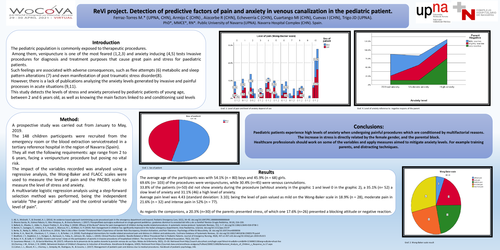
The average age of the participants was with 54.1% (n = 80) boys and 45.9% (n = 68) girls. 69.6% (n= 103) of the procedures were venipunctures, while 30.4% (n=45) were venous cannulations. 33.8% of the patients (n=50) did not show anxiety during the procedure (whitout anxiety in the graphic 1 and level 0 in the graphic 2), a 35.1% (n= 52) a slow level of anxiety and 31.1% (46) a high level of anxiety.
Average pain level was 4.43 (standard deviation: 3.10); being the level of pain valued as mild on the Wong-Baker scale in 18.9% (n = 28), moderate pain in 21.6% (n = 32) and intense pain in 52% (n = 77). As regards the companions, a 20.3% (n=30) of the parents presented stress, of which one 17.6% (n=26) presented a blocking attitude or negative reaction.
Conclusions:
Paediatric patients experience high levels of anxiety when undergoing painful procedures which are conditioned by multifactorial reasons. The increase in stress is directly related by the female gender, and the parental block.
Healthcare professionals should work on some of the variables and apply measures aimed to mitigate anxiety levels. For example training parents, and distracting techniques.