141 posters, 8 videos, 8 audios, 5 topics, 442 authors, 228 institutions
ePostersLive by SciGen Technologies S.A. All rights reserved.
6th World Congress on Vascular Access 2021
April 29 - 30, 2021 | Virtual

P134
Use of an Antimicrobial & Antithrombogenic PICC - A Prospective, Multicenter Experience
Poster Presenter
Authors
Michael A. Winkler, Nasir Siddiqi, Timothy R. Spencer, Jessica Wallace, John Gallien, Hossam Elbelasi, Mohamed Issa, Qian Yu, Driss Raissi
Affiliations
Teleflex Medical (Morrisville, NC, USA), Global Vascular Access, LLC, Scottsdale AZ, Detroit Medical Center, Emergency Department, Detroit MI, Augusta University, Department of Radiology, Medical College of Georgia, Atlana GA, Baylor College of Medicine, Department of Interventional Radiology, Houston TX, Ronald Reagan UCLA Medical Center, Department of Interventional Radiology, Los Angeles CA, Department of Radiology, College of Medicine, University of Kentucky, Lexington KY
Part of Topic
Research & Innovations
Introduction: This study evaluated an antimicrobial and anti-thrombogenic peripherally inserted central catheter (PICC) and the incidence of complications associated with its use within both inpatient and outpatient populations.
Methods: This IRB-approved, multicenter, prospective observational study was performed at three large US academic hospitals. Adults who required PICC ≥14 days were considered. Patients were monitored throughout the entire catheter dwell, to a maximum of 90 days. Data was collected from hospital, outpatient and patient PICC records. Duplex venous ultrasounds were performed before insertion, after 10 to 14 days of dwell time, and upon removal.
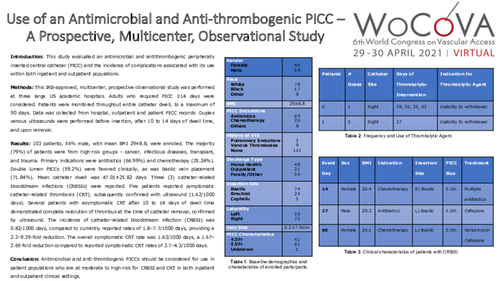
Results: 103 patients, 56% male, with a mean BMI 29±8.8, were enrolled. The majority (79%) of patients were from high-risk groups – cancer, infectious diseases, transplant, and trauma. Primary indications were antibiotics (66.99%) and chemotherapy (25.24%). Double lumen PICCs (59.2%) were favored clinically, as was basilic vein placement (71.84%). Mean catheter dwell was 47.01±25.82 days. Three (3) catheter-related bloodstream infections (CRBSIs) were reported. Five patients reported symptomatic catheter-related thrombosis (CRT), subsequently confirmed with ultrasound (1.62/1000 days). Several patients with asymptomatic CRT after 10 to 14 days of dwell time demonstrated complete resolution of thrombus at the time of catheter removal, confirmed by ultrasound. The incidence of catheter-related bloodstream infection (CRBSI) was 0.82/1000 days, compared to currently reported rates of 1.8–7.7/1000 days, providing a 2.2–9.39-fold reduction. The overall symptomatic CRT rate was 1.62/1000 days, a 1.67–2.65-fold reduction compared to reported symptomatic CRT rates of 2.7–4.3/1000 days.
Conclusion: Antimicrobial and anti-thrombogenic PICCs should be considered for use in patient populations who are at moderate to high-risk for CRBSI and CRT in both inpatient and outpatient clinical settings.