1,267 posters, 47 videos, 13 topics, 4 sessions, 853 authors
ePostersLive by SciGen Technologies S.A. All rights reserved.
SOHO 2026 Annual Meeting
September 9 - 12, 2026 | George R. Brown Convention Center, Houston, Texas

CT - 1744
Sarcopenia and Body Composition as Predictors of CAR-T Cell Therapy Outcomes in Hematologic Malignancies: A Systematic Review and Pooled Analysis
Poster Presenter
Authors
Part of Topic
Cellular Therapy (CT)
Title: Sarcopenia and Body Composition as Predictors of CAR-T Cell Therapy Outcomes in Hematologic Malignancies: A Systematic Review and Pooled Analysis
Authors: Yagnapriya Chirrareddy MD; Lakshmi Kattamuri MD; Manas Pustake MD; Bhaswanth Bollu MD; Ritwik Dey MD; Javier Corral MD. Department of Internal Medicine, Texas Tech University Health Sciences Center, El Paso, Texas, USA; Department of Hematology-Oncology, Texas Tech University Health Sciences Center, El Paso, Texas, USA.
Background: Sarcopenia and cancer-related cachexia are common in hematologic malignancies, but their impact on CAR-T cell therapy outcomes is not well defined. Studies differ in design and in how sarcopenia is measured, making the overall effect difficult to interpret from any single report.
Objective: To evaluate the association between sarcopenia, body composition, and nutritional status and CAR-T cell therapy outcomes in hematologic malignancies through a systematic review and pooled analysis.
Methods: We searched PubMed, Embase, Cochrane Library, Google Scholar, and ClinicalTrials.gov through May 2026 using terms including sarcopenia, body composition, cachexia, nutritional status, CAR-T, and hematologic malignancy. Studies reporting body composition or nutritional measures with CAR-T outcomes were included. Of 1,795 records identified, 8 studies met inclusion criteria, comprising 1,459 patients across diffuse large B-cell lymphoma (DLBCL), multiple myeloma (MM), and other hematologic malignancies. Studies were grouped by measurement methodology: four used computed tomography (CT)-based skeletal muscle index (SMI), and four assessed nutritional markers including prognostic nutritional index (PNI), albumin, and weight loss. A sample-size-weighted mean of hazard ratios was calculated across studies reporting comparable outcomes.
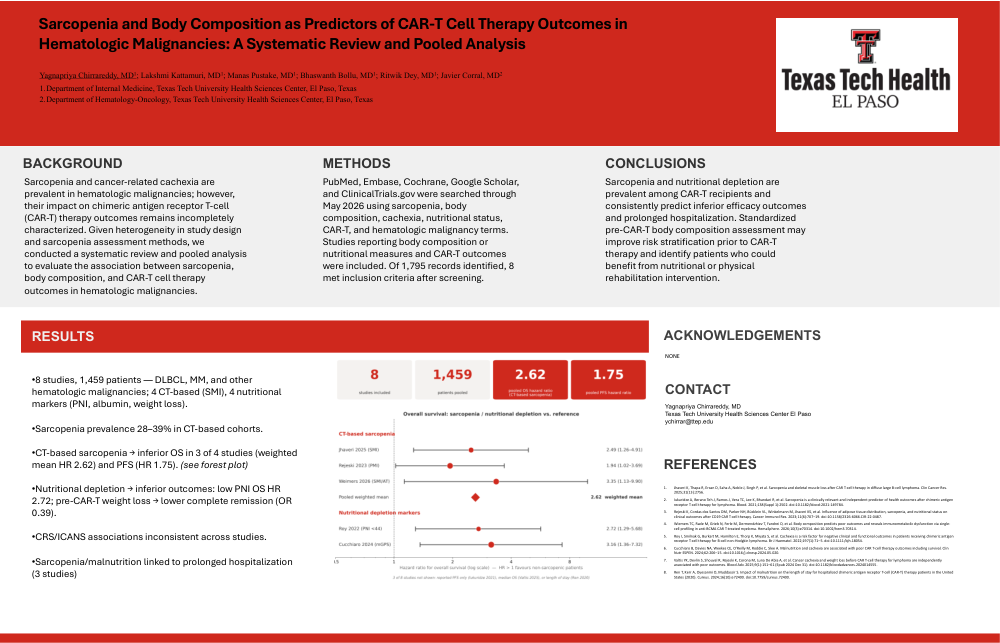
Results: Sarcopenia prevalence ranged from 28% to 39% across studies reporting CT-based measurements. In CT-based cohorts, sarcopenia consistently predicted inferior overall survival (OS), with hazard ratios (HR) ranging from 1.94 to 3.35 and a sample-size-weighted mean HR of 2.62 across three studies reporting OS. Sarcopenia was associated with inferior progression-free survival (PFS) in two of four studies (weighted mean HR 1.75). Associations with cytokine release syndrome and immune effector cell-associated neurotoxicity syndrome were inconsistent across studies. Nutritional depletion markers similarly predicted inferior outcomes: low PNI independently predicted OS (HR 2.72, p=0.02) and PFS (HR 2.48, p=0.03; Roy et al.), and pre-CAR-T weight loss was associated with inferior OS (p<0.0001) and lower complete remission rates (odds ratio 0.39, p=0.009; Valtis et al.). Sarcopenia and malnutrition were also associated with significantly prolonged hospitalization across three studies.
Conclusion: Sarcopenia and nutritional depletion are common in CAR-T recipients and consistently predict inferior survival and prolonged hospitalization. Standardized pre-CAR-T body composition assessment may improve risk stratification and identify patients who could benefit from nutritional or physical rehabilitation interventions. Because the evidence is observational with heterogeneous sarcopenia definitions, prospective validation is warranted.
Keywords: sarcopenia; body composition; skeletal muscle index; CT imaging; cachexia; malnutrition; nutritional status; prognostic nutritional index; PNI; weight loss; CAR-T cell therapy; hematologic malignancies; diffuse large B-cell lymphoma; multiple myeloma; overall survival; progression-free survival; systematic review; pooled analysis.