1,267 posters, 47 videos, 13 topics, 4 sessions, 853 authors
ePostersLive by SciGen Technologies S.A. All rights reserved.
SOHO 2026 Annual Meeting
September 9 - 12, 2026 | George R. Brown Convention Center, Houston, Texas

CT - 012
Thrombocytopenia Following CAR-T Therapy: A Systematic Review of Prospective Trials
Poster Presenter
Authors
Part of Topic
Cellular Therapy (CT)
INTRODUCTION
Chimeric antigen receptor T-cell (CAR-T) therapy has
transformed outcomes for relapsed/refractory B-cell
malignancies. Among hematologic toxicities,
thrombocytopenia is common after CAR-T and may be
prolonged, creating clinically important risks such as bleeding
and delays to subsequent therapies or trial enrolment
AIM
To systematically review prospective
clinical trial data on the incidence,
severity, duration, risk factors, and
management of thrombocytopenia
after FDA-approved CAR-T therapies.
METHOD
We searched PubMed, Embase, and the Cochrane Library for prospective
interventional clinical trials of axicabtagene ciloleucel, tisagenlecleucel, and
lisocabtagene maraleucel published between January 2016 and January 2026.
We identified 790 records. After removal of 210 duplicates, 580 unique records
were screened by title and abstract, 520 were excluded (preclinical studies, non
FDA approved therapies, case reports, reviews, non-CAR-T immunotherapies,
pediatric-only cohorts, or clearly irrelevant outcomes). 60 full-text articles were
assessed for eligibility, 51 were excluded for reasons including non-prospective
design, absence of thrombocytopenia outcomes, or being reviews/editorials.
Nine prospective interventional trials met inclusion criteria and were included in
the qualitative synthesis.
RESULTS
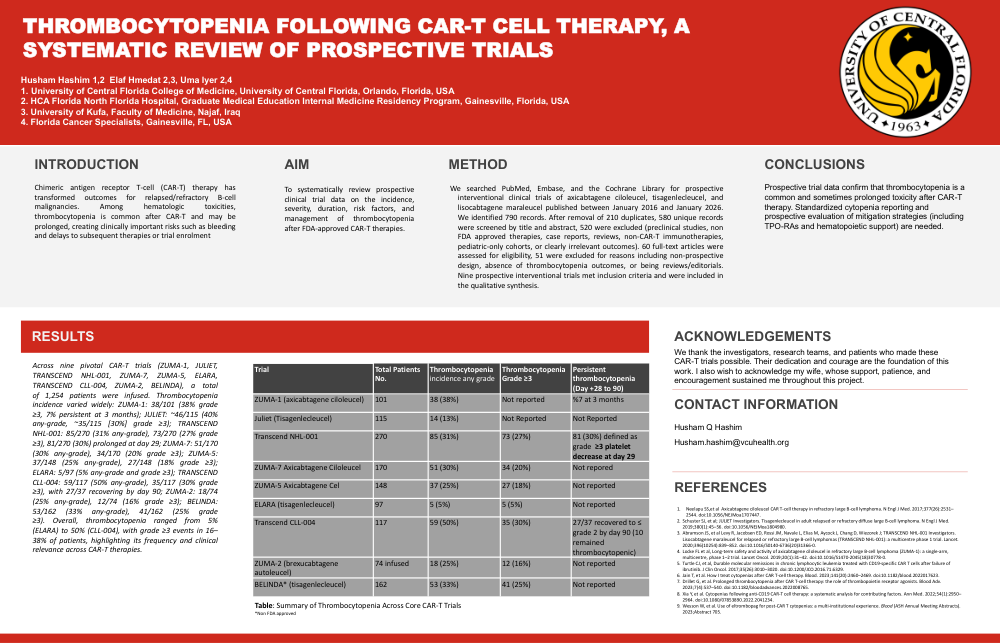
Across nine pivotal CAR-T trials (ZUMA-1, JULIET,
TRANSCEND NHL-001, ZUMA-7, ZUMA-5, ELARA,
TRANSCEND CLL-004, ZUMA-2, BELINDA), a total
of 1,254 patients were infused. Thrombocytopenia
incidence varied widely: ZUMA-1: 38/101 (38% grade
≥3, 7% persistent at 3 months); JULIET: ~46/115 (40%
any-grade, ~35/115 [30%] grade ≥3); TRANSCEND
NHL-001: 85/270 (31% any-grade), 73/270 (27% grade
≥3), 81/270 (30%) prolonged at day 29; ZUMA-7: 51/170
(30% any-grade), 34/170 (20% grade ≥3); ZUMA-5:
37/148 (25% any-grade), 27/148 (18% grade ≥3);
ELARA: 5/97 (5% any-grade and grade ≥3); TRANSCEND
CLL-004: 59/117 (50% any-grade), 35/117 (30% grade
≥3), with 27/37 recovering by day 90; ZUMA-2: 18/74
(25% any-grade), 12/74 (16% grade ≥3); BELINDA:
53/162 (33% any-grade), 41/162 (25% grade
≥3). Overall, thrombocytopenia ranged from 5%
(ELARA) to 50% (CLL-004), with grade ≥3 events in 16–
38% of patients, highlighting its frequency and clinical
relevance across CAR-T therapies.
CONCLUSIONS
Prospective trial data confirm that thrombocytopenia is a
common and sometimes prolonged toxicity after CAR-T
therapy. Standardized cytopenia reporting and
prospective evaluation of mitigation strategies (including
TPO-RAs and hematopoietic support) are needed.