1,267 posters, 47 videos, 13 topics, 4 sessions, 853 authors
ePostersLive by SciGen Technologies S.A. All rights reserved.
SOHO 2026 Annual Meeting
September 9 - 12, 2026 | George R. Brown Convention Center, Houston, Texas

MM - 1702
Trends in Overall Survival in Multiple Myeloma by Age Group in the Era of Novel Therapies: A SEER 17 Population-Based Analysis (2000-2021)
Poster Presenter
Authors
Part of Topic
Multiple Myeloma (MM)
Background
Multiple myeloma (MM) remains incurable, but the introduction of proteasome inhibitors (PIs), immunomodulatory drugs (IMiDs), and anti-CD38 monoclonal antibodies has transformed the treatment landscape over the past two decades. Whether these advances have translated into equitable survival gains across all age groups, particularly among elderly patients, remains incompletely characterized at the population level.
Methods
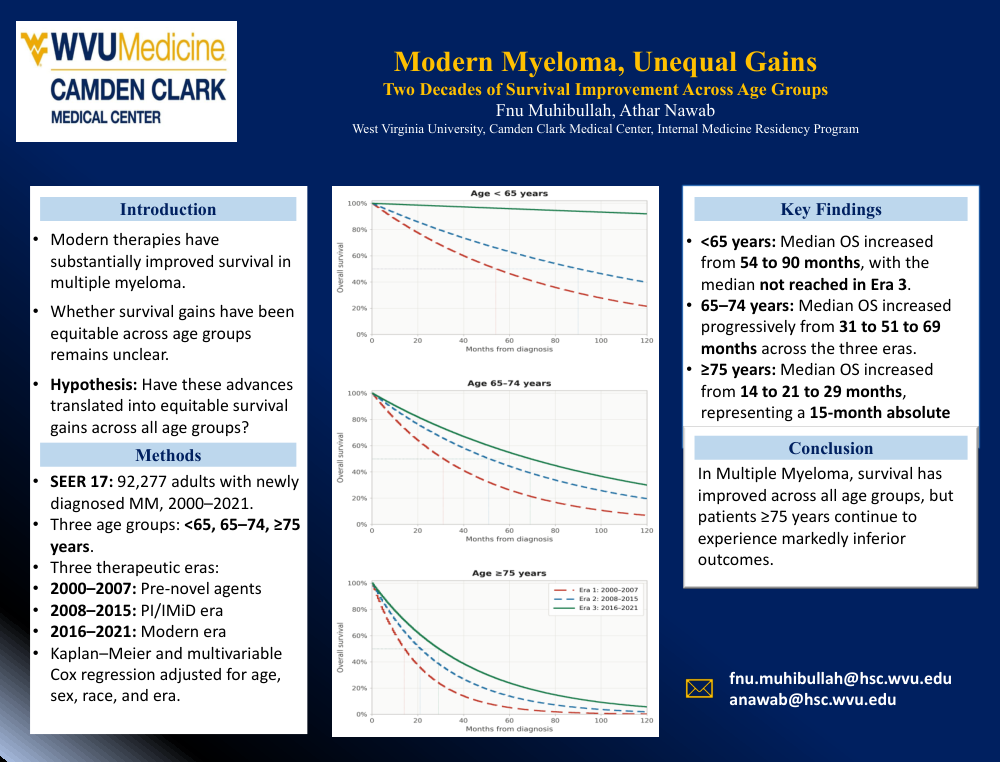
Using the SEER 17 registry, we identified 92,277 adults with a first primary diagnosis of MM (ICD-O-3 histology 9732) diagnosed between 2000 and 2021. Patients were stratified into three therapeutic eras: Era 1 (2000–2007, pre-novel agents; n=24,656), Era 2 (2008–2015, PI/IMiD era; n=31,561), and Era 3 (2016–2021, modern era including daratumumab and other targeted agents; n=36,060). Three age groups were defined: younger (<65 years), intermediate (65–74 years), and older (≥75 years). Overall survival (OS) was estimated using the Kaplan-Meier method and compared across eras within each age group using log-rank tests. A multivariable Cox proportional hazards model was fitted adjusting for age, sex, race, and therapeutic era.
Results
Survival improved significantly across all three age groups between Era 1 and Era 3 (all log-rank p<0.0001). Median OS in patients <65 years increased from 54 months in Era 1 to 90 months in Era 2, and was not reached in Era 3 (median OS = not reached), reflecting a dramatic improvement in younger patients with modern therapy. In the 65–74 age group, median OS improved from 31 to 51 to 69 months across the three eras. However, in patients ≥75 years, gains were more modest: median OS increased from 14 to 21 to 29 months, remaining substantially lower than younger cohorts despite era-over-era improvement. On multivariable Cox regression, Era 2 (HR 0.71, 95% CI 0.70–0.73) and Era 3 (HR 0.56, 95% CI 0.55–0.57) were independently associated with significantly reduced mortality risk compared to Era 1 (both p<0.0001), after adjusting for age (HR 1.044 per year, p<0.0001), sex (male HR 1.145, p<0.0001), and race. Model concordance was 0.657.
Conclusions
In this large population-based analysis of over 92,000 MM patients, therapeutic advances over the past two decades have produced meaningful and statistically significant OS improvements across all age groups. However, a striking survival gap persists in patients ≥75 years, whose median OS of 29 months in the modern era remains less than half that of younger patients. These findings underscore the urgent need for age-tailored treatment strategies and clinical trial inclusion of elderly MM patients to ensure equitable benefit from novel therapies.