1,267 posters, 47 videos, 13 topics, 4 sessions, 853 authors
ePostersLive by SciGen Technologies S.A. All rights reserved.
SOHO 2026 Annual Meeting
September 9 - 12, 2026 | George R. Brown Convention Center, Houston, Texas

MM - 039
Criteria of Systemic Immunoglobulin Light-Chain (AL) Amyloidosis in Egyptian Patients: A Single-Center Observational Study of a Rare Plasma Cell Disorder
Poster Presenter
Authors
Part of Topic
Multiple Myeloma (MM)
Criteria of Systemic Immunoglobulin Light Chain (AL) Amyloidosis in Egyptian Patients: A Single-Center Observational Study of a Rare Plasma Cell Disorder
Y. Shaaban1, B. Atef1, M. Elbogdady1, E. Jamal1, S. ELashwah2, H. MM Abdelaziz3,S. EL-Ashwah1
1. Clinical Hematology, Oncology Center, Mansoura University (OCMU), Faculty of Medicine, Mansoura, Egypt
2. Medical Oncology, Oncology Center, Mansoura University (OCMU), Faculty of Medicine, Mansoura, Egypt
3. Department of Cardiovascular Medicine, Faculty of Medicine, Mansoura University, Mansoura, Egypt
INTRODUCTION
Systemic immunoglobulin light chain (AL) amyloidosis is a rare clonal plasma cell dyscrasia arising from tissue deposition of misfolded free light chains, most often a λ isotype. These fibrils alter organ function without meeting myeloma‑defining events. Diagnosis is challenging due to subtle, nonspecific symptoms, often delaying recognition, thus resulting in significant morbidity and mortality.
AIM
To explore the clinical and laboratory criteria of Egyptian patients with confirmed AL amyloidosis.
The primary outcome was overall survival (OS), while secondary outcomes included the impact of organ involvement, laboratory parameters and first‑line treatment regimen on OS.
METHOD
This is a combined prospective and retrospective observational non-blind study of twenty-eight patients with AL amyloidosis at Oncology Center, Mansoura University between March 2016 and March 2024. Patients were first‑time attendees or referred to OCMU from nephrology and cardiology departments. Notable increase in diagnosed cases occurred between late 2018 and early 2023.
Clinical, biochemical, pathology, organ involvement, and treatment variables were analyzed.
RESULTS
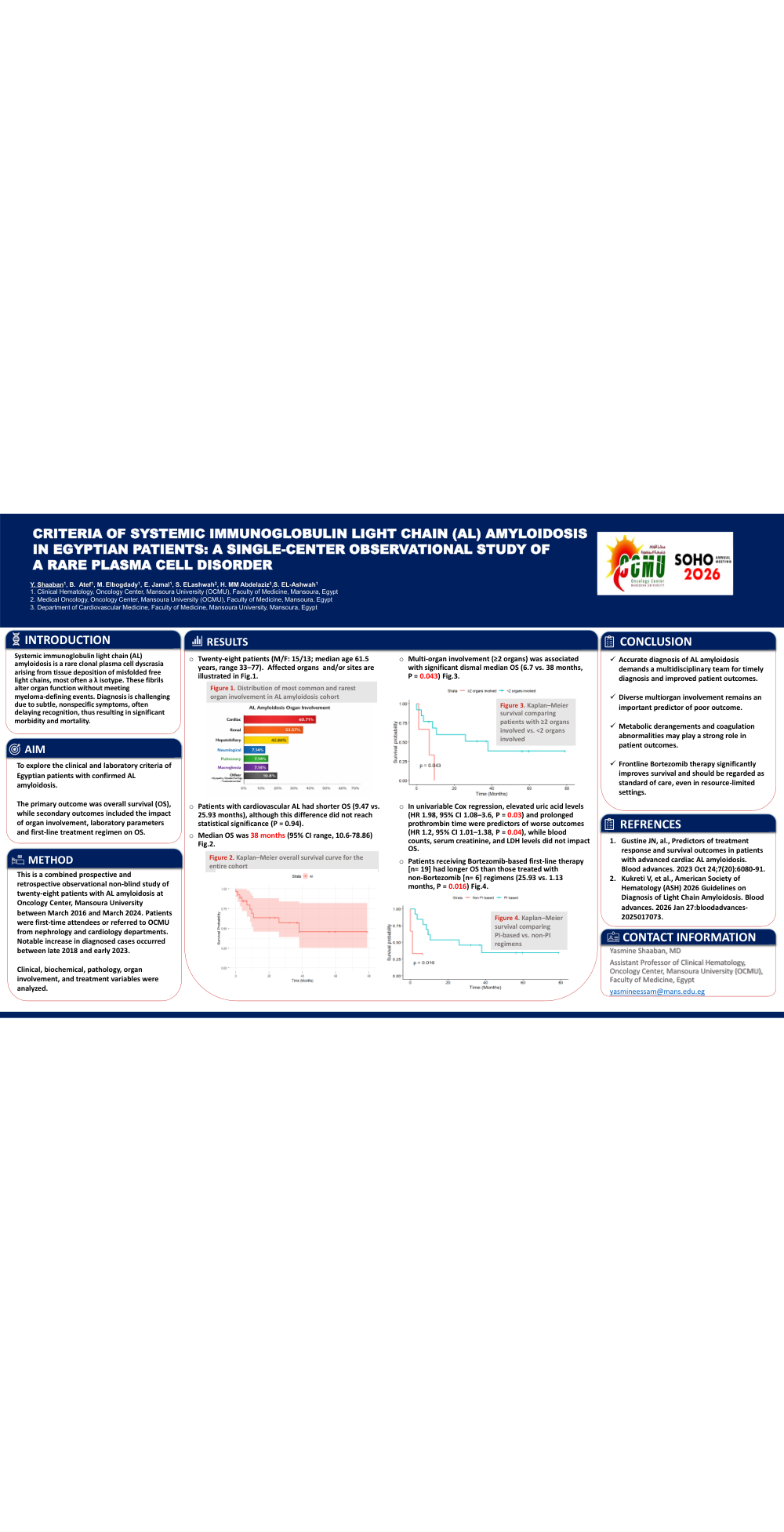
- Twenty-eight patients (M/F: 15/13; median age 61.5 years, range 33–77). Affected organs and/or sites are illustrated in Fig.1.
- Patients with cardiovascular AL had shorter OS (9.47 vs. 25.93 months), although this difference did not reach statistical significance (P = 0.94).
- Median OS was 38 months (95% CI range, 10.6-78.86) Fig.2.
- oMulti-organ involvement (≥2 organs) was associated with significant dismal median OS (6.7 vs. 38 months, P = 0.043) Fig.3.
- In univariable Cox regression, elevated uric acid levels (HR 1.98, 95% CI 1.08–3.6, P = 0.03) and prolonged prothrombin time were predictors of worse outcomes (HR 1.2, 95% CI 1.01–1.38, P = 0.04), while blood counts, serum creatinine, and LDH levels did not impact OS.
- Patients receiving Bortezomib‑based first‑line therapy [n= 19] had longer OS than those treated with non‑Bortezomib [n= 6] regimens (25.93 vs. 1.13 months, P = 0.016) Fig.4.
CONCLUSION
- Accurate diagnosis of AL amyloidosis demands a multidisciplinary team for timely diagnosis and improved patient outcomes.
- Diverse multiorgan involvement remains an important predictor of poor outcome.
- Metabolic derangements and coagulation abnormalities may play a strong role in patient outcomes.
- Frontline Bortezomib therapy significantly improves survival and should be regarded as standard of care, even in resource-limited settings.
REFRENCES
- Gustine JN, al., Predictors of treatment response and survival outcomes in patients with advanced cardiac AL amyloidosis. Blood advances. 2023 Oct 24;7(20):6080-91.
- Kukreti V, et al., American Society of Hematology (ASH) 2026 Guidelines on Diagnosis of Light Chain Amyloidosis. Blood advances. 2026 Jan 27:bloodadvances-2025017073.