1,267 posters, 47 videos, 13 topics, 4 sessions, 853 authors
ePostersLive by SciGen Technologies S.A. All rights reserved.
SOHO 2026 Annual Meeting
September 9 - 12, 2026 | George R. Brown Convention Center, Houston, Texas

AML - 1526
Temporal Changes in AML Survival Across Treatment Eras: A SEER Database Analysis (2000-2022)
Poster Presenter
Authors
Part of Topic
Acute Myeloid Leukemia (AML)
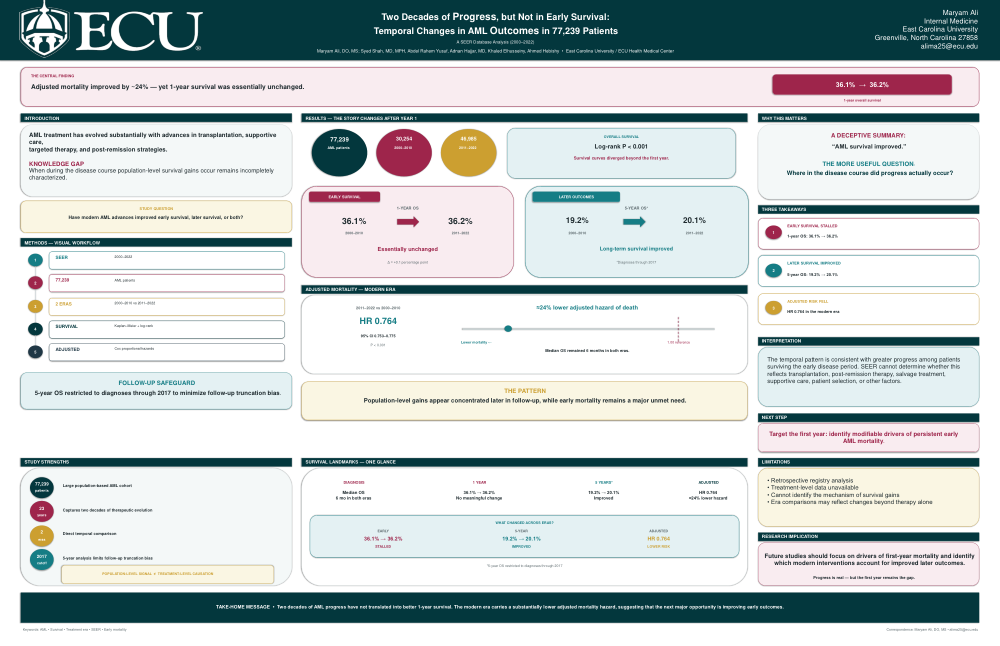
Acute myeloid leukemia (AML) treatment has evolved substantially over the past two decades with advances in transplantation, supportive care, targeted therapies, and post-remission strategies. However, it remains unclear whether these advances have translated into improvements in early survival, later survival, or both.
Using the SEER database, we evaluated 77,239 patients with AML diagnosed from 2000–2022. Patients were divided into two treatment eras: 2000–2010 (n=30,254) and 2011–2022 (n=46,985). Overall survival was evaluated using Kaplan–Meier analysis and the log-rank test, and Cox proportional hazards modeling was used to assess adjusted mortality. To minimize follow-up truncation bias, 5-year overall survival analyses were restricted to patients diagnosed through 2017.
Overall survival differed significantly between treatment eras (log-rank P<0.001), with survival curves diverging primarily beyond the first year. Despite therapeutic advances, 1-year overall survival remained essentially unchanged at 36.1% in 2000–2010 versus 36.2% in 2011–2022, representing an absolute difference of only 0.1 percentage point. In contrast, 5-year overall survival improved from 19.2% to 20.1% among patients eligible for 5-year follow-up.
After multivariable adjustment, diagnosis during the modern era was associated with a substantially lower hazard of death compared with 2000–2010 (HR 0.764, 95% CI 0.753–0.775; P<0.001), corresponding to an approximately 24% lower adjusted mortality hazard. Median overall survival, however, remained 6 months in both eras.
These findings suggest that population-level improvements in AML survival over the past two decades have been concentrated predominantly among patients surviving the early disease period, while first-year survival has remained largely unchanged. The next major opportunity for improving AML outcomes may therefore lie in identifying and addressing modifiable drivers of early mortality. Because SEER lacks treatment-level data, these findings cannot determine which specific therapeutic or supportive-care advances account for improved later outcomes.