1,267 posters, 47 videos, 13 topics, 4 sessions, 853 authors
ePostersLive by SciGen Technologies S.A. All rights reserved.
SOHO 2026 Annual Meeting
September 9 - 12, 2026 | George R. Brown Convention Center, Houston, Texas

AML - 056
Tagraxofusp in Adult Blastic Plasmacytoid Dendritic Cell Neoplasm: Clinical Trials and Real-World Outcomes: A Systematic Review
Poster Presenter
Authors
Part of Topic
Acute Myeloid Leukemia (AML)
Tagraxofusp in Adult Blastic Plasmacytoid Dendritic Cell Neoplasm: Clinical Trials and Real-World Outcomes: A Systematic Review
Bassam Muthanna MBBS, MD1, Aadhila Abbas2, Leen Saleh2, Abdulrahman Al-Mashdali MD3, Shehab Mohamed MD3
1University of Missouri-Columbia, Columbia, MO, USA. 2Qatar University, Doha, Qatar. 3Department of Hematology, National Center for Cancer Care and Research (NCCCR), Qatar, Doha, Qatar
Abstract
Context
Blastic plasmacytoid dendritic cell neoplasm (BPDCN) is a rare, aggressive, hematologic malignancy with historically poor outcomes. Tagraxofusp has redefined treatment, yet evidence remains fragmented across clinical trials and real-world studies.
Objective
To systematically evaluate the efficacy and safety of tagraxofusp in adult BPDCN across prospective and real-world settings.
Design
Systematic review of PubMed, Scopus, and Google Scholar from database inception through January 25, 2026, using predefined eligibility criteria.
Patients/Participants
Adults (≥18 years) with BPDCN treated with tagraxofusp. Studies reporting efficacy and/or safety outcomes were included; narrative reviews, pediatric-only, preclinical studies, and abstracts without extractable data were excluded.
Intervention
Tagraxofusp in frontline and relapsed/refractory settings.
Main Outcome Measures
Overall response rate (ORR), complete remission (CR)/complete remission with incomplete count recovery (CRc), bridging to hematopoietic stem-cell transplantation (HSCT), and treatment-related toxicities.
Results
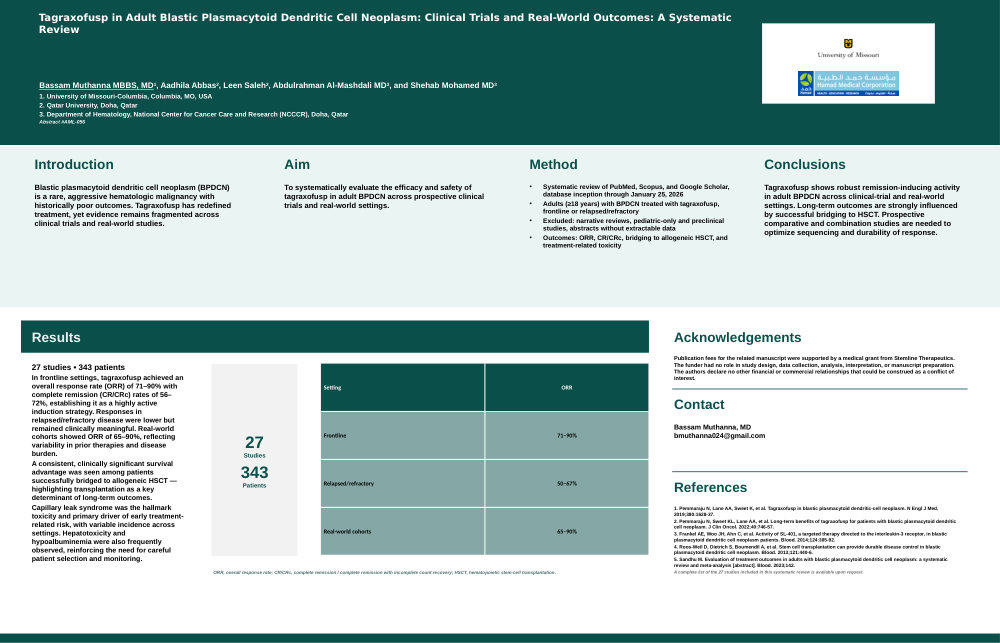
Twenty-seven studies including 343 patients were analyzed. In frontline settings, tagraxofusp achieved ORR of 71%–90% with CR/CRc rates of 56%–72%, establishing it as a highly active induction strategy. In relapsed/refractory disease, responses were lower but remained clinically meaningful. Real-world cohorts demonstrated ORR of 65%–90%, with variability reflecting prior therapies and disease burden. Across studies, a consistent and clinically significant survival advantage was observed among patients successfully bridged to allogeneic HSCT, highlighting transplantation as a key determinant of long-term outcomes. Capillary leak syndrome was the hallmark toxicity and primary driver of early treatment-
related risk, with variable incidence across settings. Hepatotoxicity and hypoalbuminemia were frequently observed, reinforcing the importance of careful patient selection and monitoring.
Conclusions
Tagraxofusp demonstrates robust remission-inducing activity in adult BPDCN across clinical-trial and real-world settings. Long-term outcomes are strongly influenced by successful bridging to HSCT. Prospective comparative and combination studies are needed to optimize sequencing and improve durability of response.
Keywords
AML, BPDCN, tagraxofusp, CD123, hematopoietic stem-cell transplantation, capillary leak syndrome