1,267 posters, 47 videos, 13 topics, 4 sessions, 853 authors
ePostersLive by SciGen Technologies S.A. All rights reserved.
SOHO 2026 Annual Meeting
September 9 - 12, 2026 | George R. Brown Convention Center, Houston, Texas

MM - 1482
Acute Kidney Injury as a Risk Stratification Tool in Multiple Myeloma: Insights from a Nationwide Analysis of Mortality and 30-Day Readmission
Poster Presenter
Authors
Part of Topic
Multiple Myeloma (MM)
Background
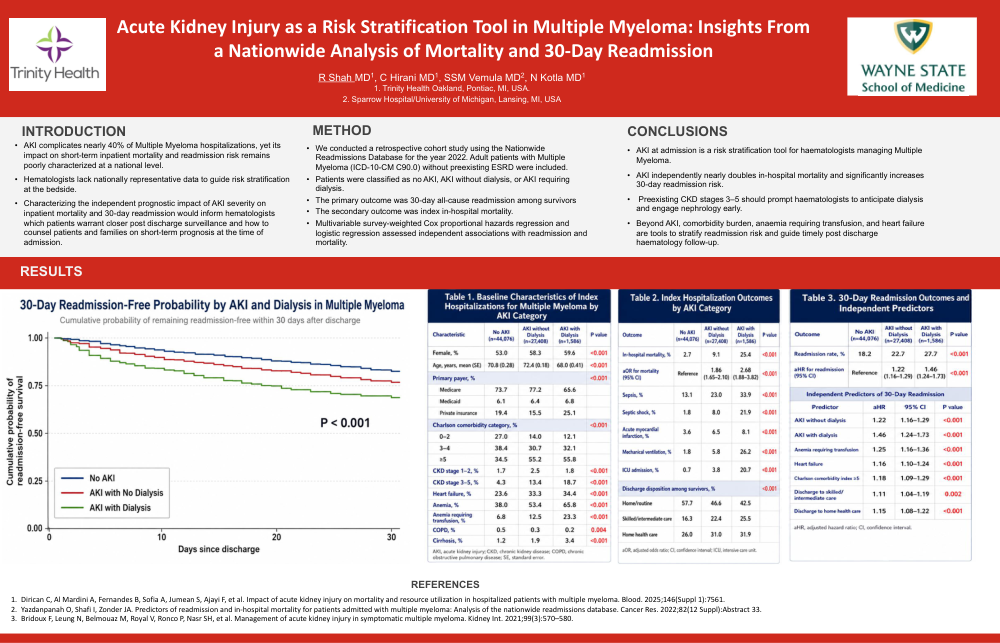
AKI complicates nearly 40% of MM hospitalizations, yet its impact on short-term inpatient mortality and readmission risk remains poorly characterized at a national level. Hematologists lack nationally representative data to guide risk stratification at the bedside. Characterizing the independent prognostic impact of AKI severity on inpatient mortality and 30-day readmission would inform hematologists which patients warrant closer postdischarge surveillance and how to counsel patients and families on short-term prognosis at the time of admission.
Methods
We conducted a retrospective cohort study using the Nationwide Readmissions Database for the year 2022. Adult patients with MM (ICD-10-CM C90.0) without preexisting ESRD were included. Patients were classified as no AKI, AKI without dialysis, or AKI requiring dialysis. The primary outcome was 30-day all-cause readmission among survivors; the secondary outcome was index in-hospital mortality. Multivariable survey-weighted Cox proportional hazards regression and logistic regression assessed independent associations with readmission and mortality.
Results
Among 73070 hospitalizations (60.3% no AKI, 37.5% AKI without dialysis, 2.2% AKI with dialysis), in-hospital mortality increased sharply with AKI severity: 2.7%, 9.1%, and 25.4% (P<0.001), respectively. On multivariable analysis, AKI without dialysis (aOR, 1.86; 95% CI, 1.65–2.10) and AKI with dialysis (aOR, 2.68; 95% CI, 1.88–3.82) were independently associated with in-hospital mortality. Patients requiring dialysis were more likely to have preexisting CKD stages 3–5 (18.7% vs 4.3% in patients with no AKI) and high comorbidity burden (Charlson Comorbidity Index ≥5 in 55.8%). The 30-day readmission rate rose from 18.2% (no AKI) to 22.7% (AKI without dialysis) and 27.7% (AKI with dialysis; P<0.001). Additional independent predictors of readmission included anemia requiring transfusion, heart failure, and Charlson Comorbidity Index ≥5.
Conclusions
AKI at admission is a risk stratification tool for hematologists managing MM. AKI independently nearly doubles in-hospital mortality and significantly increases 30-day readmission risk. Preexisting CKD stages 3–5 should prompt hematologists to anticipate dialysis and engage nephrology early. Beyond AKI, comorbidity burden, anemia requiring transfusion, and heart failure are tools to stratify readmission risk and guide timely postdischarge hematology follow-up.