1,267 posters, 47 videos, 13 topics, 4 sessions, 853 authors
ePostersLive by SciGen Technologies S.A. All rights reserved.
SOHO 2026 Annual Meeting
September 9 - 12, 2026 | George R. Brown Convention Center, Houston, Texas

MCL - 1435
Autologous Stem Cell Transplantation Remains an Effective Strategy in Mantle Cell Lymphoma in a Brazilian Real-World Cohort
Poster Presenter
Authors
Part of Topic
Mantle Cell Lymphoma (MCL)
Autologous stem cell transplantation remains an effective strategy in mantle cell lymphoma in a Brazilian real-world cohort
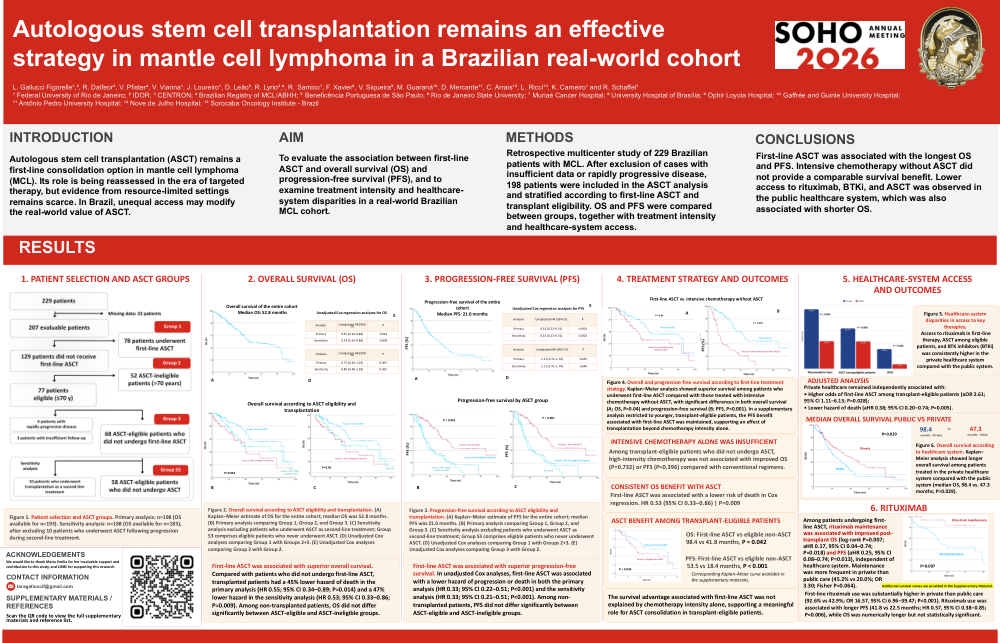
Autologous stem cell transplantation (ASCT) remains a first-line consolidation option in mantle cell lymphoma (MCL). Its role is being reassessed in the era of targeted therapy, but evidence from resource-limited settings remains scarce. In Brazil, unequal access may modify the real-world value of ASCT.
To evaluate the association between first-line ASCT and overall survival (OS) and progression-free survival (PFS), and to examine treatment intensity and healthcare-system disparities in a real-world Brazilian MCL cohort.
Retrospective multicenter study of 229 Brazilian patients with MCL. After exclusion of cases with insufficient data or rapidly progressive disease, 198 patients were included in the ASCT analysis and stratified according to first-line ASCT and transplant eligibility. OS and PFS were compared between groups, together with treatment intensity and healthcare-system access.
First-line ASCT was associated with the longest OS and PFS. Intensive chemotherapy without ASCT did not provide a comparable survival benefit. Lower access to rituximab, BTKi, and ASCT was observed in the public healthcare system, which was also associated with shorter OS.
Figure 1. Patient selection and ASCT groups. Primary analysis: n=198 (OS available for n=193). Sensitivity analysis: n=188 (OS available for n=183), after excluding 10 patients who underwent ASCT following progression during second-line treatment.
Figure 2. Overall survival according to ASCT eligibility and transplantation. (A) Kaplan–Meier estimate of OS for the entire cohort; median OS was 52.8 months. (B) Primary analysis comparing Group 1, Group 2, and Group 3. (C) Sensitivity analysis excluding patients who underwent ASCT as second-line treatment; Group S3 comprises eligible patients who never underwent ASCT. (D) Unadjusted Cox analyses comparing Group 1 with Groups 2+3. (E) Unadjusted Cox analyses comparing Group 3 with Group 2.
First-line ASCT was associated with superior overall survival. Compared with patients who did not undergo first-line ASCT, transplanted patients had a 45% lower hazard of death in the primary analysis (HR 0.55; 95% CI 0.34–0.89; P=0.014) and a 47% lower hazard in the sensitivity analysis (HR 0.53; 95% CI 0.33–0.86; P=0.009). Among non-transplanted patients, OS did not differ significantly between ASCT-eligible and ASCT-ineligible groups.
Figure 3. Progression-free survival according to ASCT eligibility and transplantation. (A) Kaplan–Meier estimate of PFS for the entire cohort; median PFS was 21.0 months. (B) Primary analysis comparing Group 1, Group 2, and Group 3. (C) Sensitivity analysis excluding patients who underwent ASCT as second-line treatment; Group S3 comprises eligible patients who never underwent ASCT. (D) Unadjusted Cox analyses comparing Group 1 with Groups 2+3. (E) Unadjusted Cox analyses comparing Group 3 with Group 2.
First-line ASCT was associated with superior progression-free survival. In unadjusted Cox analyses, first-line ASCT was associated with a lower hazard of progression or death in both the primary analysis (HR 0.33; 95% CI 0.22–0.51; P<0.001) and the sensitivity analysis (HR 0.33; 95% CI 0.21–0.51; P<0.001). Among non-transplanted patients, PFS did not differ significantly between ASCT-eligible and ASCT-ineligible groups.
Figure 4. Overall and progression-free survival according to first-line treatment strategy. Kaplan–Meier analysis showed superior survival among patients who underwent first-line ASCT compared with those treated with intensive chemotherapy without ASCT, with significant differences in both overall survival (A; OS, P=0.04) and progression-free survival (B; PFS, P<0.001). In a supplementary analysis restricted to younger, transplant-eligible patients, the PFS benefit associated with first-line ASCT was maintained, supporting an effect of transplantation beyond chemotherapy intensity alone.
Among transplant-eligible patients who did not undergo ASCT, high-intensity chemotherapy was not associated with improved OS (P=0.732) or PFS (P=0.396) compared with conventional regimens.
First-line ASCT was associated with a lower risk of death in Cox regression. HR 0.53 (95% CI 0.33–0.86) | P=0.009
OS: First-line ASCT vs eligible non-ASCT (98.4 vs 41.8 months, P = 0.042)
PFS: First-line ASCT vs eligible non-ASCT ( 53.5 vs 18.4 months, P < 0.001)
The survival advantage associated with first-line ASCT was not explained by chemotherapy intensity alone, supporting a meaningful role for ASCT consolidation in transplant-eligible patients.
Figure 5. Healthcare-system disparities in access to key therapies.
Access to rituximab in first-line therapy, ASCT among eligible patients, and BTK inhibitors (BTKi) was consistently higher in the private healthcare system compared with the public system.
Private healthcare remained independently associated with:
• Higher odds of first-line ASCT among transplant-eligible patients (aOR 2.61; 95% CI 1.11–6.13; P=0.028);
• Lower hazard of death (aHR 0.38; 95% CI 0.20–0.74; P=0.005).
Figure 6. Overall survival according to healthcare system. Kaplan–Meier analysis showed longer overall survival among patients treated in the private healthcare system compared with the public system (median OS, 98.4 vs. 47.3 months; P=0.029).
Access to effective therapies remained strongly influenced by healthcare setting in Brazil. Patients treated in the private system had greater access to rituximab, ASCT, and BTK inhibitors and experienced longer overall survival. These findings highlight the impact of treatment access on outcomes and the need to reduce disparities in MCL care.