1,267 posters, 47 videos, 13 topics, 4 sessions, 853 authors
ePostersLive by SciGen Technologies S.A. All rights reserved.
SOHO 2026 Annual Meeting
September 9 - 12, 2026 | George R. Brown Convention Center, Houston, Texas

MCL - 1013
Concurrent High-Risk Features in Mantle Cell Lymphoma: Frequency and Impact
Poster Presenter
Authors
Part of Topic
Mantle Cell Lymphoma (MCL)
MCL-1013
Concurrent High-Risk Features in Mantle Cell Lymphoma: Frequency and Impact
Carla Isabel Borre MD, MPH1, Muhammad Azeem Khan MBBS1, Aishwarya Pradeep MD1, Ayo Samuel Falade MD, MBA1, Laura Carola Magnano Mayer MD1, Michelle Thorensen RN1, Julia Wang1,2, Enaya Epps2, Adrienne Nedved PharmD, RPh, BCOP1, Robin Klebig APRN, CNP, MSN1, Gita Thanarajasingam MD1, Urshila Durani MD, MPH1, Arushi Khurana MBBS1, JC Villasboas Bisneto MD1, Jonas Paludo MD1, Stephen Ansell MD, PhD1, Thomas Habermann MD1, Thomas Witzig MD1, Yucai Wang MD, PhD1, Jithma Abeykoon MD1
1Mayo Clinic, Rochester, MN, USA. 2Century High School, Rochester, MN, USA
Abstract
Context
MCL has a wide spectrum of outcomes influenced by clinical and biological features, some of which are included in the Mantle Cell Lymphoma International Prognostic Index combined (e.g., Ki-67); however, the prevalence and impact of high-risk features such as TP53 mutation and blastoid or pleomorphic morphology have not been well characterized. We describe the prevalence of concurrent high-risk features and their impact on outcomes.
Design
Retrospective study
Setting
Routine clinical practice
Patients or Participants
Patients with MCL seen at Mayo Clinic (Rochester, MN), diagnosed between 2008 and 2026, with known TP53 mutation status (by clinical next-generation sequencing), morphology, and Ki-67.
Main Outcome Measures
PFS and OS were analyzed by the Kaplan-Meier method.
Results
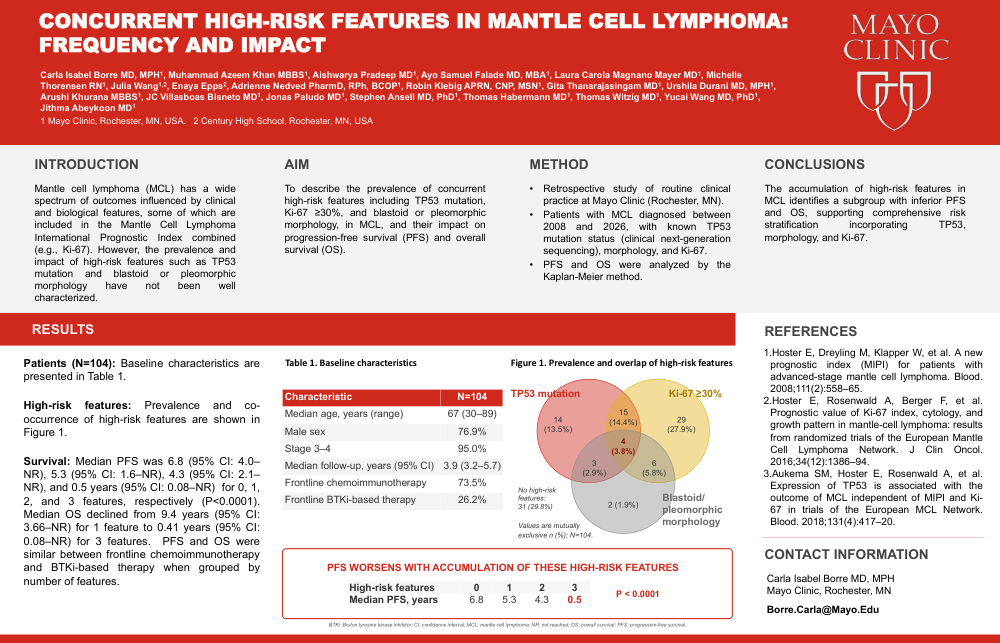
One hundred four patients were included, with a median age at diagnosis of 67 (range: 30–89) years. Most (76.9%) patients were male, 95.0% had stage 3 or 4 disease, 34.6% had TP53 mutation, 51.9% had Ki-67≥30%, and 14.4% had blastoid or pleomorphic morphology. Concurrent Ki-67≥30% and TP53 mutation were observed in 18.3% of patients, while 9.6% had both Ki-67≥30% and blastoid or pleomorphic morphology; 6.7% harbored both TP53 mutation and blastoid or pleomorphic morphology, and 3.8% harbored all three features. Median follow-up from diagnosis was 3.9 (95% CI: 3.2–5.7) years, and 73.5% of patients received frontline chemoimmunotherapy, while 26.2% received frontline BTKi-based therapy. Median PFS and OS differed significantly by the number of concurrent high-risk features present. Median PFS was 6.8 (95% CI: 4.0–NR) years, 5.3 (95% CI: 1.6–NR) years, 4.3 (95% CI: 2.1–NR) years, and 0.5 (95% CI: 0.08–NR) years for patients harboring zero, one, two, and three features, respectively (P<0.0001). Median OS similarly declined from 9.4 (95% CI: 3.66–NR) years in patients with one high-risk feature to 0.41 (95% CI: 0.08–NR) years in those harboring all three features. Similar PFS and OS rates were observed among patients treated with frontline chemoimmunotherapy and BTKi-based treatment when grouped by the number of high-risk features.
Conclusion
The accumulation of high-risk features in MCL identifies a subgroup with inferior PFS, supporting comprehensive risk stratification incorporating TP53, morphology, and Ki-67.
BTKi: Bruton tyrosine kinase inhibitor, CI: confidence interval, Ki-67: antigen Kiel 67, MCL: mantle cell lymphoma, NR: not recorded, OS: overall survival, PFS: progression-free survival, TP53: tumor protein 53
Keywords
MCL, mantle cell lymphoma, TP53 mutation, Ki-67 proliferation index, blastoid morphology, pleomorphic morphology