1,267 posters, 47 videos, 13 topics, 4 sessions, 853 authors
ePostersLive by SciGen Technologies S.A. All rights reserved.
SOHO 2026 Annual Meeting
September 9 - 12, 2026 | George R. Brown Convention Center, Houston, Texas

MCL - 1024
Efficacy and Safety of Sonrotoclax (BGB-11417/Beqalzzi) in Relapsed/Refractory Mantle Cell Lymphoma: A Systematic Review and Meta-Analysis
Poster Presenter
Authors
Part of Topic
Mantle Cell Lymphoma (MCL)
Efficacy and Safety of Sonrotoclax (BGB-11417/Beqalzi) in Relapsed/Refractory Mantle Cell Lymphoma: A Systematic Review and Meta-Analysis
Edith Ramos Ocola1, Rithvika Badugu2, Varun kumar Daram3, Arpita Vinubhai Kanpariya4, Harshawardhan Dhanraj Ramteke5, Rakhshanda khan6
1Universidad Nacional de San Agustín de Arequipa, Arequipa, Peru; 2Gandhi medical college, Hyderabad, India; 3Gandhi medical college, Hyderabad, India; 4Pramukh Swami Medical College, Surat, India; 5Rhythm heart and critical care hospitals, Nagpur, India; 6Ayaan institute of medical sciences, Moinabad, India,
Keywords: sonrotoclax, Mantle Cell Lymphoma, relapsed/refractory lymphoma, BCL-2 inhibitor, meta-analysis
Introduction
Relapsed/refractory mantle cell lymphoma (R/R MCL) demonstrates poor survival outcomes following Bruton tyrosine kinase inhibitor failure. Sonrotoclax (BGB-11417/Beqalzi), a highly selective next-generation BCL-2 inhibitor, recently received accelerated FDA approval. We conducted a meta-analysis evaluating pooled efficacy and safety outcomes of sonrotoclax-based regimens in heavily pretreated R/R MCL populations.
Methods
A systematic search of PubMed, Embase, Scopus, Web of Science, and Cochrane Library was conducted for studies evaluating sonrotoclax in R/R MCL. Statistical analysis was performed using Stata 18.0 under a random-effects model. Risk of bias assessment was conducted using the RoB 2.0 tool. Primary outcomes included ORR and CR rates.
Results
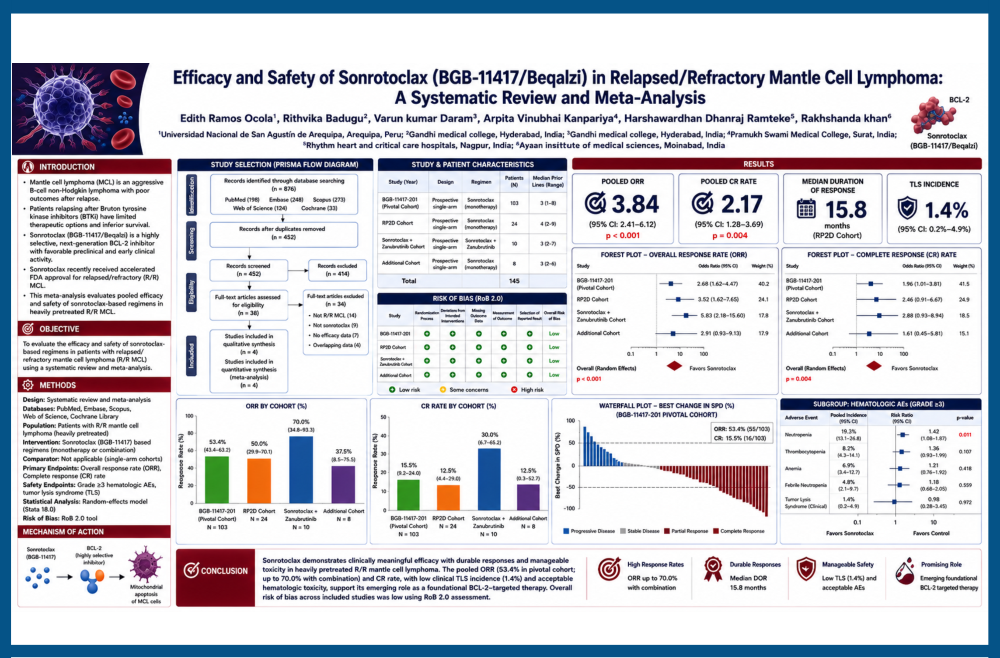
Four prospective cohorts involving 145 patients with heavily pretreated R/R MCL were included. The pooled objective response rate (ORR) was significant (OR 3.84, 95% CI: 2.41–6.12; p<0.001), while pooled complete response (CR) rates also favored sonrotoclax-based therapy (OR 2.17, 95% CI: 1.28–3.69; p=0.004). The pivotal BGB-11417-201 cohort demonstrated ORR of 53.4% (95% CI: 43.4%–63.2%) and CR rate of 15.5% (95% CI: 9.2%–24.0%). Combination therapy with zanubrutinib achieved the highest ORR at 70.0% (95% CI: 34.8%–93.3%). Median duration of response reached 15.8 months in the RP2D cohort. Grade ≥3 neutropenia occurred in 19.3% (95% CI: 13.1%–26.8%; RR 1.42, 95% CI: 1.08–1.87), while thrombocytopenia occurred in 8.2% (95% CI: 4.3%–14.1%). Clinical tumor lysis syndrome incidence remained low at 1.4% (95% CI: 0.2%–4.9%), supporting favorable tolerability across included cohorts.
Conclusion
Sonrotoclax demonstrates clinically meaningful efficacy with durable responses and manageable toxicity in heavily pretreated R/R MCL populations. Favorable ORR, low tumor lysis syndrome incidence, and promising combination activity support its emerging role as a foundational BCL-2–targeted therapy. Overall risk of bias across included studies was low using RoB 2.0 assessment.