1,267 posters, 47 videos, 13 topics, 4 sessions, 853 authors
ePostersLive by SciGen Technologies S.A. All rights reserved.
SOHO 2026 Annual Meeting
September 9 - 12, 2026 | George R. Brown Convention Center, Houston, Texas

MDS - 1364
Racial Disparities in Age at Leukemic Transformation and Temporal Progression Patterns in Myelodysplastic Syndromes: A SEER 18 Population-Based Analysis
Poster Presenter
Authors
Part of Topic
Myelodysplastic Syndromes (MDS)
Background
• Myelodysplastic syndromes (MDS) are clonal hematopoietic disorders that carry a variable risk of
transformation to acute myeloid leukemia (AML) — the primary driver of disease-related mortality.
• Whether the incidence, age at transformation, and temporal latency of leukemic progression differ
systematically by race and ethnicity remains poorly characterized.
• Current risk-stratification tools are race-agnostic, and may therefore underestimate transformation
risk in minority populations who progress earlier in life.
• Characterizing these disparities is a prerequisite for equitable, biologically informed surveillance
and treatment planning.
Methods
• Retrospective population-based cohort study using the SEER 18 database (2000–2023), including all
patients aged ≥20 years with a confirmed diagnosis of MDS.
• Leukemic transformation was defined as a subsequent AML diagnosis per HAEMARC multiple-primary
rules.
• Race/ethnicity was classified into five groups: Non-Hispanic White (NHW), Non-Hispanic Black (NHB),
Hispanic, Asian/Pacific Islander (API), and American Indian/Alaska Native (AI/AN).
• We examined mean age at transformation, the young-onset (<50 years) subgroup, and progression
latency across nine pre-specified intervals (0 to 120+ months).
• Group differences in age at transformation were compared statistically, and NHW latency phases were
characterized to describe the temporal course of progression.
Results
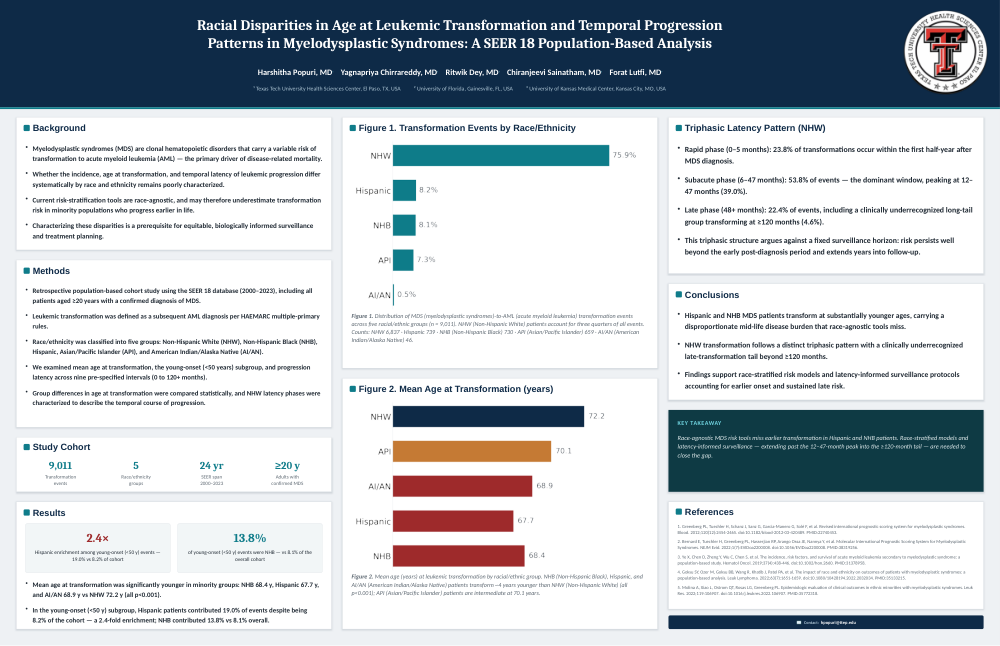
• Mean age at transformation was significantly younger in minority groups: NHB 68.4 y, Hispanic 67.7 y,
and AI/AN 68.9 y vs NHW 72.2 y (all p<0.001).
• In the young-onset (<50 y) subgroup, Hispanic patients contributed 19.0% of events despite being
8.2% of the cohort — a 2.4-fold enrichment; NHB contributed 13.8% vs 8.1% overall.
Triphasic Latency Pattern (NHW)
• Rapid phase (0–5 months): 23.8% of transformations occur within the first half-year after
MDS diagnosis.
• Subacute phase (6–47 months): 53.8% of events — the dominant window, peaking at 12–
47 months (39.0%).
• Late phase (48+ months): 22.4% of events, including a clinically underrecognized long-tail
group transforming at ≥120 months (4.6%).
• This triphasic structure argues against a fixed surveillance horizon: risk persists well
beyond the early post-diagnosis period and extends years into follow-up.
Conclusions
• Hispanic and NHB MDS patients transform at substantially younger ages, carrying a
disproportionate mid-life disease burden that race-agnostic tools miss.
• NHW transformation follows a distinct triphasic pattern with a clinically underrecognized
late-transformation tail beyond ≥120 months.
• Findings support race-stratified risk models and latency-informed surveillance protocols
accounting for earlier onset and sustained late risk.