1,267 posters, 47 videos, 13 topics, 4 sessions, 853 authors
ePostersLive by SciGen Technologies S.A. All rights reserved.
SOHO 2026 Annual Meeting
September 9 - 12, 2026 | George R. Brown Convention Center, Houston, Texas

MM - 1330
Prophylactic Tocilizumab To Reduce the Risk of CRS and ICANS in Patients With Relapsed/Refractory Multiple Myeloma Treated With Elranatamab
Poster Presenter
Authors
Part of Topic
Multiple Myeloma (MM)
INTRODUCTION
•Cytokine release syndrome (CRS) and immune effector cell-associated neurotoxicity syndrome (ICANS) are potentially fatal toxicities of bispecific antibody (BsAb) therapy.
•Elranatamab is a BCMA-directed BsAb requiring step-up dosing, the period of highest CRS risk.
•Prophylactic tocilizumab, an IL-6 receptor antagonist, may mitigate these toxicities and enable outpatient step-up dosing.
•Strategies that reduce CRS and ICANS may lower morbidity and mortality.
AIM
•Examine survival outcomes and complications in patients treated with elranatamab with and without prophylactic tocilizumab.
•Primary outcomes: Rates of CRS and ICANS
•Secondary outcomes: Overall survival, infection, treatment delay, and treatment discontinuation
METHOD
•Retrospective cohort of 86 patients receiving elranatamab step-up dosing at Moffitt Cancer Center, Oct 2023 – Mar 2026.
•Patients treated in both inpatient and outpatient settings.
•42 (49%) received prophylactic tocilizumab prior to step-up dosing.
•CRS and ICANS graded by ASTCT consensus criteria.
•Fisher exact tests, Kaplan–Meier with log-rank, and Cox regression (R 4.5.0).
CONCLUSIONS
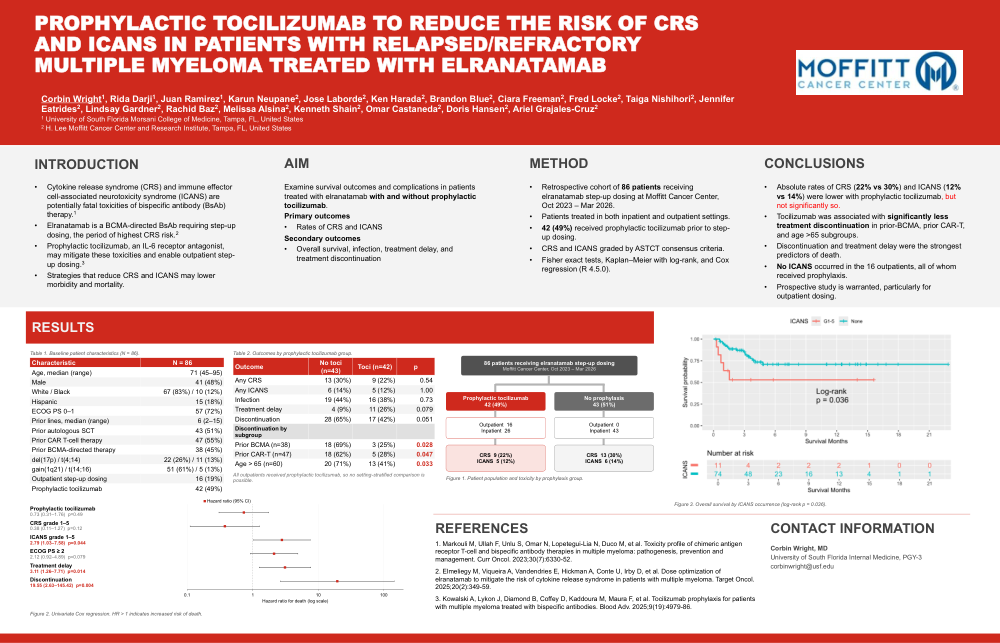
•Absolute rates of CRS (22% vs 30%) and ICANS (12% vs 14%) were lower with prophylactic tocilizumab, but not significantly so.
•Tocilizumab was associated with significantly less treatment discontinuation in prior-BCMA, prior CAR-T, and age >65 subgroups.
•Discontinuation and treatment delay were the strongest predictors of death.
•No ICANS occurred in the 16 outpatients, all of whom received prophylaxis.
•Prospective study is warranted, particularly for outpatient dosing.