1,267 posters, 47 videos, 13 topics, 4 sessions, 853 authors
ePostersLive by SciGen Technologies S.A. All rights reserved.
SOHO 2026 Annual Meeting
September 9 - 12, 2026 | George R. Brown Convention Center, Houston, Texas

CLL - 1218
The Impact of BTK Inhibitors in a Rare Familial Chronic Lymphocytic Leukemia Cluster: A Case Series
Poster Presenter
Authors
Part of Topic
Chronic Lymphocytic Leukemia (CLL)
The Impact of BTK Inhibitors in a Rare Familial Chronic Lymphocytic Leukemia Cluster: A Case Series
Abstract
Context
Familial chronic lymphocytic leukemia (CLL) is a recognized entity, but the occurrence of four affected individuals within a single family is exceptionally rare. This cluster highlights differences in clinical trajectories dictated by therapeutic access.
Objective
Characterize the clinical heterogeneity and outcomes of an exceptionally rare familial CLL cluster, specifically evaluating the survival impact of Bruton tyrosine kinase inhibitor (BTKi) availability.
Design
Retrospective familial case series evaluating longitudinal patient outcomes from August 2017 to May 2026, with up to 105 months of follow-up.
Setting
Institutional tertiary referral center (Yeolyan Hematology and Oncology Center) providing specialized hematological care in Armenia.
Patients or Other Participants
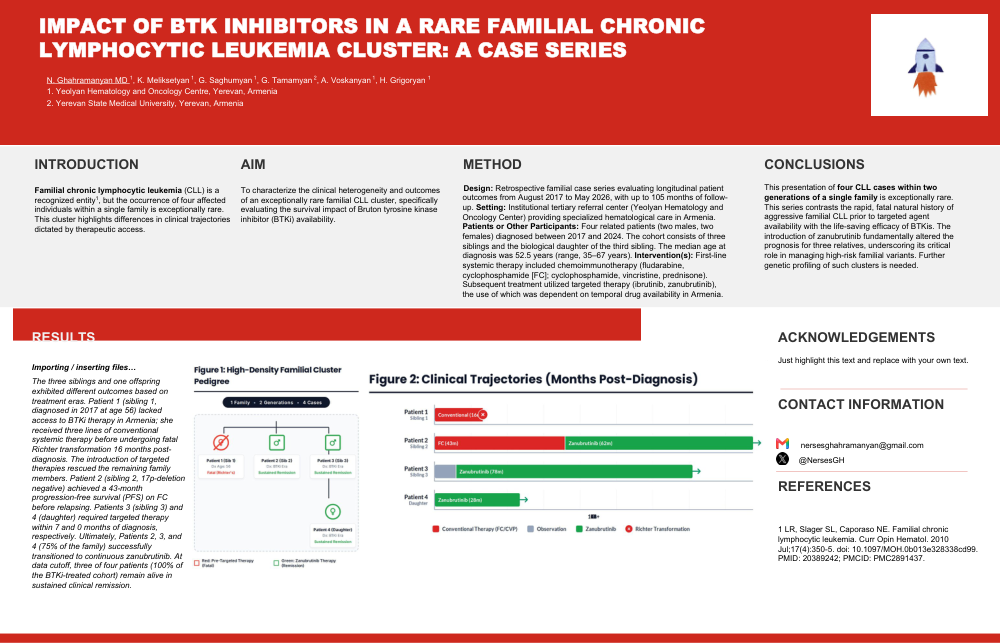
Four related patients (two males, two females) diagnosed between 2017 and 2024. The cohort consists of three siblings and the biological daughter of the third sibling. The median age at diagnosis was 52.5 years (range, 35–67 years).
Intervention(s)
First-line systemic therapy included chemoimmunotherapy (fludarabine, cyclophosphamide [FC]; cyclophosphamide, vincristine, prednisone). Subsequent treatment utilized targeted therapy (ibrutinib, zanubrutinib), the use of which was dependent on temporal drug availability in Armenia.
Results
The three siblings and one offspring exhibited different outcomes based on treatment eras. Patient 1 (sibling 1, diagnosed in 2017 at age 56) lacked access to BTKi therapy in Armenia; she received three lines of conventional systemic therapy before undergoing fatal Richter transformation 16 months post-diagnosis. The introduction of targeted therapies rescued the remaining family members. Patient 2 (sibling 2, 17p-deletion negative) achieved a 43-month progression-free survival (PFS) on FC before relapsing. Patients 3 (sibling 3) and 4 (daughter) required targeted therapy within 7 and 0 months of diagnosis, respectively. Ultimately, Patients 2, 3, and 4 (75% of the family) successfully transitioned to continuous zanubrutinib. At data cutoff, three of four patients (100% of the BTKi-treated cohort) remain alive in sustained clinical remission.
Conclusions
The presentation of four CLL cases within two generations of a single family is exceptionally rare. This series contrasts the rapid, fatal natural history of aggressive familial CLL prior to targeted agent availability with the life-saving efficacy of BTKis. The introduction of zanubrutinib fundamentally altered the prognosis for three relatives, underscoring its critical role in managing high-risk familial variants. Further genetic profiling of such clusters is warranted.
Keywords
CLL, BTKi, limited resources