1,267 posters, 47 videos, 13 topics, 4 sessions, 853 authors
ePostersLive by SciGen Technologies S.A. All rights reserved.
SOHO 2026 Annual Meeting
September 9 - 12, 2026 | George R. Brown Convention Center, Houston, Texas

MDS - 1210
Whole Genome Sequencing of Patients with Myelodysplastic Syndrome Uncovers Novel, Clinically Relevant Biomarkers Missed by Standard Of Care Methods
Poster Presenter
Authors
Part of Topic
Myelodysplastic Syndromes (MDS)
Background:
- Genomic analysis is essential for accurate diagnosis and risk stratification of myeloid malignancies.
- Whole genome sequencing (WGS) can capture a breadth of alterations, augmenting and potentially replacing current profiling.
- Traditional diagnostic techniques such as targeted next generation sequencing (NGS), chromosomal banding, FISH, and OGM (optical genome mapping) are standard of care (SOC) methods for diagnostic/prognostic workup for MDS patients.
- This study validated the molecular findings of the Tempus xH WGS assay against SOC diagnostic results from MDACC.
Methods:
Bioinformatic Filtering & Inclusion Criteria
- SNV/Indels
- Copy Number Alterations (CNAs): > 5 Mb in size.
- Structural Variants (SVs): Included if they overlapped orthogonal truth or represented recurrent myeloid fusions.
- Cytogenetic Quality: Minimum > 10 metaphases required for SOC comparison and composite karyotype calls not included.
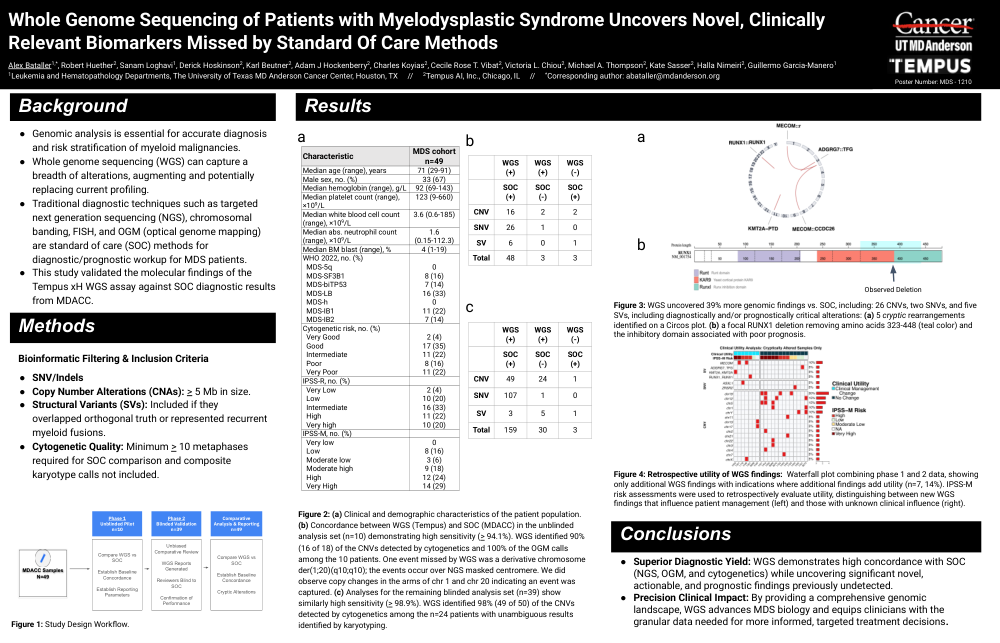
Figure 1: Study Design Workflow.
Results:
Figure 2: (a) Clinical and demographic characteristics of the patient population. (b) Concordance between WGS (Tempus) and SOC (MDACC) in the unblinded analysis set (n=10) demonstrating high sensitivity (> 94.1%). WGS identified 90% (16 of 18) of the CNVs detected by cytogenetics and 100% of the OGM calls among the 10 patients. One event missed by WGS was a derivative chromosome der(1;20)(q10;q10); the events occur over NGS masked centromere. We did observe copy changes in the arms of chr 1 and chr 20 indicating an event was captured. (c) Analyses for the remaining blinded analysis set (n=39) show similarly high sensitivity (> 98.9%). WGS identified 98% (49 of 50) of the CNVs detected by cytogenetics among the n=24 patients with unambiguous results identified by karyotyping.
Figure 3: WGS uncovered 39% more genomic findings vs. SOC, including: 26 CNVs, two SNVs, and five SVs, including diagnostically and/or prognostically critical alterations: (a) 5 cryptic rearrangements identified on a Circos plot. (b) a focal RUNX1 deletion removing amino acids 323-448 (teal color) and the inhibitory domain associated with poor prognosis.
Figure 4: Retrospective utility of WGS findings: Waterfall plot combining phase 1 and 2 data, showing only additional WGS findings with indications where additional findings add utility (n=7, 14%). IPSS-M risk assessments were used to retrospectively evaluate utility, distinguishing between new WGS findings that influence patient management (left) and those with unknown clinical influence (right).
Conclusions:
- Superior Diagnostic Yield: WGS demonstrates high concordance with SOC (NGS, OGM, and cytogenetics) while uncovering significant novel, actionable, and prognostic findings previously undetected.
- Precision Clinical Impact: By providing a comprehensive genomic landscape, WGS advances MDS biology and equips clinicians with the granular data needed for more informed, targeted treatment decisions.