1,267 posters, 47 videos, 13 topics, 4 sessions, 853 authors
ePostersLive by SciGen Technologies S.A. All rights reserved.
SOHO 2026 Annual Meeting
September 9 - 12, 2026 | George R. Brown Convention Center, Houston, Texas

CLL - 1068
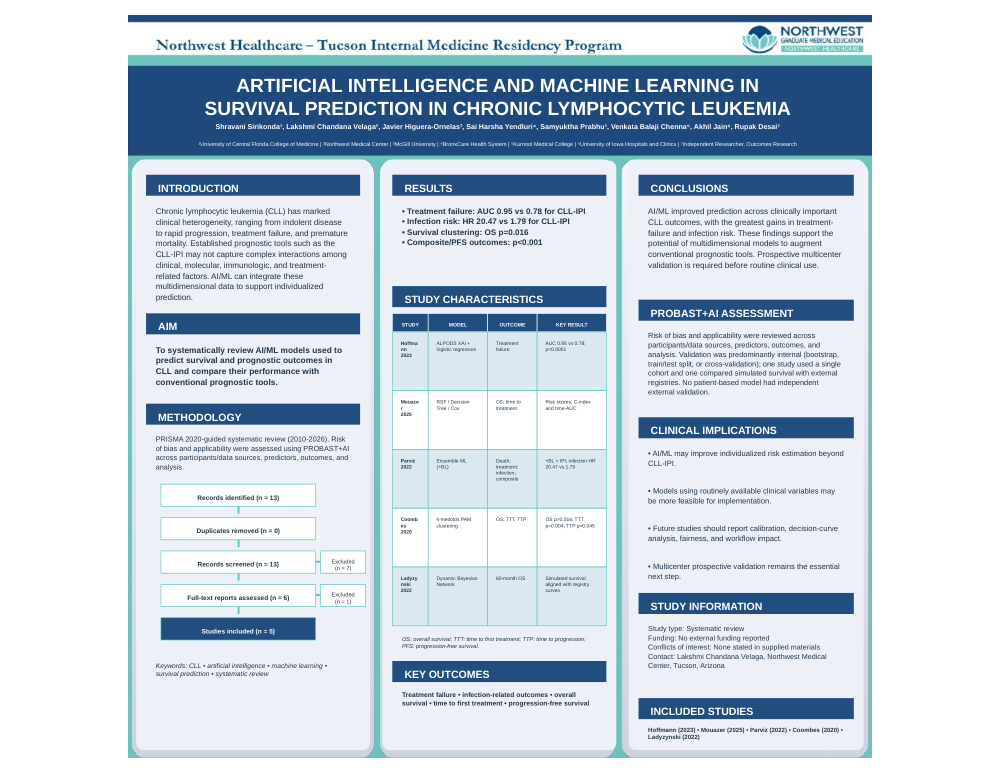
Artificial Intelligence and Machine Learning in Survival Prediction in Chronic Lymphocytic Leukemia: A Systematic Review of Predictive Modeling Approaches
Poster Presenter
Authors
Part of Topic
Chronic Lymphocytic Leukemia (CLL)
INTRODUCTION
Chronic lymphocytic leukemia (CLL) has marked
clinical heterogeneity, ranging from indolent disease
to rapid progression, treatment failure, and premature
mortality. Established prognostic tools such as the
CLL-IPI may not capture complex interactions among
clinical, molecular, immunologic, and treatment-
related factors. AI/ML can integrate these
multidimensional data to support individualized
prediction.
AIM
To systematically review AI/ML models used to
predict survival and prognostic outcomes in
CLL and compare their performance with
conventional prognostic tools.
METHODOLOGY
PRISMA 2020-guided systematic review (2010-2026). Risk
of bias and applicability were assessed using PROBAST+AI
across participants/data sources, predictors, outcomes, and
analysis.
Records identified (n = 13)
Duplicates removed (n = 0)
Records screened (n = 13)
Excluded
(n = 7)
Full-text reports assessed (n = 6)
Excluded
(n = 1)
Studies included (n = 5)
Keywords: CLL • artificial intelligence • machine learning •
survival prediction • systematic review
RESULTS
• Treatment failure: AUC 0.95 vs 0.78 for CLL-IPI
• Infection risk: HR 20.47 vs 1.79 for CLL-IPI
• Survival clustering: OS p=0.016
• Composite/PFS outcomes: p<0.001
STUDY CHARACTERISTICS
STUDY MODEL OUTCOME KEY RESULT
Hoffma
nn
2023
ALPODS XAI +
logistic regression
Treatment
failure
AUC 0.95 vs 0.78;
p<0.0001
Mouaze
r
RSF / Decision
Tree / Cox
OS; time to
treatment
Risk scores; C-index
and time-AUC
2025
Parviz
2022
Ensemble ML
(+BL)
Death;
treatment;
infection;
composite
+BL > IPI; infection HR
20.47 vs 1.79
Coomb
es
2020
k-medoids PAM
clustering
OS; TTT; TTP OS p=0.016; TTT
p=0.004; TTP p=0.045
Ladyzy
nski
2022
Dynamic Bayesian
Network
60-month OS Simulated survival
aligned with registry
curves
OS: overall survival; TTT: time to first treatment; TTP: time to progression;
PFS: progression-free survival.
KEY OUTCOMES
Treatment failure • infection-related outcomes • overall
survival • time to first treatment • progression-free survival
CONCLUSIONS
AI/ML improved prediction across clinically important
CLL outcomes, with the greatest gains in treatment-
failure and infection risk. These findings support the
potential of multidimensional models to augment
conventional prognostic tools. Prospective multicenter
validation is required before routine clinical use.
PROBAST+AI ASSESSMENT
Risk of bias and applicability were reviewed across
participants/data sources, predictors, outcomes, and
analysis. Validation was predominantly internal (bootstrap,
train/test split, or cross-validation); one study used a single
cohort and one compared simulated survival with external
registries. No patient-based model had independent
external validation.
CLINICAL IMPLICATIONS
• AI/ML may improve individualized risk estimation beyond
CLL-IPI.
• Models using routinely available clinical variables may
be more feasible for implementation.
• Future studies should report calibration, decision-curve
analysis, fairness, and workflow impact.
• Multicenter prospective validation remains the essential
next step.
STUDY INFORMATION
Study type: Systematic review
Funding: No external funding reported
Conflicts of interest: None stated in supplied materials
Contact: Lakshmi Chandana Velaga, Northwest Medical
Center, Tucson, Arizona
INCLUDED STUDIES
Hoffmann (2023) • Mouazer (2025) • Parviz (2022) • Coombes (2020) •
Ladyzynski (2022)