1,267 posters, 47 videos, 13 topics, 4 sessions, 853 authors
ePostersLive by SciGen Technologies S.A. All rights reserved.
SOHO 2026 Annual Meeting
September 9 - 12, 2026 | George R. Brown Convention Center, Houston, Texas

CLL - 951
Peripheral Blood Inflammatory Markers as Prognostic Indicators in Chronic Lymphocytic Leukemia
Poster Presenter
Authors
Part of Topic
Chronic Lymphocytic Leukemia (CLL)
TITLE
Peripheral Blood Inflammatory Markers as Prognostic Indicators in CHRONIC LYMPHOCYTIC LEUKEMIA
INTRODUCTION
Chronic lymphocytic leukemia (CLL) is shaped by interactions between leukemic cells and the tumor microenvironment. Peripheral blood inflammatory markers are simple, low-cost surrogates of systemic inflammation that may help guide treatment decisions
With BTK inhibitors now used across multiple lines of CLL therapy, identifying routinely available biomarkers that flag patients at higher risk of early progression is clinically relevant.
AIM
In CLL/SLL patients treated with BTK inhibitors, to evaluate whether pre-treatment inflammatory markers — NMR (ANC/AMC), RDW/albumin ratio, and ESR — are associated with:
- time from diagnosis to BTK inhibitor initiation (TTFT),
- progression-free survival (PFS) on BTK therapy,
- overall survival (OS).
METHODS
Retrospective, single-center cohort study.
Two-step, retrospective design. Two dedicated, partially overlapping databases were analyzed sequentially.
Step 1 — Population-level analysis (TTFT). The full first-line cohort (n=110), including all first-line regimens (BTK inhibitors, chemoimmunotherapy, BCL2i-based combinations), was used to test whether inflammatory markers at diagnosis (NMR, CD4/CD8 ratio, RDW/albumin, ESR) were associated with time to first treatment (TTFT), by Spearman correlation.
Step 2 — BTKi subgroup analysis (PFS/OS). Within the subgroup of patients treated with a BTK inhibitor at any line (n=134), the same markers were re-evaluated for their association with progression-free survival (PFS) and overall survival (OS) on BTK therapy, using ROC-derived cut-offs (Youden index) at the 12-month landmark.
This sequential design first characterizes TTFT determinants at the population level, then focuses on the BTKi-treated subgroup to test whether the same markers also carry prognostic value for PFS/OS.
RESULTS
STEP 1 — TTFT IN THE FULL FIRST-LINE POPULATION (n=110)
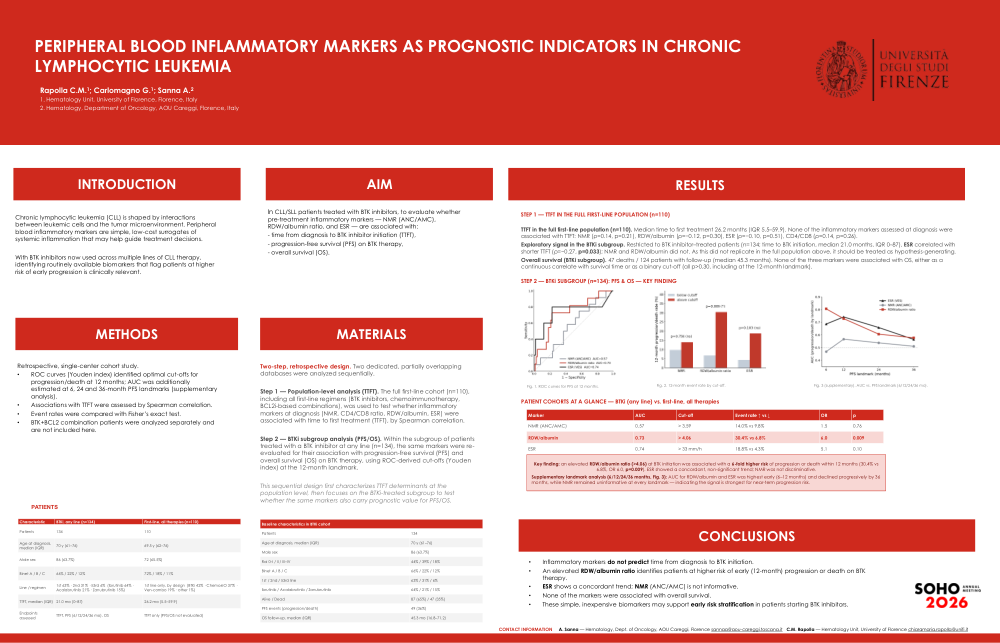
TTFT in the full first-line population (n=110). Median time to first treatment 26.2 months (IQR 5.5–59.9). None of the inflammatory markers assessed at diagnosis were associated with TTFT: NMR (ρ=0.14, p=0.21), RDW/albumin (ρ=−0.12, p=0.30), ESR (ρ=−0.10, p=0.51), CD4/CD8 (ρ=0.14, p=0.26).
Exploratory signal in the BTKi subgroup. Restricted to BTK inhibitor–treated patients (n=134; time to BTK initiation, median 21.0 months, IQR 0–87), ESR correlated with shorter TTFT (ρ=−0.27, p=0.033); NMR and RDW/albumin did not. As this did not replicate in the full population above, it should be treated as hypothesis-generating.
Overall survival (BTKi subgroup). 47 deaths / 124 patients with follow-up (median 45.3 months). None of the three markers were associated with OS, either as a continuous correlate with survival time or as a binary cut-off (all p>0.30, including at the 12-month landmark).
STEP 2 — BTKi SUBGROUP (n=134): PFS & OS — KEY FINDING -
PATIENT COHORTS AT A GLANCE — BTKi (any line) vs. first-line, all therapies
Key finding: an elevated RDW/albumin ratio (>4.06) at BTK initiation was associated with a 6-fold higher risk of progression or death within 12 months (30.4% vs 6.8%, OR 6.0, p=0.009). ESR showed a concordant, non-significant trend; NMR was not discriminative.
Supplementary landmark analysis (6/12/24/36 months, Fig. 3): AUC for RDW/albumin and ESR was highest early (6–12 months) and declined progressively by 36 months, while NMR remained uninformative at every landmark — indicating the signal is strongest for near-term progression risk.
CONCLUSIONS