1,267 posters, 47 videos, 13 topics, 4 sessions, 853 authors
ePostersLive by SciGen Technologies S.A. All rights reserved.
SOHO 2026 Annual Meeting
September 9 - 12, 2026 | George R. Brown Convention Center, Houston, Texas

MM - 919
Identification of Predictive Factors for Severe Infections in Multiple Myeloma: A Risk Model Development at a Tertiary Care Center
Poster Presenter
Part of Topic
Multiple Myeloma (MM)
IDENTIFICATION OF PREDICTIVE FACTORS FOR SEVERE INFECTION IN MULTIPLE MYELOMA: A RISK MODEL DEVELOPMENT AT TERTIARY CARE CENTER
M.F. MONTES-RODRIGUEZ1, A.OROZCO-COLLAZO1, S.BURGOS-CANALES1 and A.SANCHEZ-RODRIGUEZ2
1. Department of Hematology, Hospital Juarez de Mexico, Mexico City, Mexico
2. Department of Internal Medicine, Centro Medico ABC, Mexico City, Mexico
INTRODUCTION
Despite remarkable therapeutic advances, infectious complications represent a leading cause of morbidity and non-relapse mortality in Multiple Myeloma (MM). This vulnerability stems from disease-related inmune dysfunction, cumulative immunosuppression from sequential therapies and host factors.
As survival improves and treatment strategies become increasingly complex, identifying high risk patients for severe infections remains a critical challenge, limited by a lack of objective, biomarker – based predictive tools beyond mere clinical judgment.
AIM
To identify predictive factors of severe infection by assessing the baseline clinical and microbiological characteristics of Multiple Myeloma patients treated at a tertiary care hospital.
METHODS
Study design: Observational, retrospective and cross-sectional study.
Setting: Tertiary care referral center, Centro Medico ABC, Mexico City, Mexico.
Patients: 75 patients with confirmed MM hospitalized between January 2023 and December 2024.
Primary outcome: Severe infection (CTCAE grade >4, version 5.0).
Statistical analysis: Associations were evaluated via uni/multivariate logistic regression (ORs). CRP discrimination and model performance were assessed using ROC-AUC curves, sensitivity, specificity, accuracy, and Nagelkerke R2.
RESULTS
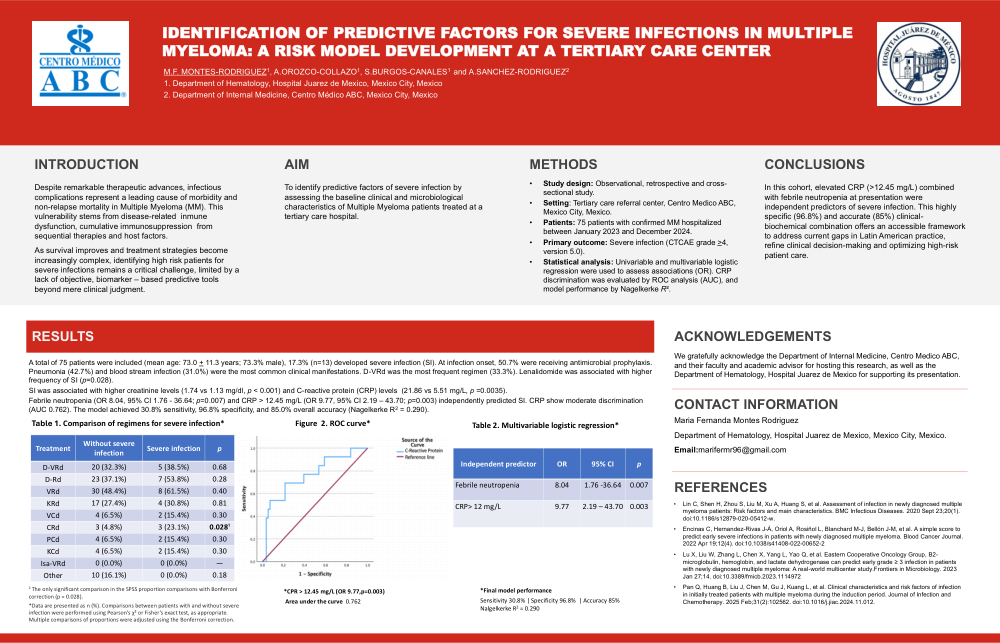
Cohort: A total of 75 patients were included, 17.3% (n=13) developed sever infection. The mean age 70.0 + 11.3 years; 73.3% male. At infection onset, 50.7% were receiving antimicrobial prophylaxis, and pneumonia (40.5%) along with bacteremia (31.0%)were the primary manifestations. D-VRd was the most frequent regimen (33.3%), notably, lenalidomide treatment show a trend toward severe infection (100% vs 70%, p=0.066), while CRd correlated with increased severe episodes (p=0.028).
Univariate Analysis: In the comparative analysis, severe infection cases presented significantly higher mean creatinine levels (1.74 vs 1.13 mg/dl, p < 0.001) as well as markedly elevated CRP (21.86 vs 5.51 mg/L, p=0.0035).
Multivariable Model: After adjustments, febrile neutropenia (OR 8.04, 95% CI 1.76-36.64; p=0.007) and CRP > 12.45 mg/L (OR 9.77, 95% CI 2.19 – 43.70;-p=0.003) independently predicted severe infection. Additionally, CRP discrimination yielded an AUC of 0.762. The final predictive model demonstrated 30.8% sensitivity, 96.8% specificity, and 85.0% overall accuracy (Nagelkerke R2 0.290).
CONCLUSIONS
In this cohort, elevated CRP (>12.45 mg/L) combined with febrile neutropenia at presentation were independent predictors of severe infection. This highly specific (96.8%) and accurate (85%) clinical-biochemical combination offers an accessible framework to address current gaps in Latin American practice, refine clinical decision-making and optimizing high-risk patient care.