1,267 posters, 47 videos, 13 topics, 4 sessions, 853 authors
ePostersLive by SciGen Technologies S.A. All rights reserved.
SOHO 2026 Annual Meeting
September 9 - 12, 2026 | George R. Brown Convention Center, Houston, Texas

MM - 915
Comparative Outcomes of CD38 Antibody-Containing Four-Drug Induction Strategies vs Standard Triplet Therapy in High-Risk Newly Diagnosed Multiple Myeloma: A Systematic Review and Meta-Analysis
Poster Presenter
Authors
Part of Topic
Multiple Myeloma (MM)
Comparative Outcomes of CD38 Antibody-Containing Four-Drug Induction Strategies Versus Standard Triplet Therapy in High-Risk Newly Diagnosed Multiple Myeloma: A Systematic Review and Meta-Analysis
1Jasvindar Kumar, 2Manohar Lal, 3Vinesh Kumar, 4Jaish Kumar, 5Medhansh Biradar, 6Imandi Venkata Lakshmi, 7Fnu Raja
1Bassett Medical Center, Cooperstown, NY, USA; 2Trinity Health Oakland/Wayne State University, Michigan, USA; 3Saint Micheal Medical Center, Newark, New Jersey, USA; 4Piedmont Augusta Hospital, Georgia, USA; 5All India Institute of Medical Sciences, Raipur, Chhattisgarh, India; 6All India Institute of Medical Sciences, Raipur, Chhattisgarh, India; 7Federal Medical and Dental College, Islamabad, Pakistan.
Keywords: CD38, Antibody, Therapy, Outcomes, Myeloma
Background: CD38 monoclonal antibody (mAb)-based quadruplet regimens have become a standard induction strategy for newly diagnosed multiple myeloma (NDMM). However, their benefit in patients with high-risk cytogenetic abnormalities remains uncertain. This systematic review and meta-analysis evaluated the efficacy of CD38 mAb-based quadruplet regimens compared with conventional triplet regimens in NDMM patients with high-risk cytogenetics.
Methods: A systematic search of PubMed, EMBASE, and the Cochrane Library was conducted for randomized controlled trials (RCTs) published through October 2025. Eligible studies included NDMM patients with high-risk cytogenetic abnormalities receiving CD38 mAb-based quadruplet therapy versus triplet regimens. Primary outcomes were measurable residual disease (MRD) negativity at the 10^-5 threshold and progression-free survival (PFS). Odds ratios (ORs) and hazard ratios (HRs) with 95% confidence intervals (CIs) were pooled using random-effects models. Subgroup and sensitivity analyses were performed according to CD38 mAb type and transplant eligibility.
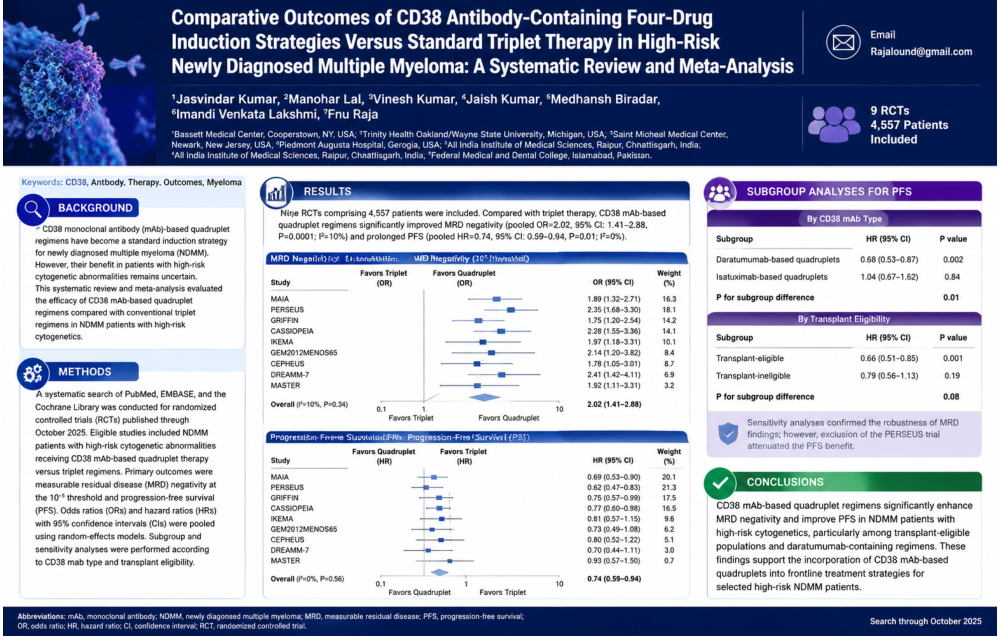
Results: Nine RCTs comprising 4,557 patients were included. Compared with triplet therapy, CD38 mAb-based quadruplet regimens significantly improved MRD negativity (pooled OR=2.02, 95% CI: 1.41–2.88, P=0.0001; I²=10%) and prolonged PFS (pooled HR=0.74, 95% CI: 0.59–0.94, P=0.01; I²=0%). Subgroup analysis demonstrated that daratumumab-based quadruplets were associated with improved PFS, whereas isatuximab-based regimens did not achieve a significant PFS advantage (HR=1.04, 95% CI: 0.67–1.62, P=0.84). Similarly, transplant-eligible patients derived greater benefit from quadruplet therapy, while no significant PFS improvement was observed among transplant-ineligible patients (HR=0.79, 95% CI: 0.56–1.13, P=0.19). Sensitivity analyses confirmed the robustness of MRD findings; however, exclusion of the PERSEUS trial attenuated the PFS benefit.
Conclusions: CD38 mAb-based quadruplet regimens significantly enhance MRD negativity and improve PFS in NDMM patients with high-risk cytogenetics, particularly among transplant-eligible populations and daratumumab-containing regimens. These findings support the incorporation of CD38 mAb-based quadruplets into frontline treatment strategies for selected high-risk NDMM patients.