1,267 posters, 47 videos, 13 topics, 4 sessions, 853 authors
ePostersLive by SciGen Technologies S.A. All rights reserved.
SOHO 2026 Annual Meeting
September 9 - 12, 2026 | George R. Brown Convention Center, Houston, Texas

CLL - 888
Efficacy and Safety of CAR T-Cell Therapy in Relapsed/Refractory Chronic Lymphocytic Leukemia: A Systematic Review and Meta-analysis
Poster Presenter
Authors
Part of Topic
Chronic Lymphocytic Leukemia (CLL)
Efficacy and Safety of CAR-T Therapy in Relapsed/Refractory Chronic Lymphocytic Leukemia: A Systematic Review and Meta-Analysis
Abstract
Background
Patients with relapsed/refractory (R/R) chronic lymphocytic leukemia (CLL) progressing after BTK and BCL-2 inhibitors have poor outcomes and limited treatment options. Chimeric antigen receptor T-cell (CAR-T) therapy has shown promise in B-cell malignancies, but its role in CLL remains under investigation.
Methods
PubMed/MEDLINE and major oncology conference proceedings (American Society of Hematology; American Society of Clinical Oncology) through 2025 were systematically reviewed for studies evaluating CAR-T therapy in adults with R/R CLL/small lymphocytic lymphoma. Random-effects meta-analysis was performed to obtain the pooled objective response rate and the complete remission/complete remission with incomplete marrow recovery (CR/CRi) rate. Survival and safety outcomes were summarized descriptively.
Results
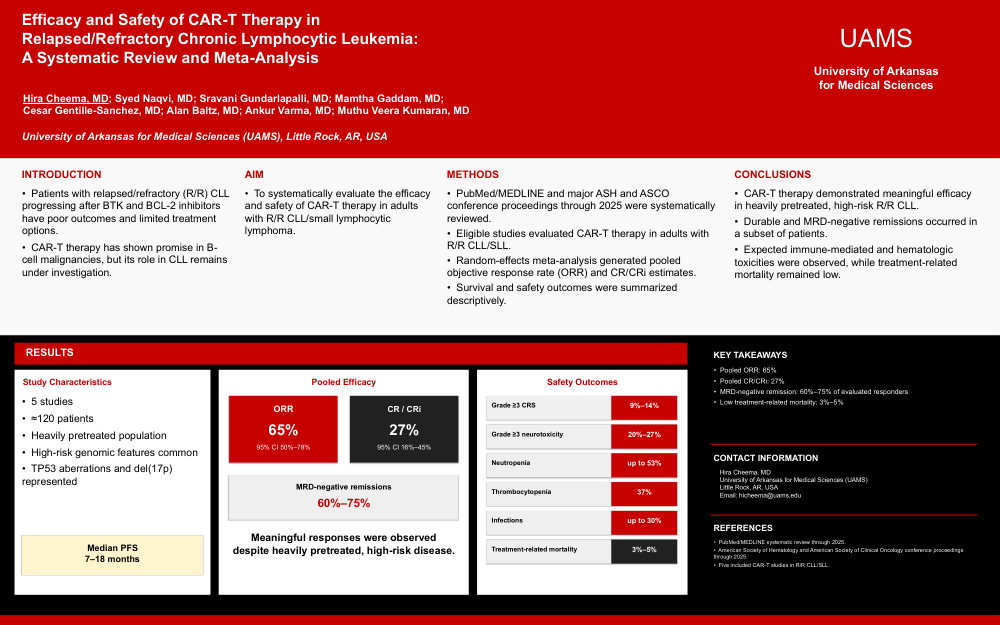
Five studies, including approximately 120 patients, were analyzed. Most patients were heavily pretreated and had high-risk genomic features, including TP53 aberrations and del(17p). The pooled objective response rate was 65% (95% CI, 50%–78%), and the pooled CR/CRi rate was 27% (95% CI, 16%–45%). MRD-negative remissions were achieved in 60% to 75% of evaluated responders. Median progression-free survival ranged from 7 to 18 months. Grade 3 or higher cytokine release syndrome occurred in 9% to 14% of patients, and grade 3 or higher neurotoxicity occurred in 20% to 27% of patients. Treatment-related mortality was uncommon (3% to 5%). Common grade 3 or higher adverse events included neutropenia (up to 53%), thrombocytopenia (37%), and infections (up to 30%).
Conclusions
CAR-T therapy demonstrated meaningful efficacy in heavily pretreated, high-risk R/R CLL, producing durable and MRD-negative remissions in a subset of patients. Although CAR-T therapy was associated with expected immune-mediated and hematologic toxicities, treatment-related mortality was low, supporting continued investigation of CAR-T therapy in CLL.