1,267 posters, 47 videos, 13 topics, 4 sessions, 853 authors
ePostersLive by SciGen Technologies S.A. All rights reserved.
SOHO 2026 Annual Meeting
September 9 - 12, 2026 | George R. Brown Convention Center, Houston, Texas

MM - 878
Rising Fall- and Fracture-Associated Mortality Despite Declining Overall Multiple Myeloma Mortality in the United States, 2018-2024: National Trends, Fracture-Site Burden, and Disparities
Poster Presenter
Authors
Part of Topic
Multiple Myeloma (MM)
Abstract
Background
Multiple myeloma (MM) is associated with skeletal fragility, osteolytic disease, frailty, and fall risk, yet national
mortality patterns involving falls and fractures remain poorly characterized. We evaluated contemporary United
States trends in fall- and fracture-associated MM mortality, compared them with overall MM-related mortality,
and examined fracture-site burden and demographic and geographic disparities.
Methods
We queried CDC WONDER Multiple Cause of Death single-race final data from 2018–2024. MM-related deaths
were identified by ICD-10 code C90.0 listed anywhere on the death certificate. The primary outcome was fall-
and fracture-associated MM mortality, defined as C90.0 plus any fall code (W00–W19) or fracture code (S02,
S12, S22, S32, S42, S52, S62, S72, S82, S92, T02, T08, T10, T12, or T14.2). Age-adjusted mortality rates (AAMRs)
were reported per 100000 population. Fracture-site analyses evaluated hip/femur (S72), thoracic/rib/sternum
(S22), and lumbar spine/pelvis (S32) fractures.
Results
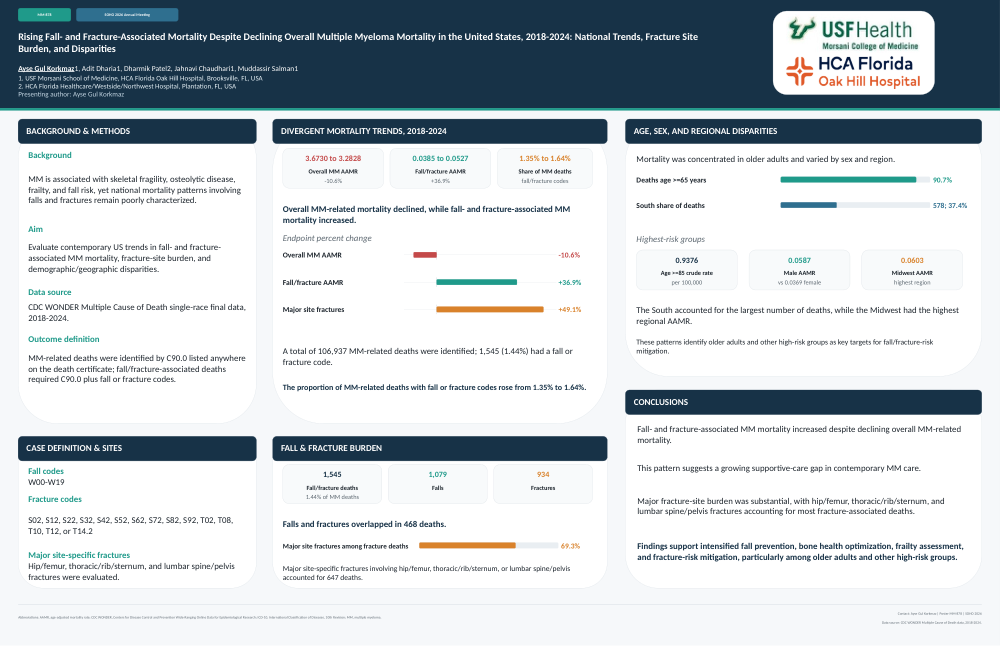
Between 2018 and 2024, 106937 MM-related deaths were identified, of which 1545 (1.44%) had a fall or fracture
code. Overall MM-related AAMR declined from 3.6730 to 3.2828 per 100000 (−10.6%); by contrast, fall- and
fracture-associated MM AAMR increased from 0.0385 to 0.0527 (+36.9%). The proportion of MM-related deaths
with fall or fracture codes rose from 1.35% to 1.64%. Falls were present in 1079 deaths, fractures in 934, and
both in 468. Major site-specific fractures involving the hip/femur, thoracic/rib/sternum, or lumbar spine/pelvis
accounted for 647 deaths, representing 69.3% of fracture-associated deaths; their AAMR increased from 0.0167
to 0.0249 (+49.1%). Mortality was concentrated in older adults, with 90.7% of deaths occurring at age ≥65 years
and the highest crude rate among adults aged ≥85 years (0.9376 per 100000). Male AAMR exceeded female
AAMR (0.0587 vs 0.0369). The Midwest had the highest regional AAMR (0.0603), and the South accounted for
the largest number of deaths (578; 37.4%).
Conclusions
Fall- and fracture-associated MM mortality increased despite declining overall MM-related mortality, suggesting
a growing supportive-care gap in contemporary MM care. These findings support intensified fall prevention,
bone health optimization, frailty assessment, and fracture-risk mitigation, particularly among older adults and
other high-risk groups.
CDC WONDER: Centers for Disease Control and Prevention Wide-Ranging Online Data for Epidemiological
Research, ICD-10: ICD-10: International Classification of Diseases, Tenth Revision
Keywords
MM, skeletal-related events, fracture-associated mortality, fall-related mortality, population-based mortality
trends