1,267 posters, 47 videos, 13 topics, 4 sessions, 853 authors
ePostersLive by SciGen Technologies S.A. All rights reserved.
SOHO 2026 Annual Meeting
September 9 - 12, 2026 | George R. Brown Convention Center, Houston, Texas

CLL - 868
Clinical Outcomes Among Anticoagulated Patients with CLL and Atrial Fibrillation/Flutter Treated with First- Versus Second-Generation BTK Inhibitors
Poster Presenter
Authors
Part of Topic
Chronic Lymphocytic Leukemia (CLL)
Clinical Outcomes Among Anticoagulated Patients with CLL and Atrial Fibrillation/Flutter Treated With First- Versus Second-Generation BTK Inhibitors
Background: Bruton tyrosine kinase inhibitors (BTKi) play a key role in treating chronic lymphocytic leukemia (CLL) but are linked to increased risks of atrial fibrillation/flutter (AF) and bleeding, especially in patients who require oral anticoagulation. There is limited real-world evidence comparing outcomes between anticoagulated CLL patients treated with first-generation and second-generation BTKi.
Methods: This retrospective cohort study leveraged data from the TriNetX Research Network. We identified adults with CLL who had a diagnosis of AF/flutter, were exposed to oral anticoagulants, and received BTKi therapy. Cohort 1 comprised patients who received the first-generation BTKi ibrutinib, while Cohort 2 included those treated with second-generation BTKis (acalabrutinib or zanubrutinib). Eligible oral anticoagulants were apixaban, rivaroxaban, dabigatran, edoxaban, or warfarin. Propensity score matching (1:1) was performed using demographic, clinical, procedural, medication, and laboratory data. Outcomes were assessed from one day after the index event through follow-up. Patients with a prior history of each endpoint were excluded from the corresponding incident outcome analysis.
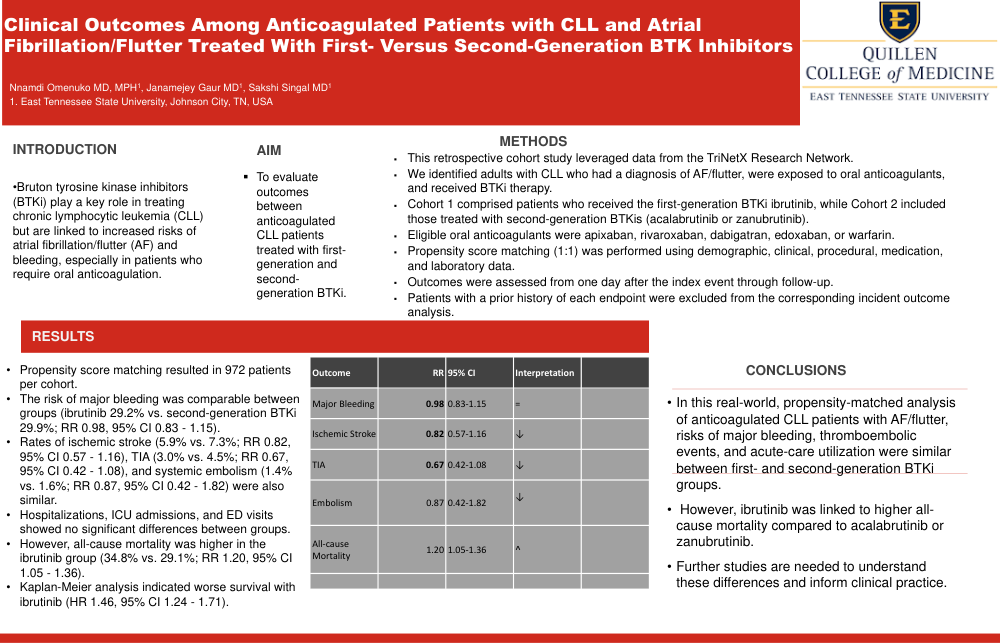
Results: Propensity score matching resulted in 972 patients per cohort. The risk of major bleeding was comparable between groups (ibrutinib 29.2% vs. second-generation BTKi 29.9%; RR 0.98, 95% CI 0.83 - 1.15). Rates of ischemic stroke (5.9% vs. 7.3%; RR 0.82, 95% CI 0.57 - 1.16), TIA (3.0% vs. 4.5%; RR 0.67, 95% CI 0.42 - 1.08), and systemic embolism (1.4% vs. 1.6%; RR 0.87, 95% CI 0.42 - 1.82) were also similar. Hospitalizations, ICU admissions, and ED visits showed no significant differences. However, all-cause mortality was higher in the ibrutinib group (34.8% vs. 29.1%; RR 1.20, 95% CI 1.05 - 1.36). Kaplan-Meier analysis indicated worse survival with ibrutinib (HR 1.46, 95% CI 1.24 - 1.71).
Conclusion: In this real-world, propensity-matched analysis of anticoagulated CLL patients with AF/flutter, risks of major bleeding, thromboembolic events, and acute-care utilization were similar between first- and second-generation BTKi groups. However, ibrutinib was linked to higher all-cause mortality compared to acalabrutinib or zanubrutinib. Further studies are needed to understand these differences and inform clinical practice.