1,267 posters, 47 videos, 13 topics, 4 sessions, 853 authors
ePostersLive by SciGen Technologies S.A. All rights reserved.
SOHO 2026 Annual Meeting
September 9 - 12, 2026 | George R. Brown Convention Center, Houston, Texas

AML - 858
Comparative Toxicity of Menin Inhibitor-Based Combination therapy in newly diagnosed Acute Myeloid Leukemia: Venetoclax-containing Versus Non-Venetoclax regimens
Poster Presenter
Authors
Part of Topic
Acute Myeloid Leukemia (AML)
Background:
Menin inhibitors are combined with venetoclax plus hypomethylating agents or intensive chemotherapy (7+3) in newly diagnosed NPM1-mutant or KMT2A-rearranged acute myeloid leukemia (AML), but comparative toxicity data are limited.
Menin inhibitors are combined with venetoclax plus hypomethylating agents or intensive chemotherapy (7+3) in newly diagnosed NPM1-mutant or KMT2A-rearranged acute myeloid leukemia (AML), but comparative toxicity data are limited.
Methods:
We systematically reviewed published trials, conference abstracts (ASH/EHA 2025), and trial registries of menin inhibitor-based therapy in newly diagnosed AML through May 2026, stratifying by venetoclax-containing versus non-venetoclax backbones. Safety outcomes were extracted using reported denominators. Odds ratios (ORs) with 95% confidence intervals (CIs) were calculated using Fisher's exact test; Haldane-Anscombe continuity correction was applied for zero-event cells.
We systematically reviewed published trials, conference abstracts (ASH/EHA 2025), and trial registries of menin inhibitor-based therapy in newly diagnosed AML through May 2026, stratifying by venetoclax-containing versus non-venetoclax backbones. Safety outcomes were extracted using reported denominators. Odds ratios (ORs) with 95% confidence intervals (CIs) were calculated using Fisher's exact test; Haldane-Anscombe continuity correction was applied for zero-event cells.
Results:
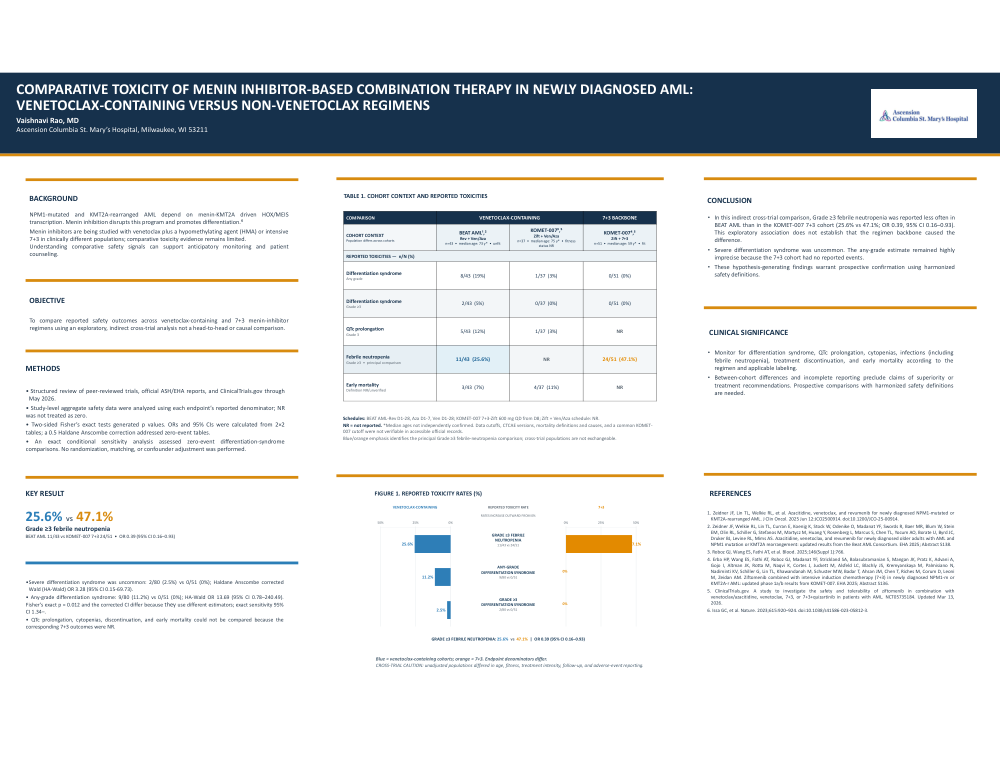
Venetoclax-based regimens: Three studies reported safety data (total enrolled n=205; newly diagnosed n=120). BEAT AML (revumenib + venetoclax + azacitidine, n=43, median age 73 years, unfit for intensive chemotherapy) reported differentiation syndrome 19% any grade, Grade ≥3 in 5% (2/43); QTc prolongation 44% any grade, Grade 3 in 12% (5/43); febrile neutropenia Grade ≥3 in 26% (11/43); treatment discontinuation 0%; early mortality 7% (3/43, sepsis/respiratory failure). KOMET-007 newly diagnosed (ziftomenib + venetoclax + azacitidine, n=37, median age 75 years) reported differentiation syndrome 3% (1/37, Grade 2 only); QTc prolongation Grade 3 in 3% (1/37); discontinuation 5.4% (2/37); early mortality 11% (4/37, predominantly sepsis). Non-venetoclax regimens: KOMET-007 7+3 (ziftomenib + cytarabine/daunorubicin, n=51, median age 59 years, fit patients) reported differentiation syndrome 0%; febrile neutropenia Grade ≥3 in 47% (24/51); QTc prolongation, discontinuation, and early mortality not reported. Statistical comparison (venetoclax-based pooled n=80 vs 7+3 n=51): Differentiation syndrome (any grade) occurred more frequently with venetoclax-based regimens (11.2% [9/80] vs 0%, OR 13.69, 95% CI 0.78–240.49, p=0.012), though zero events in the 7+3 cohort produced a wide confidence interval. Grade ≥3 differentiation syndrome was rare in both groups (2.5% [2/80] vs 0%, OR 3.28, 95% CI 0.15–69.73, p=0.52). Febrile neutropenia (BEAT AML n=43 vs 7+3 n=51) was significantly lower with venetoclax-based therapy (25.6% vs 47.1%, OR 0.39, 95% CI 0.16–0.93, p=0.035). QTc prolongation, cytopenias, discontinuation, and early mortality could not be compared due to incomplete reporting in the 7+3 cohort.
Venetoclax-based regimens: Three studies reported safety data (total enrolled n=205; newly diagnosed n=120). BEAT AML (revumenib + venetoclax + azacitidine, n=43, median age 73 years, unfit for intensive chemotherapy) reported differentiation syndrome 19% any grade, Grade ≥3 in 5% (2/43); QTc prolongation 44% any grade, Grade 3 in 12% (5/43); febrile neutropenia Grade ≥3 in 26% (11/43); treatment discontinuation 0%; early mortality 7% (3/43, sepsis/respiratory failure). KOMET-007 newly diagnosed (ziftomenib + venetoclax + azacitidine, n=37, median age 75 years) reported differentiation syndrome 3% (1/37, Grade 2 only); QTc prolongation Grade 3 in 3% (1/37); discontinuation 5.4% (2/37); early mortality 11% (4/37, predominantly sepsis). Non-venetoclax regimens: KOMET-007 7+3 (ziftomenib + cytarabine/daunorubicin, n=51, median age 59 years, fit patients) reported differentiation syndrome 0%; febrile neutropenia Grade ≥3 in 47% (24/51); QTc prolongation, discontinuation, and early mortality not reported. Statistical comparison (venetoclax-based pooled n=80 vs 7+3 n=51): Differentiation syndrome (any grade) occurred more frequently with venetoclax-based regimens (11.2% [9/80] vs 0%, OR 13.69, 95% CI 0.78–240.49, p=0.012), though zero events in the 7+3 cohort produced a wide confidence interval. Grade ≥3 differentiation syndrome was rare in both groups (2.5% [2/80] vs 0%, OR 3.28, 95% CI 0.15–69.73, p=0.52). Febrile neutropenia (BEAT AML n=43 vs 7+3 n=51) was significantly lower with venetoclax-based therapy (25.6% vs 47.1%, OR 0.39, 95% CI 0.16–0.93, p=0.035). QTc prolongation, cytopenias, discontinuation, and early mortality could not be compared due to incomplete reporting in the 7+3 cohort.
Conclusions:
Venetoclax-based menin inhibitor combinations demonstrate significantly lower febrile neutropenia versus intensive chemotherapy (OR 0.39, p=0.035) and manageable differentiation syndrome (0–5% severe). Zero differentiation syndrome with 7+3 likely reflects delayed menin inhibitor initiation after cytoreduction. Cross-trial comparisons are limited by heterogeneous populations, small samples, and incomplete reporting; ongoing Phase 3 trials will provide definitive data.
Venetoclax-based menin inhibitor combinations demonstrate significantly lower febrile neutropenia versus intensive chemotherapy (OR 0.39, p=0.035) and manageable differentiation syndrome (0–5% severe). Zero differentiation syndrome with 7+3 likely reflects delayed menin inhibitor initiation after cytoreduction. Cross-trial comparisons are limited by heterogeneous populations, small samples, and incomplete reporting; ongoing Phase 3 trials will provide definitive data.