1,267 posters, 47 videos, 13 topics, 4 sessions, 853 authors
ePostersLive by SciGen Technologies S.A. All rights reserved.
SOHO 2026 Annual Meeting
September 9 - 12, 2026 | George R. Brown Convention Center, Houston, Texas

MM - 852
GLP-1 Receptor Agonists and SGLT2 Inhibitors in Multiple Myeloma and Plasma Cell Disorders: Protective, Harmful, or Both? A Scoping Review
Poster Presenter
Authors
Part of Topic
Multiple Myeloma (MM)
Title: GLP-1 Receptor Agonists and SGLT2 Inhibitors in Multiple Myeloma and Plasma Cell Disorders: Protective, Harmful, or Both? A Scoping Review
Authors: Yagnapriya Chirrareddy MD; Eder Luna Ceron MD; Mostafa Eysha MD; Ritwik Dey MD; Bhaswanth Bollu MD; Jesus A. Gomez MD. Texas Tech University Health Sciences Center, El Paso, Texas, USA; University Medical Center, El Paso, Texas, USA.
Background: GLP-1 receptor agonists (GLP-1RAs) and sodium-glucose cotransporter-2 inhibitors (SGLT2i) are increasingly prescribed for type 2 diabetes and obesity, conditions disproportionately prevalent in patients with hematologic malignancies. Obesity is an established risk factor for these malignancies, particularly multiple myeloma (MM), where bone marrow adipocyte expansion, dysregulated adipokine signaling, and IGF-1 pathway activation have been implicated in disease initiation and monoclonal gammopathy of undetermined significance (MGUS)-to-MM progression. These biologic pathways are potential targets of metabolic therapies such as GLP-1RAs. However, evidence regarding the impact of these agents on MM risk and outcomes has not been comprehensively synthesized.
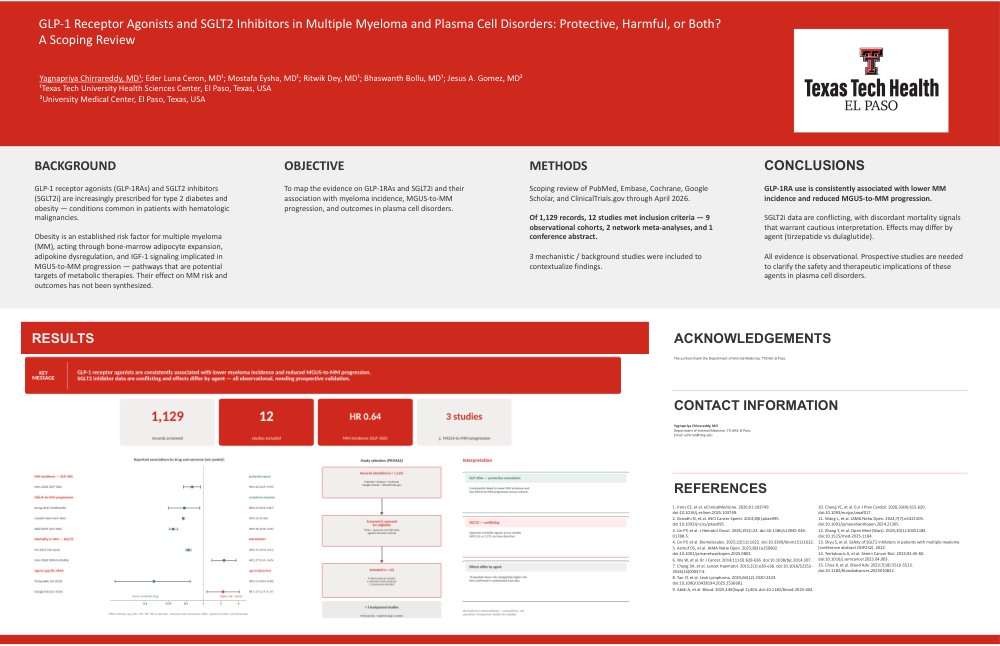
Methods: We conducted a scoping review of PubMed, Embase, Cochrane Library, Google Scholar, and ClinicalTrials.gov through April 2026. Of 1,129 records identified, 12 studies directly met inclusion criteria and 3 were mechanistic or background epidemiologic studies included to contextualize findings. Included studies comprised 9 observational cohorts, 2 network meta-analyses, and 1 conference abstract.
Results: GLP-1RA use was consistently associated with lower MM incidence across observational cohorts, including a hazard ratio (HR) of 0.64 (95% CI 0.45–0.90; Irons et al., 2026). Three independent studies demonstrated reduced MGUS-to-MM progression with metabolic therapies: metformin (HR 0.47; Chang et al., 2015), GLP-1RAs in a propensity-matched Veterans Affairs cohort of 3,291 patients (HR 0.45; Grandhi et al., 2024), and GLP-1RAs in a matched cohort of 13,454 patients (HR 0.30, 95% CI 0.26–0.36; Abidi et al., 2025). Findings for SGLT2 inhibitors were discordant: one analysis reported increased MM mortality (HR 2.27, 95% CI 1.41–3.65), whereas another demonstrated reduced all-cause mortality (HR 0.55, 95% CI 0.50–0.61; Tan et al., 2025). Agent-specific network meta-analyses suggested heterogeneous effects, with tirzepatide associated with lower hematologic malignancy risk (OR 0.14, 95% CI 0.03–0.60) and dulaglutide associated with increased risk (RR 2.17, 95% CI 1.14–4.17), although myeloma-specific signals were not clearly established in randomized trial data.
Conclusion: Current observational evidence suggests an association between GLP-1RA use and lower MM incidence and reduced MGUS-to-MM progression, supporting further investigation of metabolic pathways in plasma cell disorders. Data on SGLT2 inhibitors remain conflicting; discordant mortality signals in MM warrant cautious interpretation and prospective validation. All evidence is observational, and prospective studies are needed to clarify the safety and therapeutic implications of these agents in patients with multiple myeloma.
Keywords: GLP-1 receptor agonist; SGLT2 inhibitor; tirzepatide; dulaglutide; semaglutide; metformin; multiple myeloma; MGUS; plasma cell disorders; monoclonal gammopathy; obesity; type 2 diabetes; incidence; disease progression; mortality; scoping review.