1,267 posters, 47 videos, 13 topics, 4 sessions, 853 authors
ePostersLive by SciGen Technologies S.A. All rights reserved.
SOHO 2026 Annual Meeting
September 9 - 12, 2026 | George R. Brown Convention Center, Houston, Texas

AML - 828
ALOX5AP as an Oncogenic Regulator in Acute Myeloid Leukemia: Insights from Expression Profiling, DNA Methylation, and Molecular Pathway Analysis
Poster Presenter
Authors
Part of Topic
Acute Myeloid Leukemia (AML)
INTRODUCTION Acute myeloid leukemia (AML) is a heterogeneous group of hematologic malignancies defined by the clonal expansion of myeloid progenitor cells with impaired differentiation and uncontrolled proliferation. Arachidonate 5-lipoxygenase-activating protein (ALOX5AP) has been implicated as an oncogene capable of driving cancer progression through mechanisms involving chemotaxis and leukocyte activation; however, its specific role in AML pathobiology remains largely unexplored. This study sought to comprehensively evaluate the clinical and prognostic significance of ALOX5AP in AML by characterizing its expression landscape, DNA methylation patterns, and underlying molecular mechanisms, and to determine whether ALOX5AP retains independent prognostic value after adjustment for established clinical and cytogenetic risk factors.
METHODS ALOX5AP expression and promoter DNA methylation were compared between 173 TCGA-LAML tumor samples and 70 GTEx normal controls using GEPIA2. Kaplan-Meier survival analysis was performed to determine the prognostic relevance of ALOX5AP. Single-cell RNA sequencing datasets were leveraged to explore correlations between ALOX5AP expression and key functional states in AML. Gene co-expression analysis was conducted using LinkedOmics, and gene set enrichment analysis (GSEA) was employed to identify biological pathways associated with ALOX5AP activity. To further test the independence of ALOX5AP's prognostic value, a separately curated subset of 130 TCGA-LAML patients with complete RNA-sequencing (STAR-FPKM, UCSC Xena), survival, FLT3 mutation, and cytogenetic risk annotation was analyzed. Multivariable Cox proportional hazards regression was performed to assess the prognostic contribution of ALOX5AP after adjustment for age, sex, FLT3-ITD status, and cytogenetic risk group, with model fit and discrimination evaluated using likelihood ratio testing and Harrell's C-index.
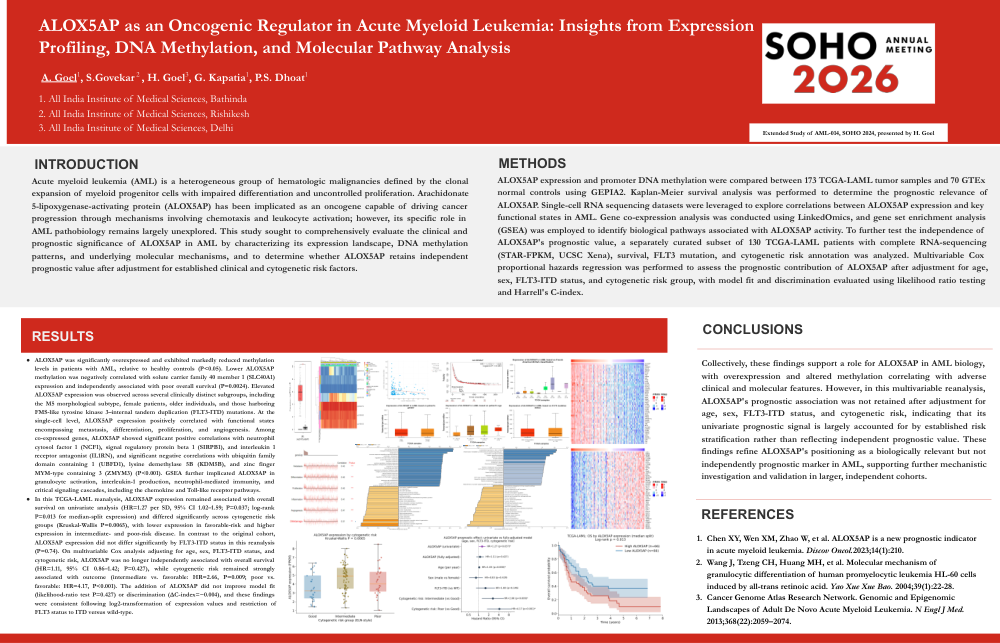
RESULTS ALOX5AP was significantly overexpressed and exhibited markedly reduced methylation levels in patients with AML, relative to healthy controls (P < 0.05). Lower ALOX5AP methylation was negatively correlated with solute carrier family 40 member 1 (SLC40A1) expression and independently associated with poor overall survival (P = 0.0024). Elevated ALOX5AP expression was observed across several clinically distinct subgroups, including the M5 morphological subtype, female patients, older individuals, and those harboring FMS-like tyrosine kinase 3-internal tandem duplication (FLT3-ITD) mutations. At the single-cell level, ALOX5AP expression positively correlated with functional states encompassing metastasis, differentiation, proliferation, and angiogenesis. Among co-expressed genes, ALOX5AP showed significant positive correlations with neutrophil cytosol factor 1 (NCF1), signal regulatory protein beta 1 (SIRPB1), and interleukin 1 receptor antagonist (IL1RN), and significant negative correlations with ubiquitin family domain containing 1 (UBFD1), lysine demethylase 5B (KDM5B), and zinc finger MYM-type containing 3 (ZMYM3) (P < 0.001). GSEA further implicated ALOX5AP in granulocyte activation, interleukin-1 production, neutrophil-mediated immunity, and critical signaling cascades, including the chemokine and Toll-like receptor pathways.
In this TCGA-LAML reanalysis, ALOX5AP expression remained associated with overall survival on univariate analysis (HR = 1.27 per SD, 95% CI 1.02–1.59; P = 0.037; log-rank P = 0.013 for median-split expression) and differed significantly across cytogenetic risk groups (Kruskal-Wallis P = 0.0065), with lower expression in favorable-risk and higher expression in intermediate and poor-risk disease. In contrast to the original cohort, ALOX5AP expression did not differ significantly by FLT3-ITD status in this reanalysis (P = 0.74). On multivariable Cox analysis adjusting for age, sex, FLT3-ITD status, and cytogenetic risk, ALOX5AP was no longer independently associated with overall survival (HR = 1.11, 95% CI 0.86–1.42; P = 0.427), while cytogenetic risk remained strongly associated with outcome (intermediate vs. favorable: HR = 2.66, P = 0.009; poor vs. favorable: HR = 4.17, P < 0.001). The addition of ALOX5AP did not improve model fit (likelihood-ratio test P = 0.427) or discrimination (ΔC-index = -0.004), and these findings were consistent following log2-transformation of expression values and restriction of FLT3 status to ITD versus wild-type.
CONCLUSIONS Collectively, these findings support a role for ALOX5AP in AML biology, with overexpression and altered methylation correlating with adverse clinical and molecular features. However, in this multivariable reanalysis, ALOX5AP's prognostic association was not retained after adjustment for age, sex, FLT3-ITD status, and cytogenetic risk, indicating that its univariate prognostic signal is largely accounted for by established risk stratification rather than reflecting independent prognostic value. These findings refine ALOX5AP's positioning as a biologically relevant but not independently prognostic marker in AML, supporting further mechanistic investigation and validation in larger, independent cohorts.
REFERENCES
-
Chen XY, Wen XM, Zhao W, et al. ALOX5AP is a new prognostic indicator in acute myeloid leukemia. Discov Oncol. 2023;14(1):210.
-
Wang J, Tzeng CH, Huang MH, et al. Molecular mechanism of granulocytic differentiation of human promyelocytic leukemia HL-60 cells induced by all-trans retinoic acid. Yao Xue Xue Bao. 2004;39(1):22-28.
-
Cancer Genome Atlas Research Network. Genomic and Epigenomic Landscapes of Adult De Novo Acute Myeloid Leukemia. N Engl J Med. 2013;368(22):2059-2074.