1,267 posters, 47 videos, 13 topics, 4 sessions, 853 authors
ePostersLive by SciGen Technologies S.A. All rights reserved.
SOHO 2026 Annual Meeting
September 9 - 12, 2026 | George R. Brown Convention Center, Houston, Texas

MM - 742
Premature Mortality in Early-Onset Multiple Myeloma in the United States, 1999-2024: Trends, Disparities, and Disproportionate Years of Potential Life Lost
Poster Presenter
Authors
Part of Topic
Multiple Myeloma (MM)
Abstract
Background
Although multiple myeloma (MM) predominantly affects older adults, deaths before age 55 represent an important
form of premature mortality, occurring during working, caregiving, and potentially transplant-eligible years. The
national burden of early-onset MM mortality, its contribution to years of potential life lost (YPLL), and how this
burden differs across demographic and geographic groups remain incompletely defined.
Methods
We analyzed CDC WONDER (Centers for Disease Control and Prevention Wide-Ranging Online Data for Epidemiologic
Research) mortality data from 1999–2024 for deaths with MM as the underlying cause of death, defined
by ICD-10 code C90.0. Early-onset MM mortality was defined as death at ages 25–54 years. Nonoverlapping
bridged-race data from 1999 to 2020 and single-race data from 2021 to 2024 were combined for national trend
and YPLL analyses. Outcomes included annual deaths, crude mortality rates, log-linear annual percent change,
YPLL before age 75 years (YPLL-75), mean YPLL per death, and the proportion of total MM-related YPLL-75
attributable to early-onset deaths. Modern-period disparities were assessed using 2018–2024 single-race data
by race, sex, and census region. Sensitivity analysis used multiple-cause-of-death records with MM listed
anywhere on the death certificate.
Results
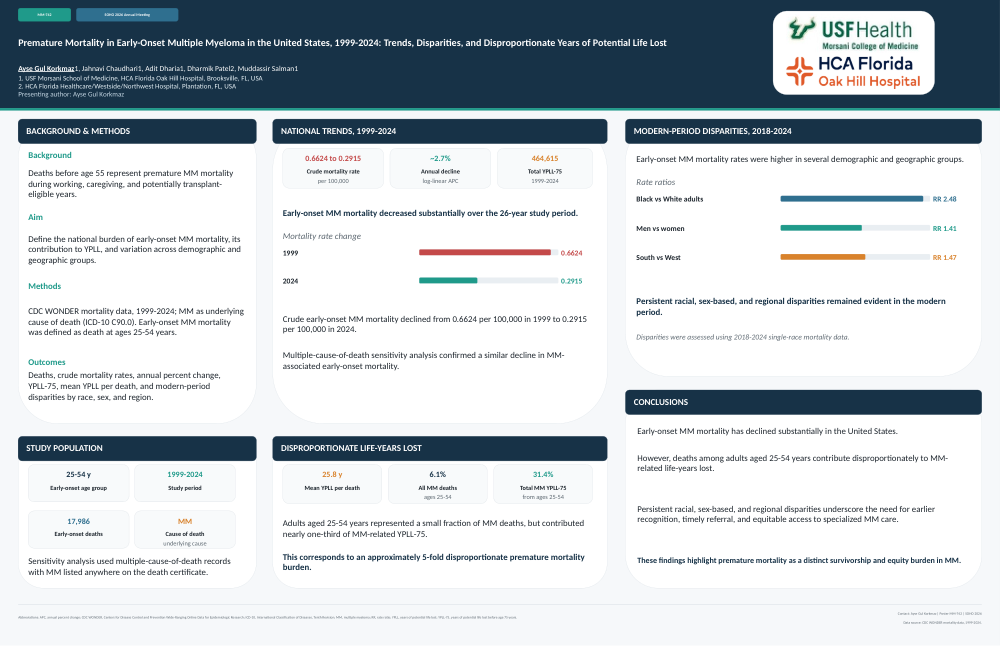
From 1999–2024, 17986 MM deaths occurred among adults aged 25–54 years. Crude early-onset MM mortality
decreased from 0.6624 per 100000 in 1999 to 0.2915 per 100000 in 2024, corresponding to an approximate 2.7%
annual decline. Despite this improvement, early-onset deaths accounted for approximately 464615 YPLL-75,
with a mean of 25.8 years lost per death. Adults aged 25–54 years represented only 6.1% of all MM deaths but
contributed 31.4% of total MM-related YPLL-75, demonstrating a 5-fold disproportionate premature mortality
burden. During 2018–2024, mortality rates were higher among Black vs White adults (rate ratio [RR], 2.48), men
vs women (RR, 1.41), and residents of the South vs West (RR, 1.47). Sensitivity analysis using multiple-cause-of-
death records confirmed a similar decline in MM-associated early-onset mortality.
Conclusions
Early-onset MM mortality has declined substantially in the United States; however, deaths among adults aged 25–
54 years contribute disproportionately to MM-related life-years lost. Persistent racial, sex-based, and regional
disparities underscore the need for earlier recognition, timely referral, and equitable access to specialized MM
care.
ICD-10: International Classification of Diseases, Tenth Revision
Keywords
MM, premature mortality, early-onset, years of potential life lost, health disparities