1,267 posters, 47 videos, 13 topics, 4 sessions, 853 authors
ePostersLive by SciGen Technologies S.A. All rights reserved.
SOHO 2026 Annual Meeting
September 9 - 12, 2026 | George R. Brown Convention Center, Houston, Texas

ALL - 741
Olverembatinib-Based Treatment for Newly Diagnosed Philadelphia Chromosome-Positive Acute Lymphoblastic Leukemia: A Multi-Center Retrospective Study
Poster Presenter
Authors
Part of Topic
Acute Lymphoblastic Leukemia (ALL)
Olverembatinib-based treatment for newly diagnosed Philadelphia chromosome-positive acute lymphoblastic leukemia: a multi-center retrospective study
Kezhi Huang1,2,3,4#, Yiqing Li1,2#, Xuejie Jiang5#, Cong Luo6, Zeyu Luo6,Wenjuan Yang1,2, Hongyun Liu1,2, Guoyang Zhang1,2, Runhui Zheng7,Guinian Huang8,Wenzheng Pang9,Xueyang Xing10,Zhenqian Huang11,Jixian Huang12,Huashan Luo13,Danian Nie1,2*
1Department of Hematology, Sun Yat-Sen Memorial Hospital, Sun Yat-Sen University, Guangzhou, China.
2Guangdong Provincial Key Laboratory of Malignant Tumor Epigenetics and Gene Regulation, Sun Yat-Sen Memorial Hospital, Sun Yat-Sen University, Guangzhou, China.
3Guangdong Provincial Key Laboratory of Cancer Pathogenesis and Precision Diagnosis and Treatment, Department of Hematology, Shenshan Medical Center, Sun Yat-sen Memorial Hospital, Sun Yat-sen University, Shanwei, China.
4Internal Medicine Ward Sixth, JieXi People’s Hospital (Sun Yat-Sen Memorial Hospital, Sun Yat-Sen University-JieXi Medical Center), JieYang, China.
5The Second Affiliated Hospital of Guangdong Medical University, Guangzhou, China.
6The First Affiliated Hospital, Department of Hematology, Hengyang Medical School, University of South China, Hengyang, China.
7 The Fifth Affiliated Hospital of Guangzhou Medical University, Guangzhou, China.
8 Zhongshan City People's Hospital, Zhongshan, China.
9 The Fifth Affiliated Hospital, Sun Yat-sen University, Zhuhai, China.
10The First Affiliated Hospital of Shantou University Medical College, Shantou, China.
11The First Affiliated Hospital of Guangzhou Medical University, Guangzhou, China.
12 Yuebei People's Hospital, Shaoguan, China.
13 Meizhou People's Hospital, Meizhou, China.
#These authors are co-first authors: Kezhi Huang, Yiqing Li, Xuejie Jiang
*Corresponding author: Danian Nie, e-mail: niedn@mail.sysu.edu.cn
Keywords: Olverembatinib, Tyrosine kinase inhibitor, Philadelphia chromosome, Acute lymphoblastic leukemia
Background: Olverembatinib,a novel third-generation tyrosine kinase inhibitor (TKI), has showed remarkable responses in chronic myeloid leukemia. Nevertheless, its role in newly diagnosed Philadelphia chromosome-positive acute lymphoblastic leukemia (Ph+ ALL) remained largely unknown.
Methods: A multi-center retrospective study from south China enrolled 18 patients (8 males) diagnosed as de novo Ph+ ALL, with median age 49 years (range 14-73). Olverembatinib was orally administered at 40 or 30 mg once every other day as frontline therapy. The majority of induction treatment was VID (Vindesine, Idarubicin, Dexamethasone) or VD, except one with blinatumomab. The consolidation was mostly done by less intensity chemotherapy, while one received allo-HSCT, and one received CAR-T therapy. Blinatumomab was applied for consolidation in 9/18 (50%) patients. 9/18 (50%) patients have entered into the maintenance therapy phase, of which 6 patients with Olverembatinib only, 2 patiens with combination of Olverembatinib and chemotherapy, and 1 patient with combination of dasatinib and chemotherapy due to the financial issue. Complete Molecular Remission (CMR) was defined as lower level of BCR-ABL1 transcript by PCR at a sensitivity of 0.01%.
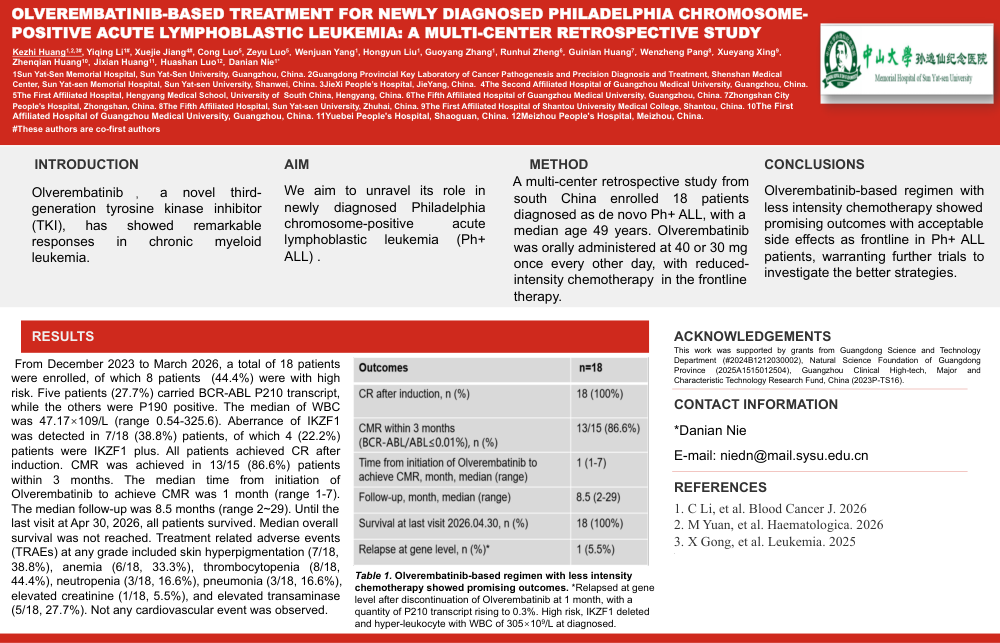
Results: From December 2023 to March 2026, a total of 18 patients were enrolled, of which 8 patients (44.4%) were with high risk. Five patients (27.7%) carried BCR-ABL P210 transcript, while the others were P190 positive. The median of WBC was 47.17×10⁹/L (range 0.54-325.6). Aberrance of IKZF1 was detected in 7/18 (38.8%) patients, of which 4 (22.2%) patients were IKZF1 plus. All patients achieved CR after induction. CMR was achieved in 13/15 (86.6%) patients within 3 months. The median time from initiation of Olverembatinib to achieve CMR was 1 month (range 1-7). The median follow-up was 8.5 months (range 2~29). Until the last visit at Apr 30, 2026, all patients survived. Median overall survival was not reached. Treatment related adverse events (TRAEs) at any grade included skin hyperpigmentation (7/18, 38.8%), anemia (6/18, 33.3%), thrombocytopenia (8/18, 44.4%), neutropenia (3/18, 16.6%), pneumonia (3/18, 16.6%), elevated creatinine (1/18, 5.5%), and elevated transaminase (5/18, 27.7%). Not any cardiovascular event was observed.
Conclusions: Olverembatinib-based regimen with less intensity chemotherapy showed promising outcomes with acceptable side effects as frontline in Ph+ ALL patients, warranting further trials to investigate the better strategies.
Acknowledgement
This work was supported by grants from Guangdong Science and Technology Department (#2024B1212030002), Natural Science Foundation of Guangdong Province (2025A1515012504), Guangzhou Clinical High-tech, Major and Characteristic Technology Research Fund, China (2023P-TS16).