1,267 posters, 47 videos, 13 topics, 4 sessions, 853 authors
ePostersLive by SciGen Technologies S.A. All rights reserved.
SOHO 2026 Annual Meeting
September 9 - 12, 2026 | George R. Brown Convention Center, Houston, Texas

ALL - 059
CD107a-Assessed NK-Cell Dysfunction and Monocyte/Macrophage Exhaustion Identify High-Risk Adult Patients With Relapsed Ph-Negative B-ALL
Poster Presenter
Authors
Part of Topic
Acute Lymphoblastic Leukemia (ALL)
CD107A-ASSESSED NK-CELL DYSFUNCTION AND MONOCYTE/MACROPHAGE EXHAUSTION IDENTIFY HIGH RISK RELAPSED PH–NEGATIVE ADULT B-ALL PATIENTS
Introduction:
Many patients with relapsed adult B-cell acute lymphoblastic leukemia (B-ALL) who receive salvage chemotherapy failed to achieve CR to go for allogeneic stem cell transplantation (allo-SCT). This could be explained by intrinsic resistance mechanisms of leukemia cells however, patient immune dysfunction has not been clearly established.
Aim:
The primary endpoint was successful bridging to allo-SCT. Secondary endpoints are response, progression-free survival (PFS), and overall survival (OS).
Methods:
We conducted a prospective study of 76 adults with relapsed Ph- Negative B-ALL received salvage chemotherapy (hyper-CVAD). Baseline (before salvage) peripheral blood monocyte/macrophage activation markers (HLA-DR), immune checkpoint expression (PD-L1) both by flow cytometry and NK-cell cytotoxic function assessed by CD107a (by flow cytometry). High macrophage exhaustion was defined as low HLA-DR expression (below 25th percentile of healthy controls)and/or high PD-L1 (≥20%), based on healthy donor reference ranges. Impaired NK-cell cytotoxicity defined as CD107a <20% (lower limit of normal cytotoxic function).
Results
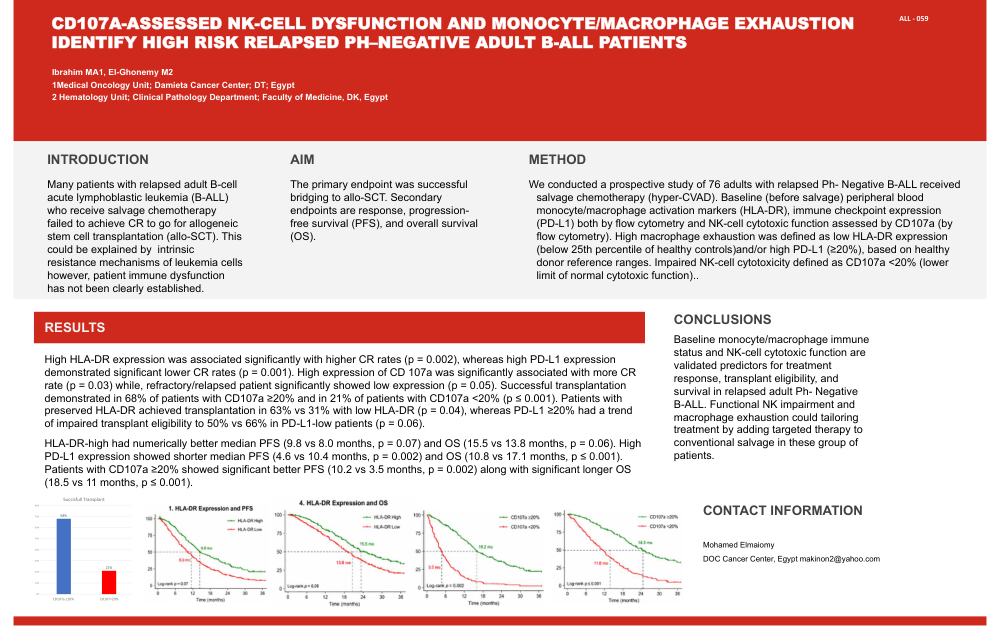
43% of patients demonstrated monocyte/macrophage exhaustion, while 37% demonstrated impaired NK-cell cytotoxicity. Expression of CD107a was significantly lower in immune-exhausted patients (p≤0.001). CD107a expression correlated inversely with BM blast percentage (p = 0.01) and serum LDH (p = 0.04). No significant difference of CD107a levels between standard- and high-risk cytogenetic groups (p = 0.4). High HLA-DR expression was associated significantly with higher CR rates (p = 0.002), whereas high PD-L1 expression demonstrated significant lower CR rates (p = 0.001). High expression of CD 107a (≥20%) was significantly associated with more CR rate (p = 0.03) while, refractory/relapsed patient significantly showed low expression (<20%) of CD 107a (p = 0.05). Successful transplantation demonstrated in 68% of patients with CD107a ≥20% and in 21% of patients with CD107a <20% (p ≤ 0.001). Patients with preserved HLA-DR achieved transplantation in 63% vs 31% with low HLA-DR (p = 0.04), whereas PD-L1 ≥20% had a trend of impaired transplant eligibility to 50% vs 66% in PD-L1-low patients (p = 0.06).
HLA-DR-high patients had numerically better median PFS (9.8 vs 8.0 months, p = 0.07) and OS (15.5 vs 13.8 months, p = 0.06). High PD-L1 expression showed shorter median PFS (4.6 vs 10.4 months, p = 0.002) and OS (10.8 vs 17.1 months, p ≤ 0.001)
Patients with CD107a ≥20% showed significant better PFS (10.2 vs 3.5 months, p = 0.002) along with significant longer OS (18.5 vs 11 months, p ≤ 0.001) at two years follow up.
Conclusion:
Baseline monocyte/macrophage immune status and NK-cell cytotoxic function are validated predictors for treatment response, transplant eligibility, and survival in relapsed adult Ph- Negative B-ALL. Functional NK impairment and macrophage exhaustion could tailoring treatment by adding targeted therapy to conventional salvage in these group of patients.