1,267 posters, 47 videos, 13 topics, 4 sessions, 853 authors
ePostersLive by SciGen Technologies S.A. All rights reserved.
SOHO 2026 Annual Meeting
September 9 - 12, 2026 | George R. Brown Convention Center, Houston, Texas

AML - 708
Frailty as a Predictor of Chemotherapy Tolerance and Survival Outcomes in Acute Myeloid Leukemia: A Systematic Review and Meta-Analysis
Poster Presenter
Authors
Part of Topic
Acute Myeloid Leukemia (AML)
Frailty as a Predictor of Chemotherapy Tolerance and Survival Outcomes in Acute Myeloid Leukemia: A Systematic Review and Meta-Analysis
Sanathanan Neelakantan Ramaswamy MBBS¹, Neha Pillai Vinod MBBS², Manaswini Krishnakumar MD³, Varsha Srinivasan MBBS⁴, Shambavi Annush⁵, Neeraj Nagarajan⁵, Aswanth Reddy MD, FACP⁶
¹Government Erode Medical College and Hospital, Perundurai, Tamilnadu, India. ²SRM Medical College and Research Center, Chennai, Tamilnadu, India. ³Saint Vincent Hospital, Worcester, Massachusetts, USA. ⁴Madras Medical College, Chennai, Tamilnadu, India. ⁵Government Stanley Medical College, Chennai, Tamilnadu, India. ⁶Mercy Hospital, Fort Smith, Arkansas, USA.
PROSPERO Registration: CRD420261392173
KEYWORDS: frailty, acute myeloid leukemia, chemotherapy tolerance, overall survival, meta-analysis, systematic review, venetoclax
CONTEXT: Frailty is common in AML yet rarely assessed pre-treatment. Its impact on chemotherapy tolerance and survival across intensive and venetoclax-based regimens is unknown.
OBJECTIVE: To determine whether frailty predicts OS, CR, chemotherapy tolerance, and toxicity in AML.
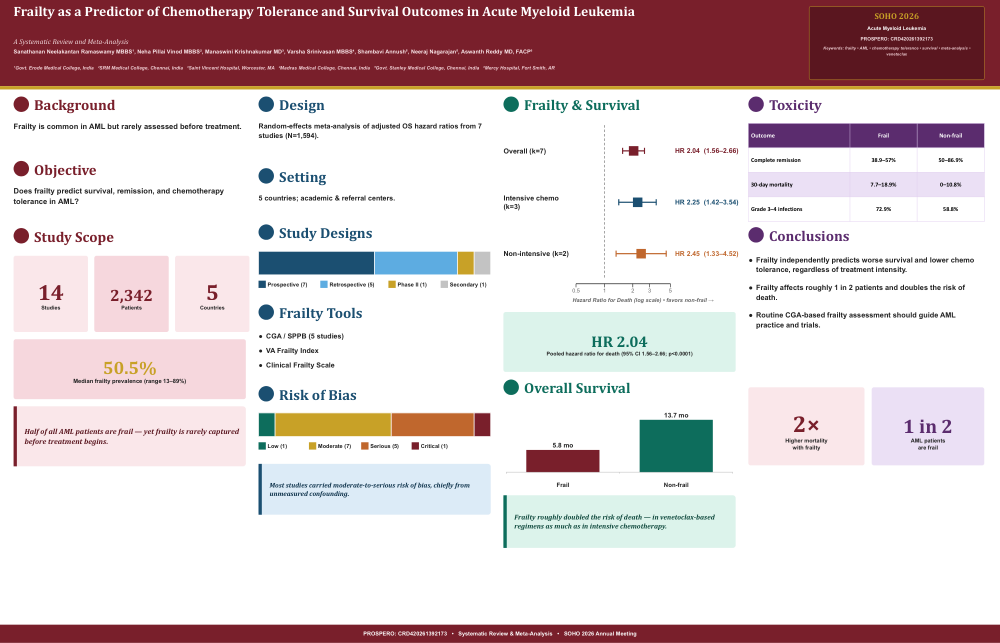
DESIGN: Pre-registered systematic review and meta-analysis (PROSPERO: CRD420261392173); studies published 2011–2026. Random-effects meta-analysis (DerSimonian–Laird) for adjusted OS HRs from 7 studies (N=1,594). Risk of bias: ROBINS-I (1 low, 7 moderate, 5 serious, 1 critical). Subgroups stratified by treatment era.
SETTING: Multi-national; 5 countries; academic medical centers and referral institutions.
PATIENTS OR OTHER PARTICIPANTS: 14 studies (N=2,342): 7 prospective cohort, 5 retrospective cohort, 1 phase II trial, 1 secondary analysis. AML patients on intensive or non-intensive/venetoclax-based regimens. Median frailty prevalence 50.5% (range 13–89%).
INTERVENTIONS: Frailty tools: CGA/SPPB (5 studies), VA Frailty Index, Frailty Index-27, Clinical Frailty Scale, disease-specific instruments. Treatment: intensive chemotherapy or non-intensive/venetoclax-based regimens.
MAIN OUTCOME MEASURES: Primary: OS by frailty status (adjusted HR). Secondary: CR rates, 30-day mortality, grade 3–4 toxicity.
RESULTS: Frailty was associated with inferior OS (pooled HR 2.04, 95% CI 1.56–2.66; p<0.0001; I²=30.3%). Effect consistent across intensive chemotherapy (k=3; HR 2.25, 95% CI 1.42–3.54) and non-intensive/venetoclax regimens (k=2; HR 2.45, 95% CI 1.33–4.52). Leave-one-out sensitivity analyses confirmed stability (HR range 1.94–2.47). Median OS: 5.8 vs. 13.7 months (frail vs. non-frail). CR rates: 38.9–57% vs. 50–86.9%. 30-day mortality: 7.7–18.9% vs. 0–10.8%. Grade 3–4 infections: 72.9% vs. 58.8%. CGA/SPPB showed strongest predictive validity; EHR-derived eFI was not predictive of OS.
CONCLUSIONS: Pre-treatment frailty predicts inferior OS and chemotherapy tolerance in AML regardless of treatment intensity, affecting 1 in 2 patients and doubling mortality risk. Heterogeneity in frailty tools and small non-intensive subgroup (k=2) limit cross-treatment comparisons. Routine CGA-based frailty assessment should be integrated into AML practice and trial stratification.