1,267 posters, 47 videos, 13 topics, 4 sessions, 853 authors
ePostersLive by SciGen Technologies S.A. All rights reserved.
SOHO 2026 Annual Meeting
September 9 - 12, 2026 | George R. Brown Convention Center, Houston, Texas

MM - 687
Chronic Proton Pump Inhibitor Use is Associated With Increased Mortality and Infectious Complications Compared with H2 Receptor Blockers in Patients With Hematological Malignancies in the US: A TriNetX-Based, Large Propensity-Matched, Active-Comparator Cohort Study
Poster Presenter
Authors
Part of Topic
Multiple Myeloma (MM)
Introduction
Proton pump inhibitors are among the most widely prescribed drug classes in patients with hematological malignancies, frequently started for steroid-associated dyspepsia, mucositis, or GI prophylaxis during chemotherapy, and often continued indefinitely without reassessment. Several mechanisms make prolonged acid suppression plausibly harmful in this specific population: gastric hypochlorhydria promotes gut dysbiosis and enteric pathogen colonization; PPIs reduce the bioavailability of orally administered tyrosine kinase inhibitors; and emerging evidence points to direct effects on immune cell function. Patients with hematological malignancies are already immunocompromised by disease biology, cytotoxic therapy, and neutropenia, so any incremental infectious risk may carry disproportionate consequence. Prior European registry data suggested increased PPI-associated cancer mortality, but US outcome data in this population are largely absent, and most prior work compared PPI users against non-users; a design vulnerable to confounding by indication.
Aim
To determine whether chronic proton pump inhibitor use is associated with increased all-cause mortality and infectious complications compared with H2 receptor antagonist use in adults with hematological malignancies, using an active-comparator, new-user design in a large national US health network.
Method
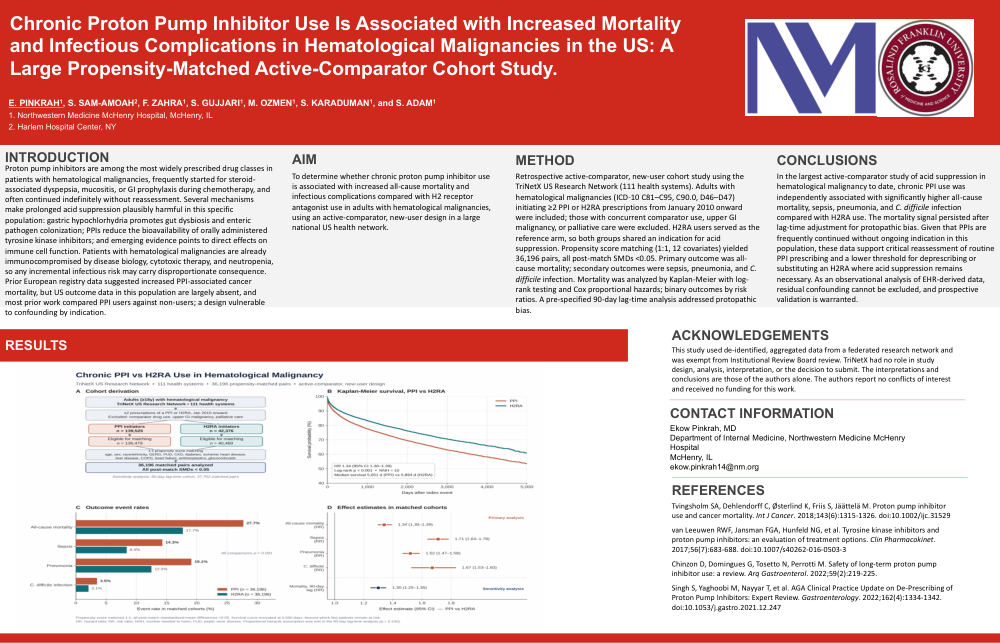
Retrospective active-comparator, new-user cohort study using the TriNetX US Research Network (111 health systems). Adults with hematological malignancies (ICD-10 C81–C95, C90.0, D46–D47) initiating ≥2 PPI or H2RA prescriptions from January 2010 onward were included; those with concurrent comparator use, upper GI malignancy, or palliative care were excluded. H2RA users served as the reference arm, so both groups shared an indication for acid suppression. Propensity score matching (1:1, 12 covariates) yielded 36,196 pairs, all post-match SMDs <0.05. Primary outcome was all-cause mortality; secondary outcomes were sepsis, pneumonia, and C.difficile infection. Mortality was analyzed by Kaplan-Meier with log-rank testing and Cox proportional hazards; binary outcomes by risk ratios. A pre-specified 90-day lag-time analysis addressed protopathic bias.
Conclusion
In the largest active-comparator study of acid suppression in hematological malignancy to date, chronic PPI use was independently associated with significantly higher all-cause mortality, sepsis, pneumonia, and C. difficile infection compared with H2RA use. The mortality signal persisted after lag-time adjustment for protopathic bias. Given that PPIs are frequently continued without ongoing indication in this population, these data support critical reassessment of routine PPI prescribing and a lower threshold for deprescribing or substituting an H2RA where acid suppression remains necessary. As an observational analysis of EHR-derived data, residual confounding cannot be excluded, and prospective validation is warranted.